Medusa, Demon of the Greek Tradition
By Ralf Ittermann · last reviewed on
Medusa is a demon of the Greek tradition.
A Gorgon with serpent hair, a petrifying gaze, the embodiment of the forbidden. Medusa is the most notorious of the three Gorgons and the only mortal one. Her sight turns to stone anyone who looks at her.
She is not a demon out of malice, but out of trauma: mutilated, cursed, banished to a cave. The hero Perseus kills her, yet her head retains the power to petrify; even after death her gaze remains effective.
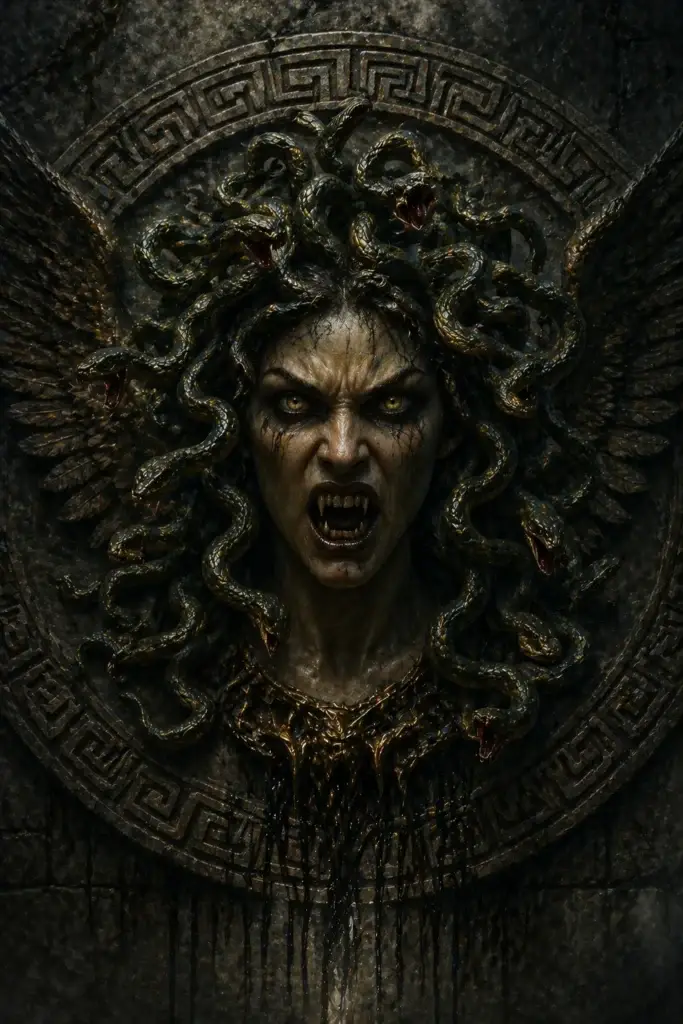
The famous gaze of Medusa causes immediate petrification.
Short Profile: Medusa
Type: Greek mythical figure, Gorgon (serpent woman)
Pantheon: Greece (peripheral in mythology, central in iconography)
Function: Apotropaic warding gaze, petrification of enemies, protectress
Main attributes: serpents instead of hair, winged brow, protruding tongue, fangs
Main cult sites: no temples of her own; Gorgoneion amulets and temple friezes (Athens), plus the pediment image of the Artemis temple at Corfu
Roman counterpart: Medusa (adopted unchanged)
Context
Period of the Texts
Medusa is attested in literature since Hesiod’s Theogony (8th century BCE); archaeologically, apotropaic Gorgon images had already spread since the 7th century BCE.
The archaic Gorgon shows the terrible face with teeth and protruding tongue; in the classical period (5th/4th century BCE) it shifts toward the beautiful, sorrowful Medusa form. Roman reception: Caravaggio, later pre- and post-modern adaptations.
Area of Distribution
Medusa had no cult sites of her own; she is a mythical figure, not a figure of cult. Her Gorgoneion (the severed head), however, appears as a protective symbol on thousands of remains: friezes of Athena temples (Athens), the pediment image of the Artemis temple at Corfu, shields, vase painting, and later also Roman coins and architectural ornaments.
State of the Sources
Central sources: Hesiod’s Theogony (270:281), Apollodorus Library (II 4), Ovid’s Metamorphoses (IV 765 ff., the most popular transformation account), Pindar’s Pythian Odes (12), Lucan’s Pharsalia (IX 619 ff.). Secondary literature: Vernant, La Mort dans les yeux; Wilk, Medusa; LIMC (Lexicon Iconographicum Mythologiae Classicae) sub voce Gorgo.
Name and Spellings
Medusa is portrayed as terrible and beautiful: a woman’s body with serpents in place of hair. Her eyes glow with deadly power. She is sometimes shown with wings.
Her symbols are the serpents, the deadly gaze, and sometimes also wings (in later versions). Her petrifying gaze is her most fearsome feature. The severed head of Medusa (carried by Perseus) becomes an apotropaion, a protective amulet against the evil eye.
Characteristics
Medusa is not venerated but feared and analysed. She is a figure of transgression, the boundary between woman and monster, human and inhuman. In later cultures her head (or its image) is used as a protective amulet, an inversion of her dangerousness.
In tragedies and epics she is read as the embodiment of female power (sexuality, anger, independence) that threatens the patriarchal order and must therefore be destroyed. Her story is one of victimisation and reversal.
Appearance and Symbolism
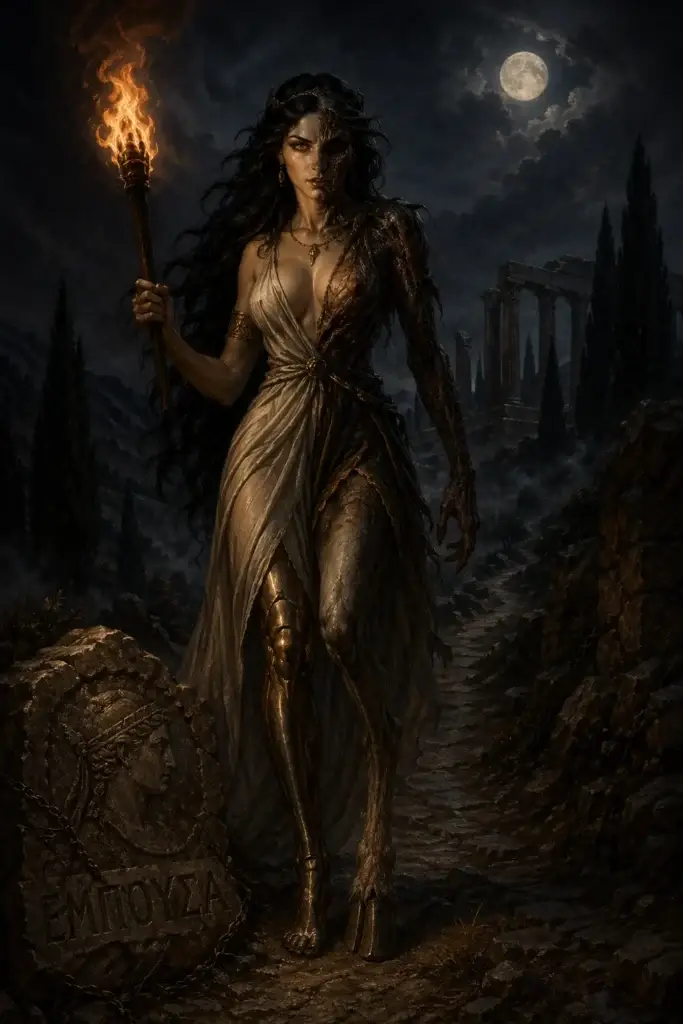
Medusa is depicted as a woman with wild, fiery hair, yet not human: living serpents instead of hair. Her eyes glitter with power and suffering alike.
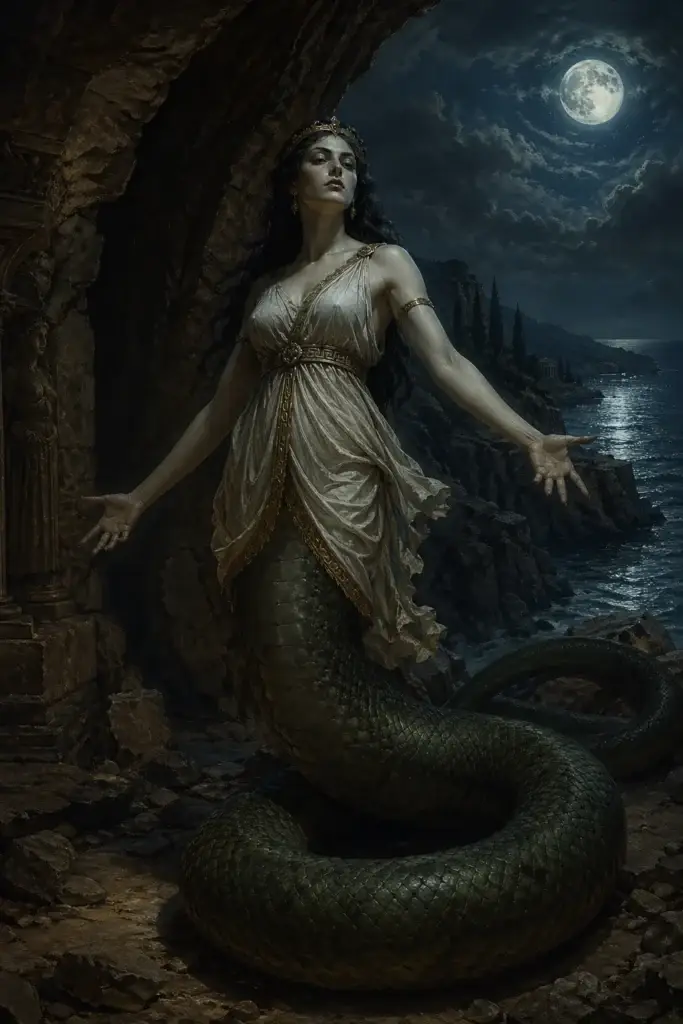
She is sometimes shown with wings, sometimes with the lower body of a dragon. Her skin can appear metallic or stony. The serpents are her primary attribute, a symbol of the feminine, the dangerous, and transformation.
The blood that flowed from her neck became poison or a healing draught. She sometimes wears winged sandals (from Perseus) or other battle trophies. Her colour is dark green or dark red, the colours of nature and of blood. She is not beautiful in a conventional way, but fascinating, ambivalent, terrible and tragic.
Profile: Medusa
The most important aspects of Medusa at a glance. The following fields summarise origin, function, appearance, veneration, symbols and parallels.
Medusa is the only mortal of the three Gorgon sisters (Stheno, Euryale, Medusa), daughters of the sea beings Phorcys and Ceto. According to Ovid she was originally a beautiful mortal, transformed by Athena as punishment for a rape in the temple.
She is killed by Perseus (with Hermes’ sickle sword and Athena’s mirror shield). From her blood arise Pegasus and the giant Chrysaor.
Apotropaic function: the Gorgoneion (severed head) acts as a protective symbol against enemies and evil spirits. Athena bears the Gorgoneion on her shield (Aegis) as a central defensive weapon.
In Roman military life it appears frequently on shields, parapets and helmets. Popular belief: the image on the threshold keeps the evil eye away.
Two forms of appearance, depending on the era:
Archaic (7th:5th century BCE): grotesque and terrifying, broad face, protruding tongue, fangs, winged temples, serpents instead of hair. Example: the temple of Artemis at Corfu, pediment image (c. 580 BCE).
Classical and later (4th century BCE onward): a beautiful, sorrowful young woman with serpents in her hair, often with a melancholic expression. Example: Caravaggio’s Medusa (1597).
Sphere of influence: Medusa had no cult of her own, but the Gorgoneion was one of the most popular protective symbols of the ancient world. It was ubiquitous on door knobs, shields, drinking vessels, grave stelae and architrave friezes.
Athena bears it on her Aegis as a central insignia of power. In popular ritual: the image on the house threshold wards off intruders and harm.
Serpents instead of hair, winged temples, protruding tongue (archaic), fangs (archaic), sickle sword (the instrument of her death), mirror shield (Perseus’ trick), Pegasus and Chrysaor (born from her blood). Sacred plant: the coral (Ovid).
Lamashtu (Mesopotamia, apotropaic face of terror), Pazuzu (Mesopotamia, protective demon with a grotesque terrifying figure), Bes (Egypt, apotropaic household protection), Humbaba (Mesopotamia, guardian with a terrible face), Rahu/Kirtimukha (Hinduism, face of terror at temple entrances). Functionally, all apotropaic faces of terror across different cultures follow the same principle.
Protective Practice
Warding Off in Everyday Life
Rituals and Invocations
Medusa was not a cult goddess; her effect unfolded solely through the image. The Gorgoneion was attached to buildings, implements and tombs in order to keep the evil eye and misfortune away.
Incantations and Invocations
Textual Tradition and Formulas
Hesiod’s “Theogony”, Pindar and Ovid’s “Metamorphoses” transmit the figure of the Gorgon Medusa. Ancient literature describes the Gorgoneion, her severed head, as a banishing pictorial sign.
Amulets and Protective Symbols
Material apotropaia and archaeological evidence
The Gorgoneion is the classic apotropaion of antiquity. It appears on shields, on the Aegis of Athena, on temple antefixes, on armour, door lintels and mosaics, and was meant to ward off harmful powers.
Medusa, Parallels in Other Cultures
Monstrous women and demons with petrifying gazes exist everywhere: Lamia (Greece, a child-killing monster), Scylla (Sicily, a many-headed monster), Lilith (Hebrew, a female demon).
The petrifying gaze resembles gaze-powers in other cultures (the evil eye, nazar). Medusa’s transformation is similar to other punishment myths. She differs in that she has no evil power; she is a victim armed with weapons.
Medusa in the Perseus Myth
The connected story of Medusa is part of the myth of the hero Perseus. King Polydectes wants to be rid of Perseus and sets him the impossible task of obtaining the head of Medusa.
Medusa is the only mortal of the three Gorgons; her gaze petrifies anyone who looks at her face. Perseus receives help from the gods: winged sandals, a cap of invisibility and a gleaming shield that serves as a mirror.
With this shield Perseus can behead Medusa without looking at her directly, since he observes only her reflection. From the neck of the slain Medusa spring, as Hesiod already relates in the Theogony, the winged horse Pegasus and the warrior Chrysaor, both offspring of her union with Poseidon.
The severed head retains its petrifying power. On his way back Perseus uses it as a weapon, for instance against the Titan Atlas and against the sea monster from which he frees Andromeda.
In the end Perseus hands the head to the goddess Athena, who sets it on her shield or breastplate, the Aegis. With this the mythical arc is closed: the dangerous being becomes a divine protective sign.
Ovid adds in the Metamorphoses a further backstory, according to which Medusa was once a beautiful maiden and was only turned into a monster by Athena after Poseidon had overpowered her in a temple of the goddess. This version is comparatively late and is not attested in the older Greek tradition.
The Gorgoneion as a Protective Sign
Independent of the narrative, the image of the Medusa head, the Gorgoneion, had its own very old function in Greek culture. It served as an apotropaic sign, that is, an image meant to ward off misfortune.
The logic behind it is one of like against like: a terrifying image is set up to keep terror away, the fearsome is meant to drive off the fearsome.
Archaeologically the Gorgoneion is exceptionally widely attested. It appears on temple pediments, for instance as a large antefix or as a central ornament, on shields, on coins, on drinking vessels, on door knockers and on roof tiles.
In the archaic period the depiction is especially terrifying: a round, grimacing face with a gaping mouth, protruding tongue, fangs and serpent-wreathed hair. Over the course of the classical and Hellenistic periods the face becomes increasingly human and at times even perceived as beautiful, without the protective function being lost.
For religious studies this finding is important because it shows that the Gorgoneion is older and more widespread than the elaborated Perseus narrative, and that the two are not simply to be equated.
Scholarship discusses whether the protective image originally stood on its own and the narrative was added later, or whether both belonged together from the start.
What is certain is that in the lived religion of the Greeks, Medusa was first encountered as an effective pictorial sign meant to confer protection on houses, sanctuaries and objects, and only secondarily as a figure in a heroic legend.
History of Research and Interpretations
Medusa has attracted scholarly and intellectual engagement to an unusual degree, and the interpretations have turned out to be very diverse.
An older, comparative line of thought saw in the Gorgon the reflection of a frightening mask or a cultic mummery; the grimacing face would then be the memory of a real mask. Others linked her to ideas of the evil eye and the averting power of the ugly.
The classical scholarship of the 20th century examined above all the function of the Gorgoneion as a pictorial sign, placing the connection of gaze, fear and warding off at the centre.
The French historian of religion Jean-Pierre Vernant worked out, in influential essays, that the Gorgon embodies the radically other, the confronting, something whose sight threatens the beholder themselves. Unlike most Greek divine faces, the Gorgoneion is depicted frontally; it looks directly at the beholder, and precisely in this lies its terror.
In more recent times, especially outside the narrower field of classical scholarship, Medusa has become a much-interpreted symbolic figure. Psychoanalytic, feminist and culturally critical readings have claimed the figure for very different questions.
From the perspective of religious studies, caution is warranted here: these modern interpretations often say more about the present than about the ancient conception. Whoever wishes to understand the Medusa of the Greeks should distinguish clearly between the ancient evidence, that is, myth and pictorial use, and the later appropriation.
Reception From Antiquity to the Present
The image of Medusa long outlasted antiquity. In Roman art the Gorgoneion remained a frequent motif on mosaics, cuirass statues and jewellery.
Famous is the depiction of a Medusa head in a mosaic floor and the head image on the breastplate of imperial statues, which recall Athena’s Aegis and present the ruler as both protected and terrifying.
In the Renaissance and the Baroque, Medusa became a valued pictorial theme. Caravaggio painted a famous Medusa head on a ceremonial shield, and in Florence stands Benvenuto Cellini’s bronze statue showing Perseus with the severed head. The artists were interested in the meeting of beauty and terror and in the moment of death and transformation.
In the modern era Medusa has entered popular culture, literature, film and also trademarks. She appears as an opponent in film adaptations of the Perseus story, as a figure in fantasy literature and as a logo. This ubiquity has detached the figure from its original religious context.
For a religious-studies understanding it therefore remains important to take note of the long history of reception while keeping the focus on the ancient core: a petrifying gaze, a heroic myth and, above all, an old, widespread protective image whose task was to banish evil through its own terrifying likeness.
Further Links
Literature (Selection)
The protective practice described here is a religious-studies classification of historical traditions. iWell Guard ties in with this cultural-historical line of wearable protective objects and represents a contemporary form of it. More about the iWell Guard →