Frau Perchta, tester of diligence and order
By Ralf Ittermann · last reviewed on
Frau Perchta is a spirit of Alpine tradition.
Guardian of diligence and order during the twelve Raunächte.
Frau Perchta is regarded in the Alps and in Bavaria as the guardian of order and diligence: whoever has worked and spun through the year is rewarded, while whoever has been negligent must expect her reproach. Literary traces appear as early as glosses of the 11th century, and in the 15th century also with Thomas Ebendorfer von Haselbach.
During the Raunächte she moves through houses and lanes, at times as a beautiful woman in bright clothing, at times as a haggard figure with a goose foot. The Perchten run, still alive today, translates this dual form into a visible winter ritual.
Type: seasonal spirit and tester of diligence and order
Origin: eastern Alpine region, literary traces since the 11th century (glosses, 1393, Vintler 1411, Thomas Ebendorfer 1439)
Texts: medieval penitential sermons, Handwörterbuch des deutschen Aberglaubens, 19th-century legend collections
Period: the twelve Raunächte between Christmas and Epiphany
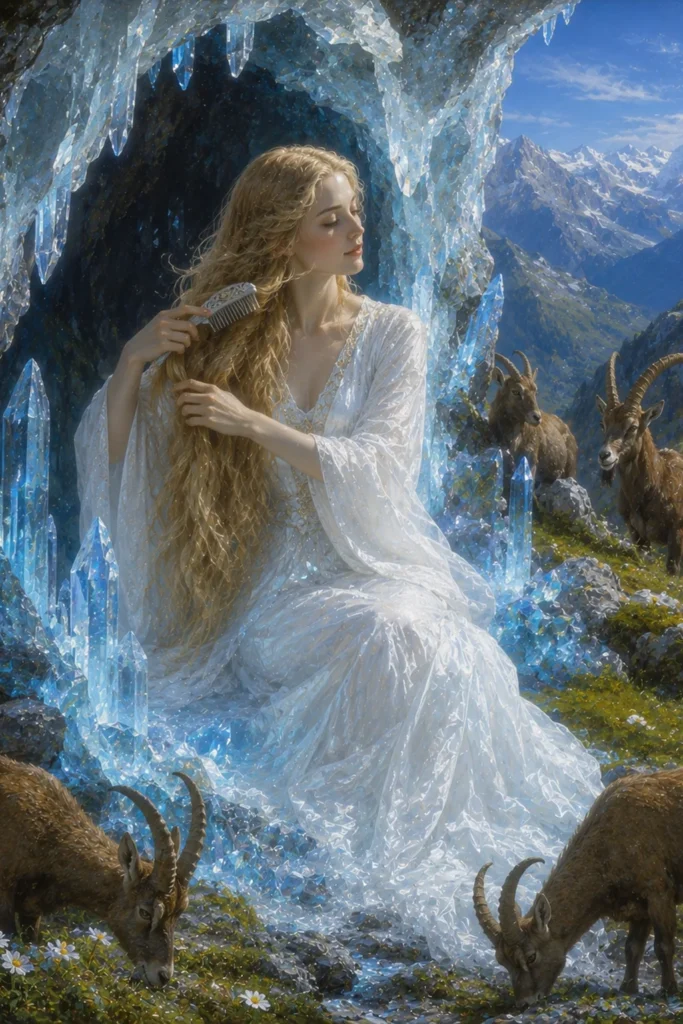
Appearance: a beautiful woman dressed in white, or a haggard, long-nosed old woman with a goose foot

Source context
Period of the Texts
Literary traces since glosses of the 11th century, plus a Tyrolean poem of 1393, Hans Vintler in 1411 and Thomas Ebendorfer in 1439; richly documented in folklore studies of the 19th and early 20th centuries.
Area of Diffusion
Bavaria, Austria, South Tyrol and the eastern Alpine region, with northern parallel figures as far as central Germany.
Sources
Medieval penitential sermons, the Handwörterbuch des deutschen Aberglaubens and the 19th-century legend collections form the source base.
Name and variants
Old High German: The name is usually traced to beraht, the shining one, less often to pergan, the hidden one; scholars have not conclusively settled the question. The name is also linked to Berchtentag, the feast of Epiphany on 6 January.
Form and effect
Appearance
Perchta appears in two contrasting forms: as a beautiful woman in a bright, often white garment, associated with light, purity and fertility, or as a gaunt figure with a long nose, unkempt hair and the goose foot or swan foot.
Effect
Both forms check whether spinning distaffs have been cleared, houses tidied and the year’s work properly finished. In the Perchtenlauf of the eastern Alps, this dual nature is still reflected today in the beautiful and the ugly Perchten masks.
Profile: Frau Perchta
The most important aspects of the guardian of the Raunächte at a glance.
Seasonal spirit of the eastern Alpine region, attested in glosses since the 11th century and classified by Jacob Grimm as a southern relative of Frau Holle.
Spinners, servants and children: Perchta controls diligence and order in the household and watches over the transition from the old year to the new.
A beautiful woman dressed in white, or a gaunt, long-nosed old woman with a goose foot; depicted in the Perchtenlauf as the beautiful and the ugly mask.
Diligence rewarded with blessings and a good harvest, reproach and, in older tales, harsher punishments for negligence.
Cleared spinning distaffs and tidied rooms before the critical night, together with smoke cleansing, banishing formulas and prayers spoken at the threshold.
From penitential sermon to Berchtentag
The name Perchta is usually traced to Old High German beraht, ‘the shining one’, more rarely to pergan, ‘the hidden one’. Literary traces appear as early as glosses of the 11th century, in a Tyrolean poem of 1393 and in Hans Vintler in 1411, and in the 15th century also in the sermon collection De decem praeceptis by Thomas Ebendorfer von Haselbach, who condemns the Perchta cult as superstitious, and in the Thesaurus pauperum of 1468. The name is connected to Berchtentag, the feast of Epiphany on 6 January, on which the figure received particular attention.
In his Deutsche Mythologie, Jacob Grimm classified Perchta as a southern relative of the north German Frau Holle, with whom she shares the roles of overseer of the spinning room and protector of animals; whether this reflects a shared older figure or parallel, regionally distinct traditions is debated in scholarship. Older layers of legend include a drastic motif of punishment in which Perchta slits the belly open and fills it with straw or chaff; in the tradition as told and lived in the Alps today, however, her role as a mild, if strict, examiner clearly comes to the fore.
Early Evidence: Giperchtennacht, 1393 and 1411
The name leads back to the church language of the Middle Ages. In Middle High German, bercht means “shining” or “radiant.” The shining night was the eve of 6 January, the Feast of the Epiphany. The Mondsee Glosses, from the 11th century, attest the term Giperchtennacht for this night.
The legendary figure of Perchta becomes traceable from the late Middle Ages onward. A Tyrolean poem from 1393 mentions the Berchten with the long nose. In 1411, Hans Vintler mocked the belief in Perchten with the iron nose in his Pluemen der Tugent (Flowers of Virtue).
Masked processions at the turn of the year, however, are older than the name itself. As early as around 500, Caesarius of Arles preached against noisy disguising customs at the start of the year. Whether there is any continuity between such late-antique processions and the alpine Perchten remains disputed among scholars.
The folklorist Marianne Rumpf interpreted the figure mainly as arising from church teaching rather than pagan tradition. No pre-Christian goddess Perchta is attested in the sources.
Perchtenlauf and modern reinterpretation
Perchta has remained alive in the Alpine region above all through the Perchtenlauf, still held today on New Year’s Eve and around 6 January in Salzburg, Tyrol and neighbouring regions. In contemporary popular and esoteric literature she is often reinterpreted as a goddess of the Raunächte and the seasons, a reading that departs from the older, stricter folk legend.
Perchta belongs to the so-called seasonal demonesses, whose appearance is tied to the transition between years and who embody both control and fertility. Her dual form of beautiful and ugly appearance can be read as a personification of reward and punishment, embedded in an economy of household work in which spinning and order were central values. The condemnation of the Perchta cult by the church since the 15th century shows that the figure was long perceived as a remnant of pre-Christian belief, even though an unbroken continuity of cult practice cannot be proven from the late sources.
Schönperchten and Schiachperchten
The custom has two faces, and the two belong together.
Schönperchten — the “beautiful Perchten” — appear by day. They wear splendid, often tower-high headdresses adorned with mirrors, flowers and ribbons, and wish the houses they visit luck and blessing for the new year.
Schiachperchten are the night side of the custom. The Upper German word schiach means “ugly.” They wear demonic wooden Larven — masks — fitted with horns and teeth, along with fur and bells. They move through the streets making noise. According to a widespread interpretation, they drive out the misfortune of the old year before the blessing can enter.
The Perchten Season: Raunächte and Perchtennacht
The true season of the Perchten is the Raunächte, running from Christmas Eve to Epiphany. During these nights, the order of the world was believed to become permeable. Processions, noise and blessings were meant to carry house and farm safely through the turn of the year.
The season closes on 5 January — called Glöckeltag, or “Bell Day,” in some places — followed by Perchtennacht on the eve of Epiphany. Communities that still hold to tradition carry out their runs on this date to this day.
Perchten Runs: from the Pongau to the Salzkammergut
The best-known traditional run is the Pongauer Perchtenlauf in the Salzburg region, documented as far back as before 1850. It rotates each year among the municipalities of St. Johann, Altenmarkt, Bischofshofen, Bad Gastein and Bad Hofgastein, always around Epiphany. In the Gastein Valley, the procession includes Tafelperchten and Kappenperchten — Perchten wearing tablet-shaped and hood-shaped headdresses towering meters high — along with accompanying figures such as the Habergeiß or the bear with its handler.
Alongside it stand a number of independent regional forms. In Rauris, the Schnabelperchten make their rounds — figures with long fabric beaks who, according to legend, check that house and home are kept orderly and clean. In the Salzkammergut, the Glöckler — “bell-ringers,” figures dressed in white with glowing light-crowns — parade on 5 January. In the Pinzgau, the Tresterer perform their old stepping dance, and in the Ennstal the Vogelpercht, or “bird Percht,” appears.
What Else Are Perchten Called? Regional Names
The figure carries different names depending on the region. In Lower Austria she was called Bechtra, in the Ausseerland Bärigl, and in Eastern Styria and Burgenland Rauweib or Pudelfrau. In Upper Bavaria, related figures are known as Holzmandl or Moosmann, and in northeastern Bavaria as Specht. In central Germany, Frau Holle takes on the role of the wintry female figure.
Even the spellings vary: Percht, Bercht, Berchta, Perchta. All refer to the same figure of the Raunächte.
Masks, Passen and the Custom Today
Perchten masks, called Larven in the Alpine region, are carved from Swiss pine or linden wood, often finished with real horns and fur trim. Many Passen — the local groups that perform the runs — carve their own Larven or commission specialized carvers. Old Larven are sought-after collector’s items and are displayed in local heritage museums throughout the Alps.
Today the custom lives on in two forms. The traditional communities hold fast to the established date and sequence. Alongside them, an event scene has grown up, with large exhibition runs, fire shows and hundreds of participants filling the Advent calendar. The tension between preserving tradition and staging a spectacle has itself become part of the story of the Perchten.
Perchten and Krampus: The Difference
The two figures are often confused, but they should be kept distinct.
The Krampus belongs to St. Nicholas and thus to Advent. He appears on 5 and 6 December as the saint’s punishing companion. The Perchten belong to the other end of the Christmas season, to the Raunächte around 6 January, and they accompany no one. They appear as an independent band.
In the present day, the two customs increasingly blend together. Many Advent events are called Perchtenlauf yet feature Krampus figures, and modern exhibition runs combine both types of mask. Folklore scholars and long-established Passen, however, still distinguish strictly by date and role.
Diligence, order and the protection of the threshold
According to tradition, anyone fearing Perchta’s examination could protect themselves above all through diligence and order: cleared spinning distaffs and tidied rooms and stables before the critical night were considered the most effective precaution. In addition, during the Raunächte it was customary to cense the rooms with incense to purify the air of wandering spirits, as well as to speak banishing formulas and prayers at the threshold. Besprechen, the ritual recitation of fixed formulas by experienced persons, also counted among the traditional means of warding off the more uncanny appearance of the Percht.
A Terror Meant to Protect
The Perchten reveal a pattern found across many cultures: the figure that inspires fear is, at the same time, the one that protects. The clatter of the bells, the demonic Larve, the nighttime procession — none of it is directed against people, but against whatever might do them harm. Whoever has the fearsome figure on their side enters the new year strengthened.
In this lexicon, the Perchten thus stand alongside figures such as the Krampus, nocturnal pressing spirits such as the Alp, or guardian figures from other cultures: terror turned into protection.
Punishing household spirits and nocturnal processions of women
In East Slavic tradition, the Kikimora fulfils a related role as a household spirit who punishes negligence in spinning and housekeeping, though with a distinctly more sinister basic character than the Alpine Percht. An older, church-recorded parallel appears in the 10th-century Canon Episcopi, which reports on women who believed they rode at night with the Roman goddess Diana; this notion of a nocturnal procession of women is often linked by scholars to the later legends of Perchta and Holda. Within the Alpine region, the Salige Frau is considered another related protective and nature figure.
Frequently asked questions about Frau Perchta
Is Frau Perchta the same as Frau Holle?
Both figures share essential functions such as overseeing spinning work and being bound to the Raunächte. Jacob Grimm described Perchta as a southern relative of Holle; whether an original shared figure or two independent regional traditions lie behind this is not conclusively settled in scholarship.
Why does Perchta have two such different appearances?
The beautiful and the gaunt figures represent the two sides of her function: rewarding diligence and admonishing negligence. This duality lives on today in the Perchtenlauf, in the beautiful and the ugly masks.
When exactly does Perchta appear?
The focus lies on the twelve Raunächte between Christmas and Epiphany, with particular emphasis on the night before 6 January, the old Berchtentag. During this time, according to legend, spinning work was to rest and house and farm were to be put in order.
What do the Perchten mean?
Perchten are masked figures of the Raunächte in the Alpine region. They embody the double character of the turn of the year: Schiachperchten drive out the misfortune of the old year with noise and terror, while Schönperchten bring luck and blessing for the new one. The name goes back to the Giperchtennacht, the shining night before Epiphany.
What is the difference between Perchten and Krampus?
The Krampus is the punishing companion of St. Nicholas and appears on 5 and 6 December. The Perchten appear independently and belong to the Raunächte around 6 January. Today the two customs blend together in commercial runs, though traditionally their date and role are kept clearly separate.
Where does the Perchten custom come from?
The custom originates in the Alpine region, above all in Austria, Old Bavaria and South Tyrol. The figure of the Percht is attested from the late Middle Ages, and the name itself as early as the 11th century. Whether pre-Christian procession customs lie behind it remains disputed among scholars. The Pongauer Perchtenlauf is documented as far back as before 1850.
What else are Perchten called?
By their appearance, one distinguishes Schönperchten from Schiachperchten. Regional names for the figure include, among others, Bechtra, Bärigl, Rauweib and Pudelfrau. Related local forms include the Glöckler in the Salzkammergut, the Tresterer in the Pinzgau and the Schnabelperchten in Rauris.
Further links
Further reading:
- Alpine region – all beings of Alpine legend
- Frau Holle, Habergeiß – related figures of the Raunächte
- Incense, Banishing formula, Besprechen, Prayers, Protective signs – traditional forms of protection
- Protection Compass – protective means at a glance
Literature (selection)
Further standard works in the bibliography.
Also known as Percht, a legendary figure of the Alps, she remains closely bound to the Perchta Raunächte, the twelve nights between Christmas and Epiphany, in which diligence is rewarded and negligence rebuked.