The vajra is both a ritual implement and a symbol. Its name denotes both the thunderbolt and the diamond, and so it joins the idea of irresistible force with that of the indestructible. In Tibetan Buddhism it is one of the most important signs.
The vajra is a small, symmetrically shaped ritual implement that plays a central role in Buddhism, and especially in Tibetan Buddhism. In the Tibetan language it is called dorje. It is held in the hand during religious acts and is at the same time a meaningful symbol.
The name vajra carries a double meaning. On the one hand it denotes the thunderbolt, the lightning missile that strikes down with irresistible force. On the other hand it denotes the diamond, the hardest and indestructible substance. Both meanings work together in the concept of the vajra.
The sense of the symbol arises from this double meaning. The vajra stands for a force that penetrates everything, and for a permanence that nothing can destroy. It joins the idea of unstoppable action with that of the imperishable.
In religious studies the vajra is a good example of a symbol that was taken over from an older tradition into a new one and reinterpreted in the process. Its path leads from a weapon of the gods to a symbol of enlightenment. This transformation is decisive for understanding the vajra.
The vajra is a small implement that fits in the hand. It is not a large cult image, but a close, personal ritual object. This handiness is significant, for the vajra is held and moved during the ritual. It is a symbol that one grasps in the literal sense.
The history of the vajra begins before Buddhism. In the older Indian tradition, in the Vedic religion, the vajra was the weapon of the god Indra. Indra was a mighty sky and weather god, and the vajra was his thunderbolt.
With this thunderbolt Indra struck down his opponents. In this early period the vajra was therefore above all a weapon, a missile of immense, irresistible force. It belonged to the world of the gods and their battles.
With the emergence of Buddhism the vajra was taken over into a new tradition. In the process its meaning changed fundamentally. The weapon that destroys became a symbol for that which cannot be destroyed. The thrust of the concept shifted from shattering to the indestructible.
This reinterpretation is telling. Buddhism took over an existing, powerful symbol and filled it with new content. The old idea of irresistible force was retained, yet it was now related to the truth of the teaching and to enlightenment. The vajra thus changed from a missile into a spiritual sign.
The older tradition relates that Indra’s thunderbolt was fashioned from the bones of a seer. Such accounts show how the vajra was originally rooted in the world of the battles of the gods. Buddhism freed the symbol from this warlike context and gave it a spiritual meaning.
At the center of the Buddhist meaning of the vajra stands the indestructible. The diamond is one image for this. It is the hardest substance; it can be neither scratched nor broken. In it the idea of a perfect permanence is embodied.
Buddhism relates this permanence to the truth of its teaching and to the reality of enlightenment. Both are held to be unchanging and indestructible. Just as the diamond can be scratched by nothing, the recognized truth can be shaken by nothing.
Lightning is the other image. It stands for a force that acts suddenly and irresistibly. Applied to the teaching, it denotes the penetrating action of insight, which breaks through ignorance at a single stroke. The vajra thus joins two images, calm endurance and lightning-like action.
The power of the symbol lies in this combination. The vajra is at once firm and penetrating, enduring and effective. It stands for a truth that cannot be shaken and that at the same time powerfully intervenes in reality. Both sides belong inseparably to the vajra.
The word vajra appears in numerous compound terms of Buddhism. It occurs in the title of the ritual master, in the designation of the seat of enlightenment, and in many further words. This wide use of the term shows how central the idea of the indestructible is for the teaching.
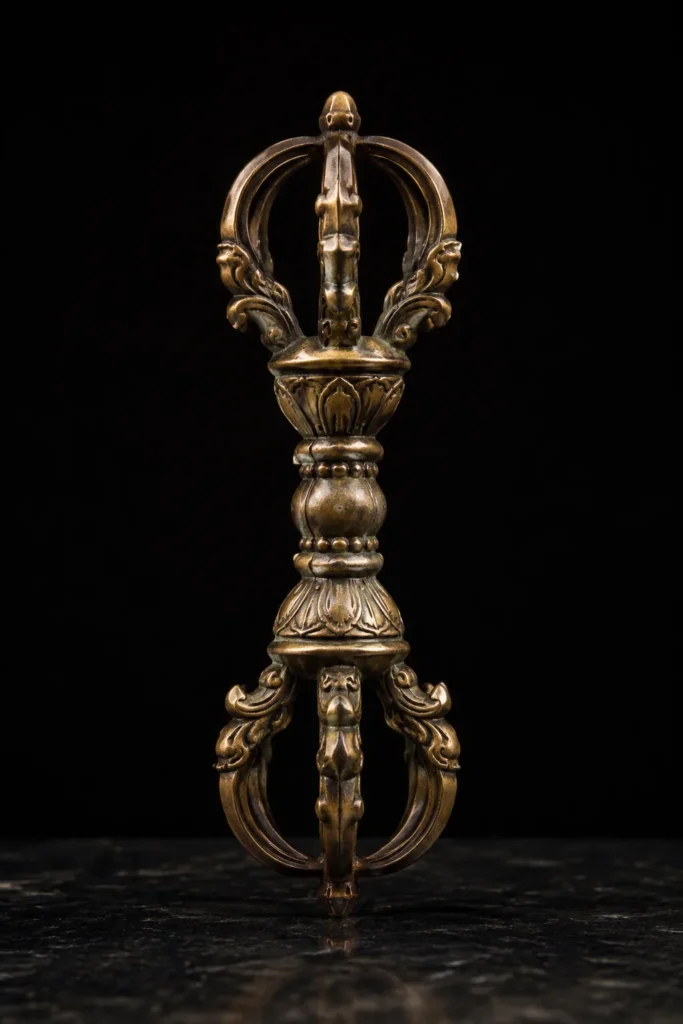
As a ritual implement, the vajra has a clear, symmetrical form. In the middle sits a small sphere that forms the center. From this sphere short axes extend to both sides, at the ends of which are curved prongs.
These prongs are the most striking feature. Usually there are five prongs at each end, four of which curve around a central one. The prongs meet at their tips, so that each end forms a closed, bud-like shape. The whole implement is perfectly symmetrical about its center.
This symmetry is meaningful. The vajra has neither a front nor a back, neither a top nor a bottom. It is the same in both directions. This balance suits its meaning as a symbol of a self-contained, perfect reality.
The vajra is made of metal, often of bronze, and may be richly decorated. The number of prongs can vary, yet the five-pronged form is the most widespread. Specific meanings are assigned to its prongs. The form of the vajra is therefore not arbitrary, but thought through down to the smallest detail.
Specific meanings are assigned to the five prongs at each end of the vajra. They are often connected with the five Buddha families and with five forms of wisdom. The form of the vajra is thus thought through right down to the number of prongs and carries the teaching in its details.

In ritual the vajra almost always appears together with another implement, the bell. Vajra and bell belong together like a pair. In the religious act the practitioner holds the vajra in one hand and the bell in the other.
Usually the vajra is held in the right hand, the bell in the left. Different meanings are assigned to these two implements. The vajra in the right hand stands for the effective means and for compassion. The bell in the left hand stands for wisdom.
In the interplay of the two hands a core idea of the teaching is thus expressed. Means and wisdom, compassion and insight must work together. In the ritual the practitioner holds both at once and thus represents their inseparability.
Vajra and bell are therefore more than mere implements. Together they form a visible teaching. Whoever observes the ritual sees in the two hands the working together of the supporting forces of the Buddhist path. The vajra is the one indispensable part of this pair.
The simultaneous holding of vajra and bell is itself an instruction. The posture of the two hands expresses that means and wisdom cannot be separated. This gesture is performed in countless rituals and makes a core idea of the teaching visible to all.
The significance of the vajra is so great that an entire branch of Buddhism is named after it. This branch is called Vajrayana, which may be translated as the vehicle of the vajra. It is the form of Buddhism that is found above all in Tibet and in the surrounding regions.
The name Vajrayana expresses a claim. This branch understands itself as a path that works with the means of the vajra, that is, with irresistible effectiveness and with reference to the indestructible. The vajra thus stands not for a minor topic, but in the name of an entire tradition.
The Vajrayana is rich in rituals, in symbols, and in special practices. In this world of signs and acts the vajra holds a preeminent place. It is present in the rituals, it appears in art, and it lends its name to many terms.
Whoever wishes to understand the vajra should therefore see it in the context of the Vajrayana. The vajra is not one single object among many, but the guiding symbol of an entire Buddhist branch. In it is condensed what this path aims at.
The Vajrayana spread from India to Tibet, to Mongolia, and to further regions. Everywhere this branch reached, it took the vajra with it. The ritual implement and the symbol thus became known across vast spaces and retained their supporting significance.
The vajra also has a meaning that belongs to the realm of protection. This meaning ties in with its old origin as a thunderbolt. As a powerful symbol, the vajra is credited with removing obstacles and driving away harmful influences.
The obstacles that the vajra removes are above all of a spiritual kind. What is meant are ignorance, delusion, and the disturbing forces that stand in the way of the path to enlightenment. The vajra cuts through them, just as lightning breaks through the darkness.
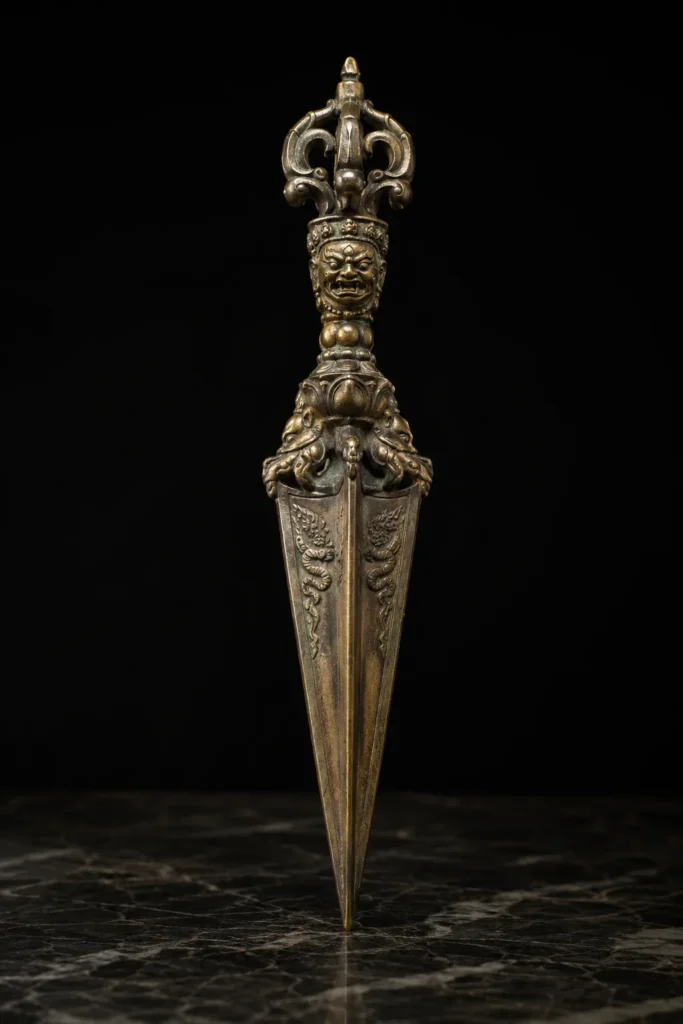
In this meaning the vajra stands close to the phurba, another ritual implement of Tibetan Buddhism. The phurba is a three-sided ritual dagger that is credited with banishing harmful powers. Vajra and phurba both belong to the realm of powerful, defensive ritual implements.
The protection that the vajra offers is thus closely bound up with its spiritual meaning. It does not primarily ward off outer dangers, but removes the inner obstacles on the path. In this too the special character of the vajra as a symbol of the teaching shows itself.
The vajra cuts through ignorance, just as a diamond cuts through other material. The actual opponent here is not an outer enemy, but the delusion within the human being. The protection that the vajra offers is therefore directed above all at the obstacles of one’s own mind.
The vajra does not stand alone in Tibetan Buddhism. It belongs to a whole series of ritual implements used in religious acts. Together these implements form the equipment of the ritual.
The most important related object is the bell already mentioned, which forms a pair with the vajra. Beside it stands the phurba, the three-sided ritual dagger. Furthermore, prayer wheels, offering vessels, and further implements belong to the world of Tibetan ritual objects.
Many of these implements bear the form of the vajra within them. The handle of the phurba is often shaped as a vajra, and other implements too take up the vajra form. The vajra is therefore not only a single object, but a formal motif that runs through the entire ritual world.
This integration shows the central position of the vajra. It is, so to speak, the basic symbol from which the remaining ritual equipment can be understood. Whoever knows the vajra holds a key to the rich world of Tibetan ritual objects.
A special form is the double vajra, in which two vajras are joined crosswise. This crossed symbol stands for firmness and for a secure foundation. It often appears where a foundation or a reliable ground is to be represented.
Today the vajra is known far beyond the Buddhist sphere. With the spread of Tibetan Buddhism in many countries, the vajra too became familiar to a broad public. It appears in Buddhist practice as well as in depictions that refer to Tibet.
As a piece of jewelry and as a symbol, the vajra is also worn outside religious practice. For some people it stands in a general sense for inner firmness, for clarity, or for a spiritual attitude. In this use the precise ritual meaning recedes into the background.
In Buddhist practice itself the vajra remains a full ritual implement. It is used in religious acts, and its meaning as a symbol of the indestructible remains unbrokenly alive. For practitioners it is an object of high standing.
The vajra thus remains a symbol of great depth. From the thunderbolt of a god there arose a symbol of unshakable truth and of penetrating insight. This transformation from weapon to spiritual sign makes the vajra one of the most striking symbols of the Buddhist world.
Today the vajra is widely worn and depicted, even outside actual ritual practice. Its name has become widely known through the designation Vajrayana. The vajra thus belongs to the symbols that represent Tibetan Buddhism visibly to the outside world.
Related key terms: Vajra Dorje thunderbolt diamond Vajrayana bell Indra ritual implement Tibetan Buddhism.
iWell Guard stands in the cultural-historical line of portable protective objects, to which the vajra also belongs. A modern companion for people who live with protective symbols: made in Germany, 41 layers of solid gold, platinum, and silver, with a 30-day return policy.
Personal experiences may vary. Not a medical device. No healing promise.