The Abracadabra Triangle: the diminishing letter amulet
By Ralf Ittermann · last reviewed on
The Abracadabra triangle is an ancient protective amulet. The word Abracadabra is shortened by one letter line by line, until only a single letter remains. As the word diminished, the illness was meant to diminish with it.
The Abracadabra triangle is a letter amulet whose diminishing form is meant to let the illness subside.
Classification
The Abracadabra triangle is a protective amulet whose origin lies in Roman antiquity. It belongs to the script and formula amulets, whose effect is bound to a written word.
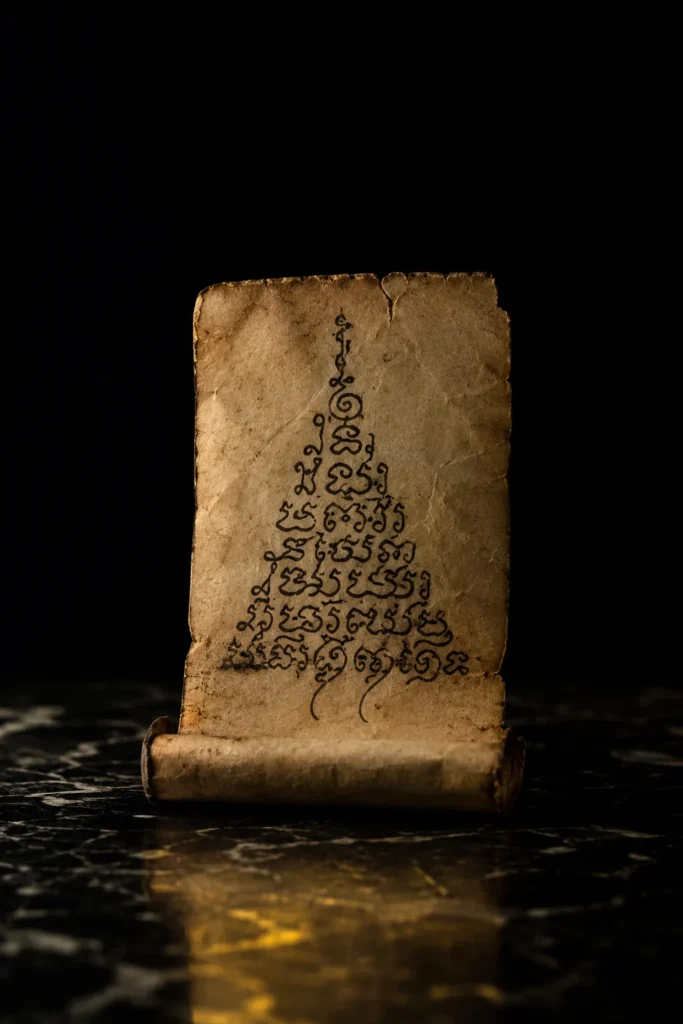
The amulet consists of the word Abracadabra, written in several lines one beneath the other. In each line one more letter is missing, so that the word gradually diminishes.
This stepwise shortening produces a triangular shape. The topmost line bears the full word, the bottom line only a single letter. Hence the name Abracadabra triangle.
The amulet was directed above all against fever. It was meant to free the sick from the illness or to preserve the healthy from it.
In religious studies, the Abracadabra triangle is a good example of a diminishing amulet. Its working principle rests on the gradual disappearance of the written word.
The amulet is also instructive because, through it, the word Abracadabra became one of the best-known magic words of all. Its history, however, begins as a seriously intended means of protection.
The source: Serenus Sammonicus
The earliest known description of the Abracadabra amulet comes from Roman antiquity. It is found in the work of a man named Quintus Serenus Sammonicus.
Serenus Sammonicus lived in the late second and early third century of our era. He composed a didactic poem on medicine in which he described numerous remedies and healing methods.
In this didactic poem, Serenus describes the Abracadabra amulet. He states how the word is to be written and how the amulet is to be used in order to drive away the fever.
The Abracadabra triangle is thus one of the few protective amulets whose instructions survive in a datable ancient source. Its origin in Roman antiquity is well attested.
Serenus Sammonicus treated the amulet in the context of medicine. For him it was one remedy among others, embedded in a medical work of his time.
This source shows that the Abracadabra triangle was from the start a seriously intended means of protection and healing. It was not a game, but a means of ancient medicine against a feared illness.
The shape of the triangle
The shape of the Abracadabra amulet follows from a simple rule. The word Abracadabra is written several times one beneath the other, and in each line one letter is dropped.
The topmost line bears the complete word. The second line omits the last letter. The third line omits a further letter, and so on.
In this way the word grows shorter from line to line. At the end, in the bottom line, only a single letter remains.
Because the lines grow shorter from top to bottom, the result is the form of a triangle pointing downward with its tip. This triangular shape is the hallmark of the amulet.
The piece thus described, usually a strip of parchment or paper, was folded and worn on a cord around the neck. It lay on the chest of the sick person or of the one to be protected.
The instructions sometimes also stated how long the amulet was to be worn and how it was to be treated after the cure. The exact execution was part of the amulet’s effectiveness.
The working principle: the diminishing word
The Abracadabra triangle follows a clear, vivid working principle. It rests on the gradual diminishing of the written word.
The basic idea is a correspondence. Just as the word grows shorter from line to line and finally disappears, so too the illness is meant to decrease and finally disappear.
The shrinking word is thus an image of the shrinking illness. The sick person wears the amulet, and the visible diminishing of the word is meant to bring about the diminishing of the fever.
This principle is known as diminishing magic. It is not confined to the Abracadabra triangle but appears in the folk medicine of many cultures in various forms.
Underlying the conception is the idea that a visible action brings about a corresponding invisible effect. What happens to the word is meant to happen to the illness.
The Abracadabra triangle is a particularly clear and vivid example of this principle. The triangle makes the diminishing immediately visible, and it is precisely in this visible diminishing that its potency lies.
The word Abracadabra
At the center of the amulet stands the word Abracadabra. There is no certain information about its origin and its original meaning.
Various interpretations have been proposed. Some derive the word from Aramaic or Hebrew, others from Greek, and still others hold it to be a pure sequence of sounds without literal meaning.
What is certain is that the word was regarded as powerful. Whether it originally had a meaning or was from the start a pure magic word cannot be decided.
For the amulet’s effect, the literal sense was not decisive in any case. What mattered was that the word was regarded as effective and that it lent itself to the diminishing triangle.
The word also has a favorable form for this amulet. It is long enough to produce a clearly recognizable triangle, and its sequence of letters lent itself well to being shortened step by step.
Through the amulet and through its long use, Abracadabra eventually became one of the best-known magic words of all. Today it stands generally for the magic word. Its origin, however, lies in this seriously intended ancient healing amulet.
Fever as a danger
The Abracadabra triangle was directed above all against fever. To understand the amulet, one must know what threat fever posed in the ancient world.
Febrile illnesses were ubiquitous and dangerous in antiquity. Especially feared were the recurring fevers connected with malaria, which were widespread in many regions.
Against such illnesses there was no reliable cure in the present-day sense. Ancient medicine commanded limited knowledge, and the course of a febrile illness often could not be influenced.
In this situation people sought help in many ways. Alongside healing herbs and medical treatment stood prayers, incantations, and protective amulets.
The Abracadabra triangle was one of these means. It belonged to the domain in which medicine and protective magic interlocked. Serenus Sammonicus placed it alongside other remedies in his medical work.
The amulet thus answered a very real, everyday threat. It was not a game and not mere superstition in the disparaging sense, but a seriously intended means against a feared illness.
A long history of use
The Abracadabra triangle did not remain confined to Roman antiquity. It was used over many centuries.
In the Middle Ages and the early modern period, the Abracadabra amulet was a fixed part of folk medicine and protective magic. It was used against fever and against other illnesses.
A well-known testimony comes from the time of the great plague. Reports about severe years of epidemic mention that people wore the Abracadabra amulet for protection against the pestilence.
The long use shows how widespread and enduring this amulet was. From the Roman medical book of Serenus Sammonicus into the modern era, its history extends.
This endurance connects the Abracadabra triangle with the SATOR square. Both are protective formulas that stem from Roman antiquity and were used over a very long period.
Only with the rise of modern medicine did the Abracadabra amulet recede. What had been a remedy taken seriously for centuries was now regarded as outdated.
Diminishing amulets in other cultures
The Abracadabra triangle is the best-known diminishing amulet, yet the principle of the diminishing word is not confined to this one amulet.
In the folk medicine of many cultures one encounters the idea of driving away an illness through a decreasing word or a decreasing sign. The diminishing of the sign is meant to bring about the diminishing of the evil.
There are diminishing formulas with other words that were written in the same triangular form. Writing an illness on an object that was then destroyed or thrown away also follows a related idea.
Underlying all these customs is the principle of correspondence. A visible decrease is meant to bring about a corresponding invisible decrease.
Within this group, the Abracadabra triangle is the most famous and best-attested example. Through the ancient source and through its long use, it is particularly well graspable.
It thus shows a widespread working principle in especially clear form. The diminishing word as an image of the diminishing illness is an idea that reaches far beyond this one amulet.
Reception today
The Abracadabra triangle as a healing amulet is today no longer a living custom. With the rise of modern medicine, it lost its role as a remedy taken seriously.
The word Abracadabra, by contrast, has remained extraordinarily well known. It has become the magic word par excellence and is today associated above all with stage magic and with play.
In this present-day usage, the original meaning has faded. Hardly anyone still associates the word Abracadabra with a seriously intended ancient healing amulet against fever.
It is precisely in this that the appeal of a careful account lies. The Abracadabra triangle shows that behind today’s playful word stands a long, serious history.
For the study of ancient medicine and protective magic, the Abracadabra triangle is a valuable source. It shows how closely medicine and protective magic were bound together in antiquity.
The Abracadabra triangle thus remains a striking example of a diminishing amulet. In it a famous word, a vivid triangular form, and the working principle that the evil should diminish along with the diminishing word all come together.
Related pages in the lexicon: an overview of the protective symbols at a glance as well as the page on the SATOR square.
References (selection)
Related key terms: Abracadabra diminishing amulet Serenus Sammonicus fever letter triangle protective formula magic word.
iWell Guard and protective traditions
iWell Guard stands in the cultural-historical line of portable protective objects, to which the Abracadabra triangle also belongs. A modern companion for people who live with protective symbols: made in Germany, 41 layers of solid gold, platinum, and silver, with a 30-day right of return.
Personal experiences may vary. Not a medical device. No promise of healing.