Coin Amulet: the round lucky coin with a square hole
By Ralf Ittermann · last reviewed on
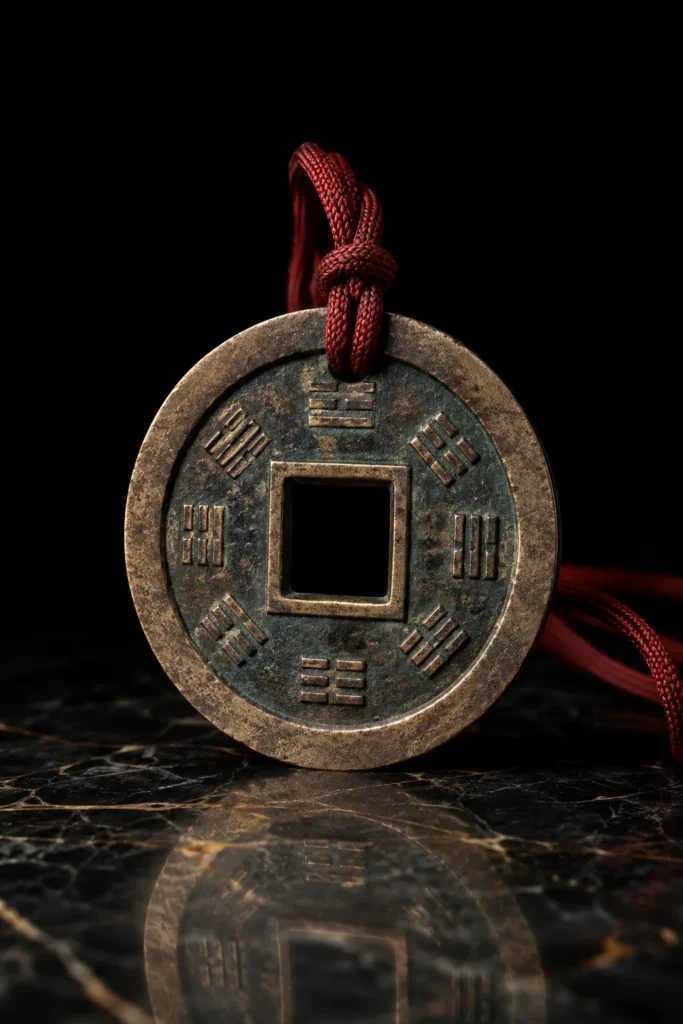
The Chinese coin amulet is the round coin with a square hole in the centre. Derived from the old money of China, it is regarded as a sign of luck and protection. Worn, hung up or joined into bundles, it is said to bring prosperity and ward off misfortune.
Classification
The coin amulet is a sign of protection and good fortune from the tradition of China. It goes back to the old Chinese coin and shares with it its distinctive shape.
This shape is the round coin with a square hole in the centre. For over two millennia this was the basic form of Chinese money.
From this coin the coin amulet emerged. The coin was understood beyond its monetary value as a sign of luck and protection, and in this sense it was worn, hung up and collected.
Alongside the coins in circulation, specially made coins were also created that never served as money. From the outset they were amulets and bore lucky inscriptions and protective images.
In religious studies, the coin amulet is a good example of an everyday object that became a sign of protection. Money became a bearer of good fortune and preservation.
This page presents the Chinese coin amulet as a sign of luck and protection. It describes its origin, its form and its meaning, and places it within the protective tradition of China.
The old Chinese coin
The coin amulet goes back to the old Chinese coin. This coin kept a consistent basic form over a very long period.
The coin was round and bore a square hole in the centre. This form was retained in China over more than two millennia, from the early imperial period into modern times.
The square hole had practical reasons. It allowed many coins to be strung onto a cord, and it helped in manufacture, since the cast coins could be held by the square hole and finished.
Beyond the practical, this form received an interpretation. The round outline was associated with heaven, the square hole with the earth. The coin thus carried the image of heaven and earth within it.
The coin usually bore an inscription of a few characters. It frequently named the reign period during which the coin was cast.
This old coin, round with a square hole and with a short inscription, is the basis of the coin amulet. Its form and its interpretation passed directly into the amulet.
From coin to sign of good fortune
Over time the ordinary coin became a sign of good fortune. Several reasons worked together here.
The first reason is the coin’s direct relation to money. The coin stood for prosperity and for a good livelihood. To carry a coin meant to carry the image of prosperity with oneself.
The second reason lies in the interpreted form. The round coin with the square hole carried the image of heaven and earth and thus an image of the ordered world.
The third reason lies in the inscriptions. On the coins, and especially on the specially made amulet coins, there were often characters that asked for luck, long life and prosperity.
Thus the coin became, beyond its monetary value, a bearer of an auspicious meaning. It was at once money, an ordered image of the world and a wish for good fortune.
The coin amulet is the result of this development. In it the coin has turned fully into a sign of luck and protection, without giving up its familiar form, known from the coin.
Lucky inscriptions and protective images
The specially made coin amulets often bear more than the plain inscription of the circulating coins. They are provided with lucky inscriptions and protective images.
On one side, many amulets bear characters that express a wish for good fortune. They ask for wealth, long life, many descendants or an honourable standing.
On the other side, many amulets bear an image. Depicted are auspicious animals, plants and signs to which Chinese tradition assigns a fortune-bringing meaning.
Some coin amulets also show signs that serve expressly for warding off. Among them are the eight-trigram sign, that is the Bagua, and further signs of the Daoist tradition.
In this way the coin amulets unite two sides of the idea of protection. On one side they ask for the good, and on the other side they ward off misfortune.
The variety of inscriptions and images makes the coin amulets a rich subject. Each amulet bears its own message, and together they reflect the many wishes and concerns of those who wore them.
Wearing, hanging up and bundling
The coin amulet is used in various ways. Common to all uses is the square hole, which allows the coin to be fastened easily.
The coin amulet is often worn. Fastened to a cord, it is hung around the neck or attached to clothing, and so it accompanies the person wearing it.
The coin amulet is also hung up. Placed in the house, on the door or above an important spot, it is meant to set the place and its inhabitants under a favourable fate.
A form of its own is the bundling of coins. Several coins are strung onto a red cord or skilfully tied into a figure. The large number of coins reinforces the favourable meaning.
A particular use concerns children. Coin amulets were hung around children to protect them, and they were given as gifts on certain occasions such as birth or the turn of the year.
In all these uses the coin amulet acts as a sign of luck and protection. Whether worn, hung up or bundled, it is meant to bring prosperity and preservation upon the person and the place.
The coin amulet and the coin sword
The coin amulet stands in close connection with another Chinese protective object, the coin sword. Both proceed from the same coin.
The coin sword is a sword made entirely of strung coins. On the page about the coin sword, this object of defence is presented in more detail.
The coin sword can be understood as a particular application of the coin amulet. It brings the individual lucky coins together into the shape of a sword, and so it joins the lucky power of the coins with the defensive power of the sword.
This shows the range of the coin amulet. The individual coin is a plain sign of good fortune. Joined into a figure or into a sword, it becomes part of a larger protective object.
In both cases the coin remains the basic building block. Its form, its lucky meaning and its square hole, which allows the joining, make it a suitable material for many kinds of protective objects.
The coin amulet and the coin sword are thus two expressions of the same basic idea. Both use the Chinese coin as a sign of luck and protection, the one as a single amulet, the other as a composite object of defence.
Heaven, earth and the ordered world
A meaning of its own in the coin amulet lies in its form. The round coin with the square hole was interpreted as an image of the world.
According to a notion widespread in China, heaven is round and the earth is square. The round coin and the square hole render this image.
In its very form, the coin thus carries an image of the ordered world within it. Heaven, as a round rim, encloses the square hole of the earth.
This interpretation gives the coin amulet a meaning that reaches beyond good fortune. It is not only a wish for prosperity, but also a small image of the world order.
An object that depicts the ordered world was regarded as favourable and as protective. In the ordered world misfortune has no proper place, and an image of this order wards it off.
The coin amulet thus joins two ideas. It is a sign of good fortune that asks for prosperity, and at the same time an image of the ordered world that protects through this order.
The coin amulet in the protective tradition of China
The coin amulet belongs to a rich protective tradition of China. This tradition combines elements of Daoism, of folk religion and of the general Chinese world of ideas.
Within this tradition the coin amulet belongs among the most widespread and familiar signs of protection. Unlike rare or precious objects, the coin was known to everyone.
The coin amulet thus stands for a side of the protective tradition that lies close to everyday life. It is a sign of protection that arose from ordinary life, from the daily handling of money.
The coin also frequently appears as part of larger protective objects and as a pictorial motif. It adorns doors, furniture and clothing, and is a frequent sign in images of luck and prosperity.
This broad use shows the special position of the coin amulet. It is not an object for special occasions, but a familiar sign of daily life.
The coin amulet is therefore a readily graspable example of the Chinese protective tradition. In it one sees how an everyday object, money, could become a lasting sign of luck and protection.
Reception today
The coin amulet remains a well-known and widespread sign of protection up to the present day. In China and in Chinese communities all over the world it continues to be used.
The coin amulet is frequently encountered in connection with the Chinese teaching on the favourable arrangement of living and business spaces. Coins, singly or joined into bundles, are among the means there that are meant to promote prosperity.
Coin amulets are made today in many forms. Alongside old coins there are specially made pieces, often provided with a red cord and with lucky inscriptions.
The old Chinese coin form is also present as jewellery and as a pendant. Its clear, easily recognisable shape makes it a popular motif.
For religious studies and for numismatics, the coin amulet is an instructive subject. It connects the history of Chinese money with the history of signs of protection and good fortune.
The coin amulet is thus a striking example of a Chinese sign of luck and protection. In it the familiar form of the old coin, the image of the ordered world and the wish for prosperity and preservation come together.
Literature (selection)
Related key terms: coin amulet Chinese coin square hole lucky coin sign of protection prosperity Bagua China lucky inscription.
iWell Guard and protective traditions
iWell Guard stands in the cultural-historical line of wearable protective objects, to which the coin amulet also belongs. A modern companion for people who live with protective symbols: made in Germany, 41 layers of solid gold, platinum and silver, with a 30-day right of return.
Personal experiences may vary. Not a medical device. No healing promise.