Manannan Mac Lir, God of the Celtic Tradition
By Ralf Ittermann · last reviewed on
Manannan mac Lir is the god of the Celtic tradition, lord of the sea and of the Otherworld (Tír na nÓg), guardian god of transitions and spiritual spheres.
In terms of the history of religion, he represents the Indo-European type of the boundary and water god and is central to the insular Celtic concept of the “otherworldly” realms.
Manannan Mac Lir
Manannan is portrayed as a supernatural sea king and seafarer who moves between the human world and the Otherworld (Tír na nÓg, Mag Mell). He possesses a white, supernaturally swift horse (Enbarr) that runs over the water and a self-sailing ship (Scuabtuinne).
In Irish tales he appears as a guide of souls and a protector of travelers. According to legend, he wards off demons and keeps demonic beings in check. In some texts he is the teacher or foster father of heroes such as Cú Chulainn.
At a Glance: Manannan Mac Lir
The evidence comes from the Immram Brain maic Febail (“Voyage of Bran mac Febail”), the Imram Curaig Maél Dúin (“Sea Journey of Máel Dúin”), and other adventure myths recorded from the 8th and 9th centuries onward.
Manannan is mentioned in genealogical texts and in the Ulaid saga. His function as psychopomp and guardian of boundaries is characteristic of insular Celtic cosmology. Modern sources: folkloric tradition in Ireland and Scotland (Hebrides, Isle of Man).
Context
Period of the Texts
The continuity of the tradition over these long spans is remarkable and shows a deep, stable cultural rootedness. Even in modern times the memory, and at times active veneration, remains alive, sometimes transformed but still recognizable in its essentials.
Mythological Classification
Manannan mac Lir is a god and supernatural being of Irish and Welsh Celtic mythology. He is lord of the sea, of magic and of the Otherworld. Manannan is a traveler between the worlds and a protector. His role is central to Celtic understanding.
Area of Distribution
Manannan mac Lir was known above all in the coastal regions around the Irish Sea.
The spread of Manannán mac Lir follows the sea routes of the Irish Sea: he was known in Ireland, on the Isle of Man, and in Scotland, and the Isle of Man bears his name. This distribution across several Gaelic-speaking coastal regions is explained by the close shipping and trading connections between them; the basic form of the god remained the same in all regions, a lord of the sea and of the crossing.
Source Situation
Primary sources: Immram Brain maic Febail (ca. 8th century), Imram Curaig Maél Dúin (ca. 9th century), Togail Bruidne Dá Derga (“Destruction of Da Derga’s Hostel”), and later also the Mabinogion (Welsh, 11th to 13th century, featuring Manawydan). Period: the oral traditions are older (possibly Iron Age), while the written fixation took place in the medieval era. Scholars: Mac Cana (Celtic Mythology), Jenny Rowland (Early Welsh Saga Poetry), W. Y. Evans-Wentz (The Fairy Faith in Celtic Countries) document Manannan traditions.
Name
Manannan mac Lir is depicted in the various sources and artistic traditions with certain recurring iconographic elements that remain relatively constant across decades and across different geographic regions. These elements are not purely decorative or chosen at random but are deeply coded with symbolic meaning and carry great significance.
The attributes of Manannán mac Lir form a readable system of signs: the cloak of mist stands for his power to conceal things and veil boundaries, the self-propelled boat Wave-Sweeper for his rule over the sea, the horse Aonbharr, which runs across water, for the lifting of the boundary between land and sea, and the apple island Emain Ablach for his connection to the Otherworld. Anyone familiar with the Irish narrative tradition grasps the god’s domain and rank directly through these objects; none of the attributes is chosen at random, and all are firmly transmitted in the medieval texts.
The overall system is like a sacred script or a coded image: it allows initiates or the culturally educated to grasp the essential deeper meaning and to understand it correctly. Colors, sacred objects or weapons, physical attributes, specific accessories, all are significant and traditionally transmitted.
Characteristics
The practice was not arbitrary or ad hoc but precisely handed down and often led by trained priests or other specialists. The continuity of these practices over many generations clearly shows that the practice was regarded as effective and necessary.
Their functions were manifold: some were preventive (warding off potential misfortune), some healing (relief from illness or suffering), some transformative (accompaniment through transitions between stages of life).
Appearance and Symbolism
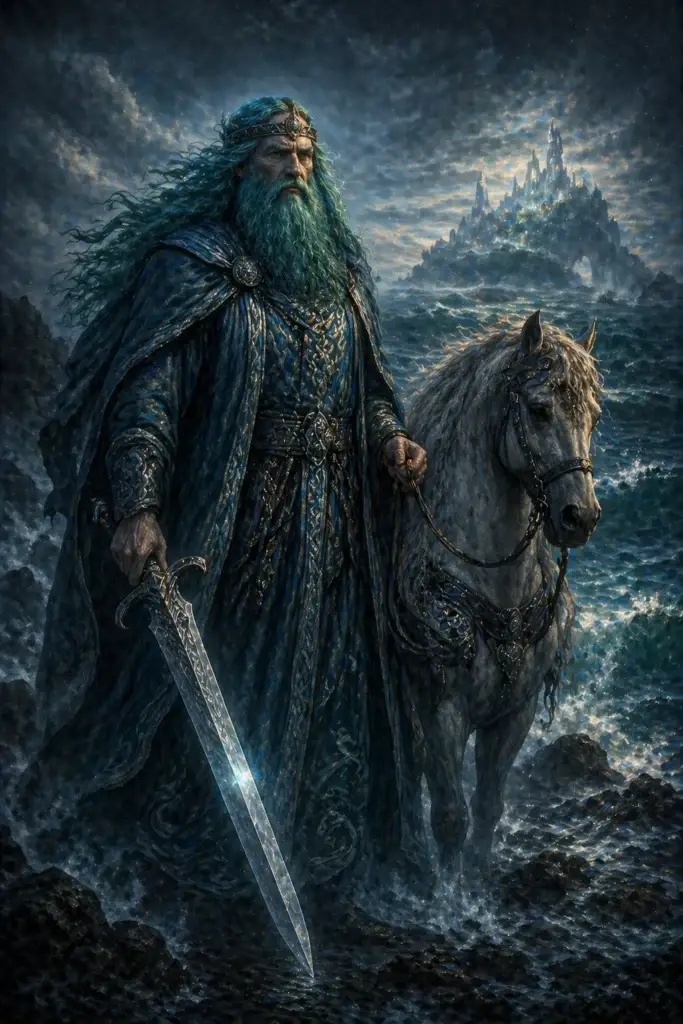
Manannan is portrayed as a beautiful, enigmatic man in shimmering, changeable clothing. He rides his horse Enbarr across the sea. The mist is his cloak, granting invisibility. His magical mantle and sword are legendary artifacts. Magic fills his presence.
Profile: Manannan Mac Lir
The Profile illuminates Manannan in six aspects: his position as lord of the Otherworld and of the sea’s nature, his role as psychopomp and travel companion, his characteristic attributes and wondrous objects, his cosmic and protective powers, as well as spiritual ways of invocation and cultural analogues.
This yields a portrait of this enigmatic god of boundaries.
Manannan originates from the Otherworld and belongs, according to the sources, to the Tuatha Dé Danann. His name combines “Mana” (possibly “moon” or “power”) with “mac Lir” (“son of the sea”, Lir being a sea god).
Geographically he is anchored to Ireland and the island world, with traces on the Isle of Man (Mona Innis, named after him). Literary attestations from the 8th century onward.
Manannan was invoked by seafarers, travelers, heroes and spiritual seekers for protection at sea, guidance into the Otherworld and protection from demonic forces. He was a patron of travelers between the worlds. In magical contexts he was asked for secrecy and concealment. His veneration is not organized as a cult but is folkloric and shamanic.
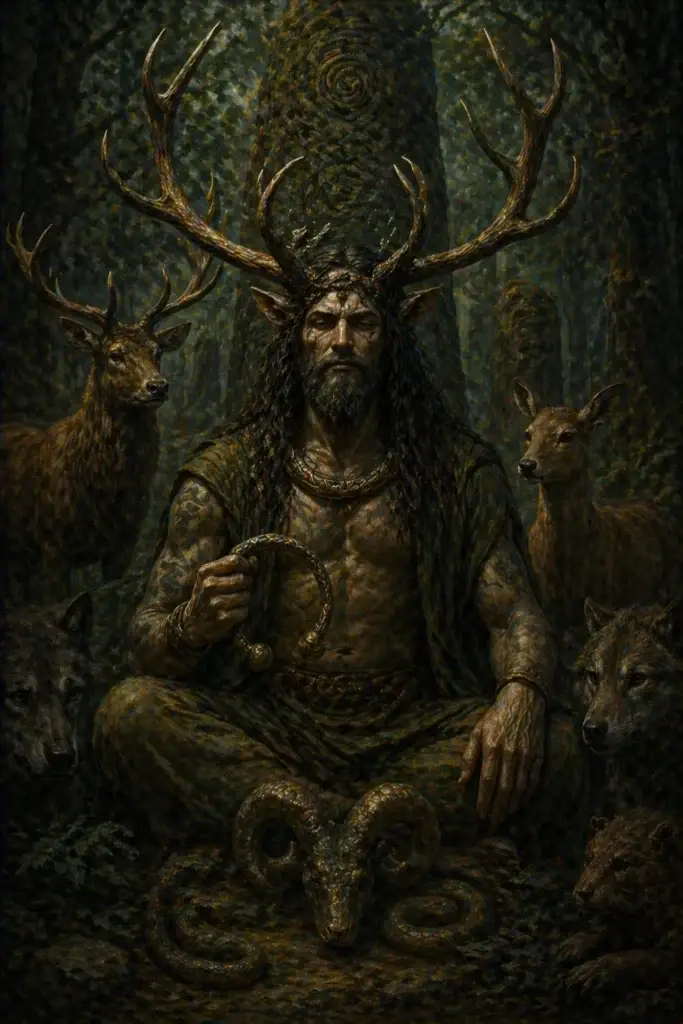
Manannan is portrayed as a noble, supernatural man, often with royal insignia and in the finest clothing. He sometimes wears green or shimmering armor. His horse Enbarr is described as white and supernaturally swift. His ship is self-sailing and invisible. In some texts he has supernatural eyes or a piercing gaze that reveals the truth.
Manannan is not dangerous in an evil sense, but powerful and somewhat unpredictable. He protects against demonic beings, yet his knowledge of the Otherworld makes him uncontrollable. Respect and caution are advised when invoking him.
Modern spiritual practice sees him as a helper at boundary transitions and on inner journeys. Some traditions teach protective mantras or appeasements in order to secure his support safely.
Comparable figures are Charon (Greek) as the ferryman of the dead, Poseidon as a sea god and lord of transitions, the Germanic Forseti as a god of boundaries and reconciliation, and the Roman Neptune as a sea god.
In Asian traditions: Yama as a god of death and guide of the way, and the Buddha Amitabha as a savior and guide into the beyond.
Manannan Mac Lir, Parallels in Other Cultures
Rituals and Veneration
In coastal settlements of Ireland, offerings were made to Manannan mac Lir at the water: jewelry, drink or food offerings before longer sea voyages.
Druids invoked him by means of sea chant at particular phases of the moon.
Conjurations and Invocations
In the literature he appears as a counselor and guiding spirit, summoned by courageous heroes. A well-known invocation for sea voyages ran: “Manannan mac Lir, teach me the safe ways.”
Amulets and Protective Symbols
Symbols of the wave, the crescent moon and the spiral were engraved on protective amulets. In modern esoteric practice, thalasso crystals (aquamarine, blue topaz) are regarded as connected to Manannan.
Jewish tradition: No direct equivalent. A distant relation could be Elijah, who moves between heaven and earth and undertakes supernatural journeys.
Greco-Roman world: Charon as the ferryman between life and death. Hermes/Mercury as psychopomp and god of boundaries, guide of souls. Poseidon as sea god and lord of transitions, Hades as king of the Otherworld. The functions overlap significantly.
Mesopotamia: Anu as sky god and guardian of boundaries, Ereshkigal as queen of the underworld, Nergal as ruler of chthonic realms. Also Enki with his connection to hidden waters and wisdom.
India/Asia: Yama as god of death and of transitions, Charon-like. In Buddhism: Mahakala as protective god and ruler of the underworld. Tibetan yidams too, as meditative aids for boundary experiences, correspond functionally to Manannan.
The Irish and Welsh Sources and Their Layering
Manannan mac Lir, whose name denotes the son of the sea or the one connected with the sea, is broadly attested in the medieval manuscripts of Ireland, yet the sources are uneven and in many cases were written down only centuries after Christianization.
The monks who composed these texts placed the old gods into a new, Christian framing of history, for instance as earlier inhabitants of Ireland or as mortal kings of antiquity.
Manannan appears in several narrative cycles. In what is called the Mythological Cycle he belongs to the Tuatha De Danann, the people of the gods who inhabited Ireland before the human Goidels.
In the Lebor Gabala Erenn, the Book of Invasions, he is placed within the genealogies of this people. In tales such as Immram Brain, the Voyage of Bran, and in texts concerning the hero Cu Chulainn, he appears as lord of an otherworldly island realm.
The Welsh tradition knows a related figure under the name Manawydan, son of Llyr, who appears in the second and third branches of the Mabinogi. There, however, Manawydan is less a sea god than a clever, patient man who averts misfortune through craft and cunning.
The relationship between the two figures is disputed in scholarship: they share the name of the father and some traits, but differ considerably in character and function.
This source situation calls for caution. A unified, original image of the god cannot be reconstructed. What the manuscripts transmit are already literarily shaped, Christian-filtered and regionally varying versions of a figure whose pre-literary form remains largely in the dark.
The Lord of the Otherworldly Islands and His Possessions
In the Irish tradition, Manannan is the lord of an Otherworld imagined as an island realm beyond the sea or beneath the waves. His best-known dwelling bears the name Emain Ablach, the Isle of Apples, a place free from age, illness and want.
In the Voyage of Bran, Manannan appears to him upon the water and describes to him the true nature of the sea, which for the god is a flowering plain across which he drives in his chariot, while Bran sees only waves.
To Manannan belongs a series of possessions transmitted by name and named again and again in the texts. His boat travels without sail or oar, solely according to the will of its steersman.
His horse, in some sources called Aonbharr, can run over land and water alike. His mantle, when he shakes it between two people, makes them forget one another. His sword bears its own name, and some texts speak of armor that renders one invulnerable.
A recurring motif is Manannan’s pigs, which can be slaughtered and eaten and are alive again the next day, so that his retinue never suffers want. This food of immortality links the god to the notion of an otherworldly feast that never ends.
These possessions are more than narrative furnishing. They outline the god’s power over the boundaries between the worlds, over sea and land, over remembering and forgetting, over death and return. Manannan is the boundary crosser par excellence, and his objects are the tools with which these boundaries can be crossed.
Manannan, Lugh and Fosterage Among the People of the Gods
In the Irish tradition, Manannan is closely woven into the web of relationships among the Tuatha De Danann, particularly through the institution of fosterage. In medieval Ireland, the entrusting of a child to a foster father was a significant social practice that forged alliances. The narratives transfer this pattern onto the gods.
Best known is Manannan’s role as foster father of the light god Lugh. According to tradition, Lugh grew up with Manannan in the god’s otherworldly realm, and the sea god equipped him with several of his gifts before Lugh joined the Tuatha De Danann.
With this, Manannan stands at the beginning of the heroic career of one of the central figures of the Irish pantheon.
Even after the defeat of the Tuatha De Danann by the human conquerors, Manannan retains an ordering function.
A tradition known as Altram Tige Da Medar, the Fosterage in the House of the Two Milk Vessels, attributes to him that, after the people of the gods withdrew into the sid, the hills and otherworldly dwellings, he distributed these among the individual gods and thus ordered the Otherworld.
In this role Manannan acts almost like an organizer of the transition from the age of the gods to the age of humans.
His web of kinship is inconsistent in the sources. Several women are associated with him, among them Fand, who plays a role in the tale of Cu Chulainn’s sickbed. Various children are also ascribed to him.
This vagueness is typical of the Irish tradition of the gods, in which genealogies vary by text and region. What remains to be noted is that Manannan is not an isolated sea god but a figure who holds the people of the gods together through bonds of fosterage and through the ordering of the Otherworld.
The Isle of Man and Survival in Popular Belief
The Isle of Man in the Irish Sea, according to a widespread view already attested in the Middle Ages, bears its name in connection with Manannan.
Medieval Irish texts name him as the first ruler or guardian spirit of the island and attribute to him that he wrapped it in mist to hide it from enemies.
Whether the island’s name is in fact derived from the god’s name, or whether the connection was instead established secondarily in reverse, has not been conclusively settled in linguistics, yet the close association is old and culturally potent.
On the Isle of Man the memory of Manannan persisted into modern times.
Folklore records of the eighteenth and nineteenth centuries attest the custom of presenting to the being remembered as Manannan beg mac y Leirr, on the summer solstice or on the eve of certain festivals, a gift of rushes or green reeds, often on a height.
This custom linked the old figure to the rhythm of farming and fishing life.
In Ireland itself the name lived on in place names, proverbs and tales, frequently much altered and detached from the learned tradition. The rediscovery of the medieval manuscripts by Celtic philology of the nineteenth and twentieth centuries then brought the god back into literary awareness as well.
In modern cultural life Manannan is present on the Isle of Man, for instance in public art and in the cultivation of local identity.
This persistence shows that the figure is not merely an object of manuscript research but, through the island culture, possesses an unbroken, if transformed, line down to the present. Manannan thus belongs to the few Celtic divine figures whose name was never entirely lost.
Literature (Selection)
Further standard works in the literature index.