Mago Halmi, Goddess of the Korean Tradition
By Ralf Ittermann · last reviewed on
Mago Halmi (Grandmother Mago) is the cosmic primordial mother goddess of Korean tradition, venerated as the ground of all things. Her theological status is contested, but in Daoism and in neo-religious movements she is regarded as a primordial force from which heaven and earth arose. This entry situates Mago Halmi within Korean Myth as the primordial grandmother from whom heaven and earth arose.
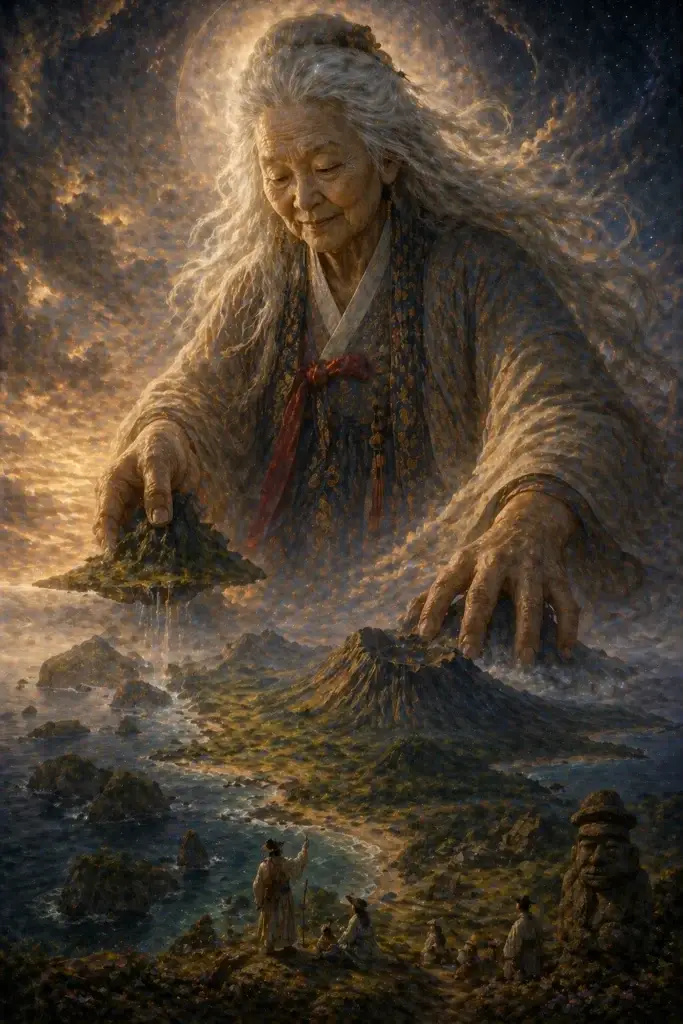
Mago Halmi
In later cosmological texts (especially in Korean Daoism and neo-religious traditions) Mago Halmi is described as a primordial goddess from whom all other gods emerged. She embodies the feminine principle of creation and the power of nature.
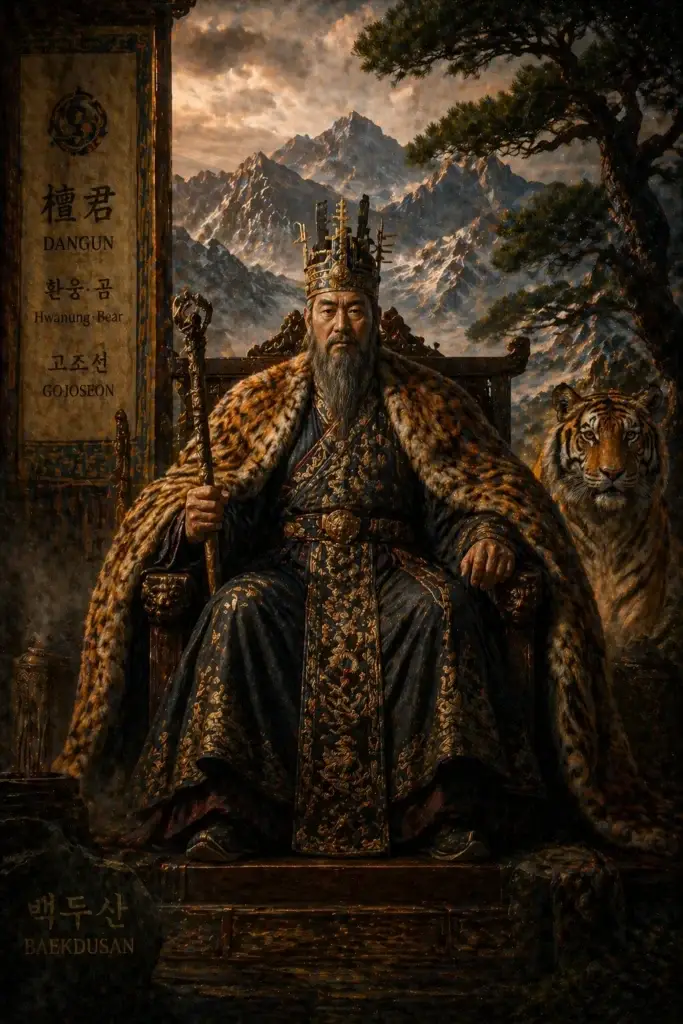
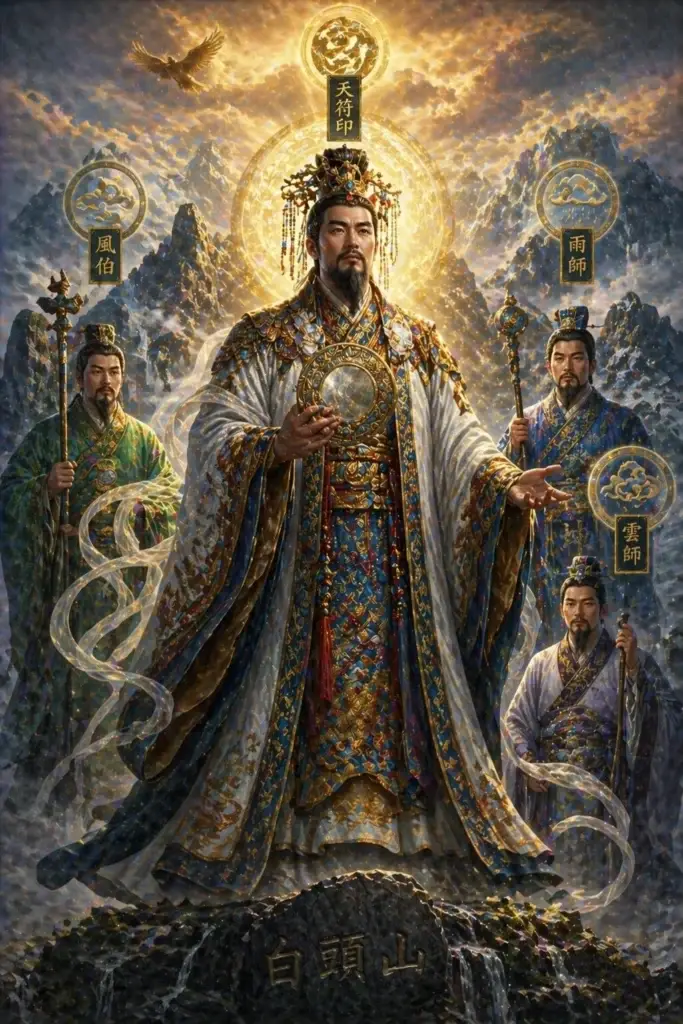
Unlike Hwanung and Dangun, who are attested in early sources, Mago Halmi is less present in older texts, but she is gaining significance in modern esoteric and religious movements. She is sometimes portrayed as the mother of Hwanung.
Brief Profile: Mago Halmi
Mago Halmi does not appear in the classical Samguk yusa, but rather in later Daoist and neo-religious writings of the twentieth century. Her veneration is strongly connected with modern spiritual movements (in particular with the Damoism movement and other syncretistic religions).
Religious ethnologists such as Kim Tae-gon document her growth in folk and neo-shamanic practices. She is less studied academically than other Korean deities, but is growing culturally.
Classification
Period of the Texts
The continuity of the tradition across these long spans of time is remarkable and shows a deep, stable cultural rootedness. Even in modern times the memory, and sometimes active veneration, remains alive, at times transformed, but still recognizable in its basic features.
Mythological Classification
Mago Halmi (마고할미, “Grandmother Mago”) is a primordial feminine force in Korean shamanic and shamanistically influenced traditions. She is understood as the originator of the world or as a cosmic grandmother.
Area of Distribution
This clearly points to a central role in the self-understanding of the entire people. Trade, migration and cultural exchange contributed to the geographical distribution and to the stable uniformity of the veneration.
Source Situation
Mago Halmi has no early literary attestation in classical sources such as the Samguk yusa. As a goddess she is first mentioned in modern neo-religious texts, especially in writings of the Damoism movement (Korea, late twentieth century) and in esoteric interpretations of Korean mythology.
Kim Tae-gon examines her in his work on Korean nature veneration and shamanism. Daoism (Chinese sources such as the Daodejing) offers conceptual parallels for the principle of the primordial mother or the primordial ground (Dao/De).
In terms of religious history she is understood as a modern reconstruction or reinterpretation of archaic fertility and nature-mother cults.
Name
In the various sources and artistic traditions, Mago Halmi is depicted with certain recurring iconographic elements that remain relatively constant across decades and across different geographical areas.
These elements are not purely decorative or randomly chosen, but are deeply symbolically encoded and carry great meaning. They convey, in a central way, the functions, sources of power, areas of responsibility and cosmic role of the being.
The overall system is like a sacred scripture or a coded image; it allows initiates or the culturally educated to grasp and correctly understand the essential, deeper meaning. Colors, sacred objects or weapons, bodily attributes, specific accessories, all of it is significant and traditionally handed down.
Characteristics
The practice was not arbitrary or ad hoc, but precisely handed down and often led by trained priests or other specialists. The continuity of these practices across many generations clearly shows that the practice was regarded as effective and necessary.
The functions were diverse: some were preventive (warding off potential misfortune), some healing (alleviation of illness or suffering), some transformative (accompaniment through transitions between stages of life).
Appearance and Symbolism
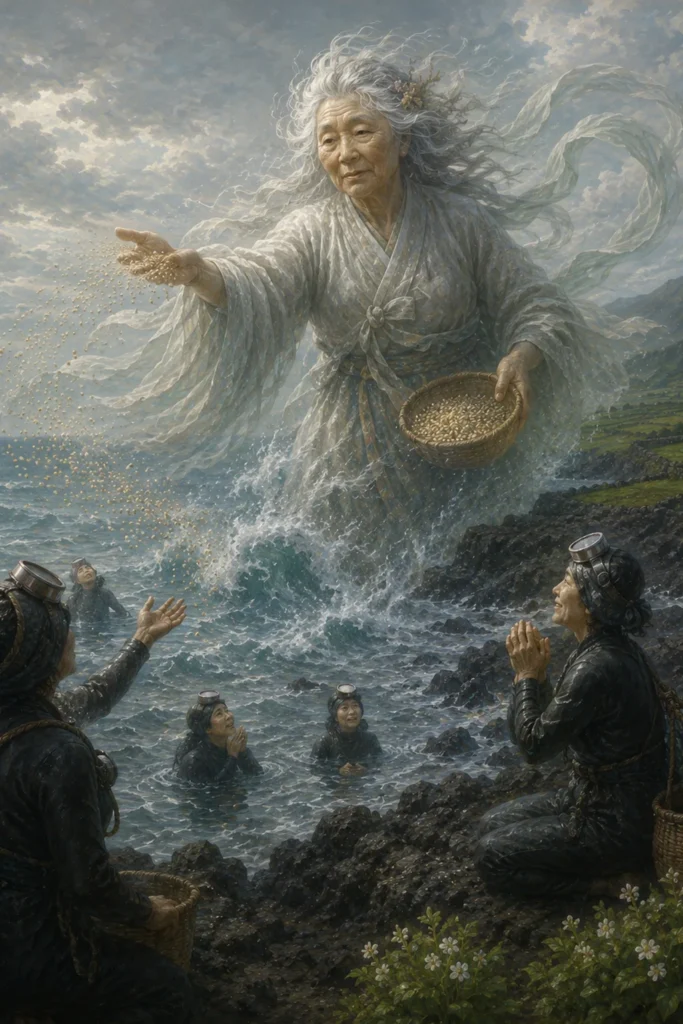
Mago Halmi is depicted as an ancient grandmother of infinite wisdom, often in traditional clothing. She is associated with the earth itself, sometimes as a combination of Tian (heaven) and earth. Her symbols are natural elements: stone, water, plants. She is often shown sitting or meditating.
Profile: Mago Halmi
The Profile treats Mago Halmi from six perspectives: her cosmological origin and role, the groups of her modern veneration, her iconography and symbolism, her protective functions and similarities in neighboring cultures. These dimensions show her position as a primordial mother between archaic fertility cult and modern neo-religious interpretation.
Mago Halmi is situated cosmologically as a primordial ground or primordial mother force that existed before the differentiation into heaven and earth. Geographically she is not locally bound like mountain deities, but is depicted as a ubiquitous, immanent force.
Her veneration did not arise in early sources, but reconstructed itself in the twentieth century from fragments of folk mythology and neo-religious interpretation. The dating of the formalization of her modern cult lies in the late twentieth century.
Mago Halmi is venerated primarily by followers of neo-religious movements (Damoism, Jeungsan religions, syncretistic groups), less so by traditional shamans or Confucian elites.
Her veneration appeals to women, conservationists and spiritual seekers who are looking for a primordial feminine force. Occasions for her veneration include personal spiritual practice, nature conservation and the search for an authentic feminine spirituality beyond patriarchal traditions.
In modern depictions Mago Halmi is shown as an old woman, primordial mother or abstract cosmic force, often with a white or golden halo. Her attributes are the earth, plants, mountains or the Tao symbol (yin-yang).
She is sometimes depicted with wings to suggest her supernatural nature. In esoteric works of art she appears as a luminous or glowing figure that radiates light and life. She is often shown in mountainous or wooded landscapes to symbolize her connection with nature.
Mago Halmi is a benevolent, creative being. Her veneration serves the harmonization with nature, the protection of the earth and unity with the cosmic principle. Rituals of veneration include prayers to nature, offerings of thanks for fertility and meditation on the primordial mother force.
In the modern neo-religious context, rituals for environmental protection and for the empowerment of women are also connected with her. Protection comes about less through apotropaic measures than through spiritual orientation toward the primordial source.
Comparable are other primordial grandmothers or creation mothers: Gaia in Greek mythology, the primordial earth mother, fertility goddesses in West Africa, and Papatūānuku in the Polynesian tradition. Common to them all is the embodiment of the generative power of the earth and the function as origin of all life.
Mago Halmi, Parallels in Other Cultures
Rituals and Veneration
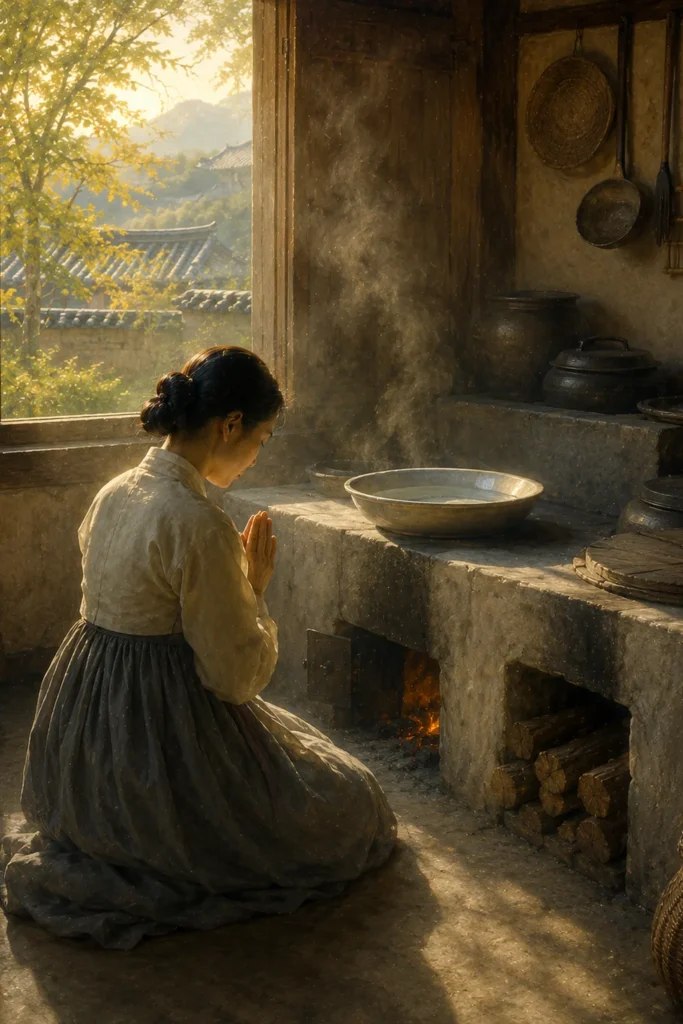
In mudang rituals (kut) Mago-halmi is invoked through dance and song. The shamaness embodies the goddess in order to ask for blessing for harvests and family prosperity. Offerings included grain, fruit and wine. Temples and shrines were widespread in the mountains, especially in spring regions (as a water-cult syncretism).
Invocations and Appeals
Classical invocations in mudang rituals run: “Mago-halmi, primordial mother of heaven, bless this family.” Shamans recited invocation chants that were embedded in the rhythms of the earth drums. One transmitted formula emphasizes her dual nature (Yin-Yang): “Great Mother, from you flows all life.”
Amulets and Protective Symbols
The symbol of the feminine spiral and of the earth (sanggeum sign) were worn as amulets. Women wore bands and cords furnished with knots, each knot a request to Mago-halmi. Harvest festivities were celebrated with ritual cloths and flower wreaths.
Jewish tradition: In Judaism there is no direct equivalent to Mago Halmi. The tradition knows the Shekhina (feminine presence of God), which in later mystical interpretations takes on a creative role, but remains not hypostatized as an independent goddess.
Kabbalah offers, with Binah (understanding/mother), a conceptual parallel to the primordial mother, but not as a cult figure.
Greco-Roman world: Gaia (Earth) and Rhea (mother of the Olympian gods) functionally correspond to Mago Halmi. Both are primordial sources from which other gods and being emerged.
Gaia in particular, as the primordial force of the earth and mother of all things, shows structural similarities. Their veneration, however, was more decentralized and less dogmatized than Mago Halmi’s modern cult form.
Mesopotamia: Tiamat in Babylonian mythology (Enuma Elish) is the primordial mother from whose body the world was created. She is a chaotic, primordial force, who is subdued and reorganized by the god Marduk. Mago Halmi differs through her benevolent nature, whereas Tiamat is ambivalent or destructive.
India/Asia: The Indian Prakriti (primordial matter) or Shakti (feminine energy) resemble Mago Halmi as a primordial feminine force.
In Daoism the Dao is the primordial mother or the primordial principle from which all things flow, a parallel to the cosmological function of Mago Halmi. In the Tibetan tradition there are similar primordial-mother aspects of the Absolute.
Mago Halmi as Primordial Creator of the Landscape
Mago Halmi, often rendered as “Grandmother Mago”, is in Korean tradition a giant female figure who shaped the landscape in primordial times.
She belongs to the widespread mythic type of the creator giantess, who brings forth the geography not through word or plan, but through her body and her everyday activities. Mountains arise where she heaps up earth, valleys where she digs, islands where earth falls from her apron.
The tradition is especially dense on the island of Jeju, where the creator giantess is usually called Seolmundae Halmang and is regarded as the shaper of the entire island; the central volcano Hallasan is connected with her.
On the mainland and in other regions, comparable giantesses appear under the name Mago Halmi or similar designations, to whom individual mountains, rock formations, passes and watercourses are attributed. The narratives are strongly bound to the respective local landscape and explain striking landforms.
Characteristic is the combination of immense size and familiar domesticity. Mago Halmi cooks, washes, weaves, eats and excretes, and it is precisely these everyday activities that have cosmic consequences. This mixture of sublimity and household economy distinguishes her from the distant, abstract creator deities of other traditions.
Scholarship assigns Mago Halmi to the widespread type of the “giantess as shaper of the landscape”, which is especially richly developed in Korea and which represents an old, popular layer of Korean mythology. Related creative female figures are found in the wider Korean tradition.
Regional Variants and the Binding to Concrete Places
Mago Halmi is not a unified figure of an all-Korean pantheon, but a figure that exists in numerous local variants.
Almost every region has its own tales of a giantess who shaped the local terrain, and the names vary: Seolmundae Halmang on Jeju, Mago Halmi or Mago Halmae in many mainland regions, alongside further local designations.
Whether this concerns an originally unified deity that diverged regionally, or various local giantesses who were only secondarily combined under the name Mago, is contested in scholarship.
The narratives follow recurring patterns. A frequent motif is that Mago Halmi wants to build something, such as a bridge to the mainland or a dam, and the work remains unfinished; the unfinished rock formation is then the visible proof.
Also widespread is the motif of her clothing: earth falls from her torn apron and forms hills and islands. Other tales report her enormous meals, of rocks that she used as cooking stones, or of depressions in the rock that are interpreted as her footprints.
This close binding to place is the essential feature of Mago Halmi. The myths are not abstract cosmogonies, but explanations for a particular piece of landscape known to the narrator and listener.
A striking rock, a gorge, a small island off the coast become charged with meaning through the narrative and are bound into a mythical past.
Scholarship speaks here of local legends or aetiological narratives. For an understanding of Mago Halmi it follows that she must not be treated as a single, clearly delineated goddess, but as a narrative motif fanned out into many local forms, which appears everywhere a landscape demanded an explanation.
The Problem of the Modern Mago Interpretation
In the late twentieth and the twenty-first century, the figure of Mago Halmi has become the object of its own, partly ideologically charged interpretive movement, which must be carefully distinguished from the transmitted folk tale.
In certain currents that appeal to a text called the Budoji, “Mago” is elevated to a cosmic primordial mother and creator goddess at the beginning of the world, to the ancestral mother of humanity or at least of the Korean people.
Caution is warranted here. The Budoji is a text whose age and authenticity are very contested in scholarship; many researchers consider it a creation of the twentieth century or at least heavily revised, and see it in the context of modern national-religious movements.
The notion, based on it, of a unified, high-ranking primordial goddess Mago is therefore not a secured tradition of traditional Korean religion, but a modern construction. Alongside this there is a feminist-motivated reception that seeks in Mago a pre-patriarchal mother goddess; it too works more with interpretation and appropriation than with secured source material.
For a serious account, this means a clear distinction. Documentable and well attested is the folkloristic Mago Halmi: the landscape-shaping giantess of the local legends, multiform, regional, bound to concrete landforms.
Not documentable in the same way is the notion of a unified cosmic primordial goddess Mago; she belongs to the domain of modern religious and cultural appropriation.
Both strands exist and both belong to the reception history of the name, but they have a very different source value. Whoever writes about Mago Halmi should place the well-attested folkloristic figure in the foreground and characterize the modern primordial-mother theory as what it is: an interpretation, not a tradition.
Sources and Literature
Further standard works in the literature index.