Hand of God: a Slavic protective sign and its modern form
By Ralf Ittermann · last reviewed on
Hand of God, in Polish Ręka Boga, denotes a Slavic protective sign. Its widespread present form, however, is largely a modern reconstruction. This page places the sign honestly between the evidence and its interpretation.
Assessment
Hand of God is a sign associated with the Slavic world. In Polish it bears the name Ręka Boga, which literally means Hand of God.
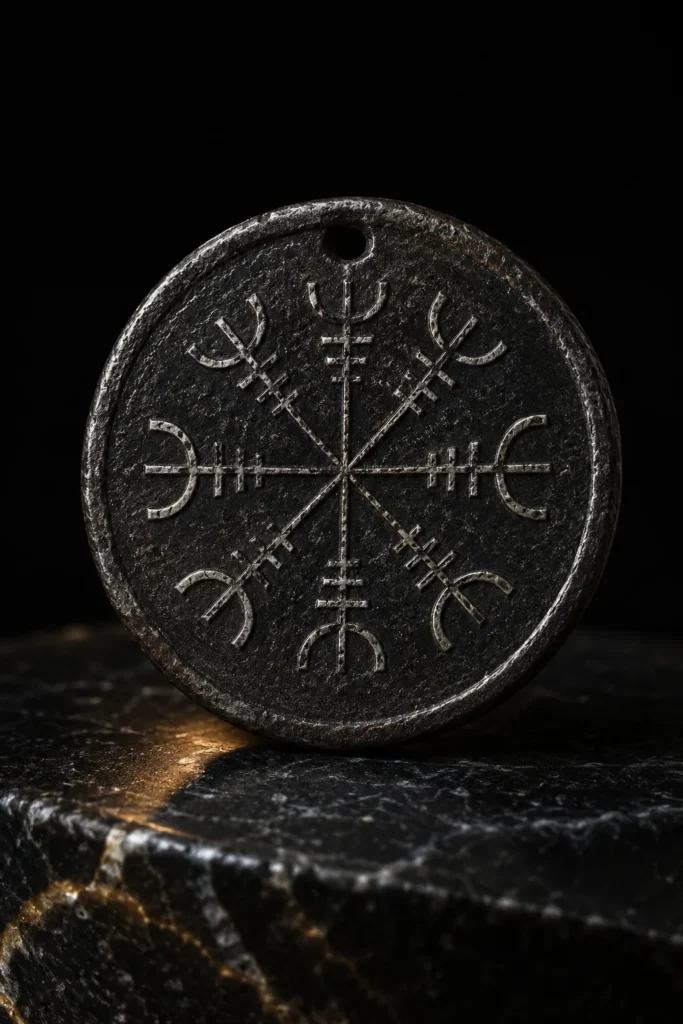
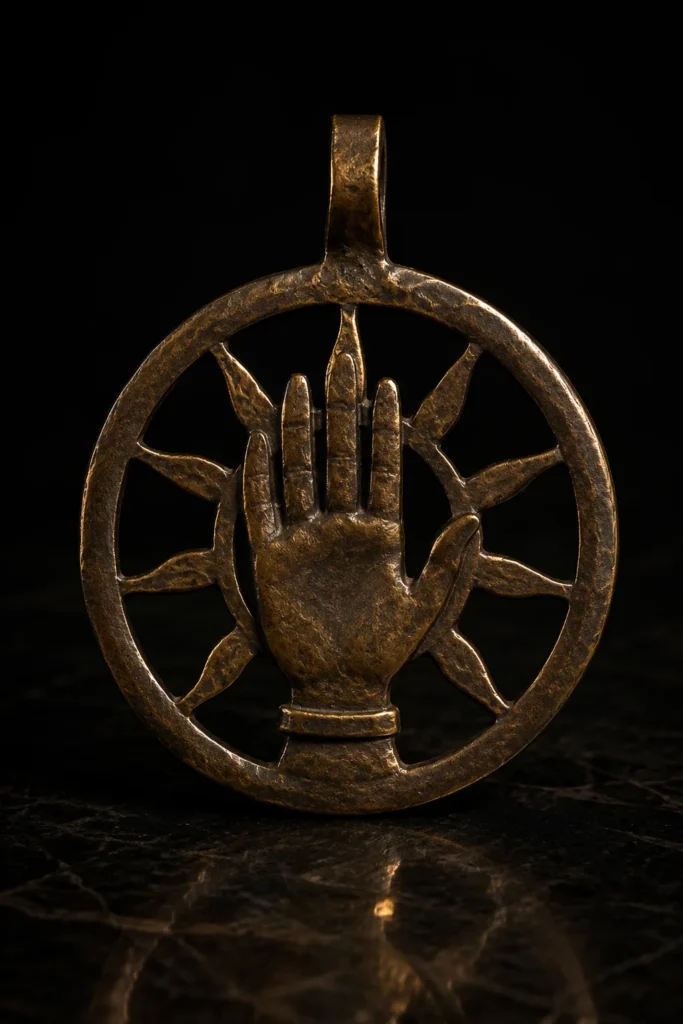
Today the sign is usually depicted as an abstract, geometric pattern. It shows an arrangement of lines that, in some versions, is meant to recall a hand or a tree.
Hand of God is understood as a protective sign. It is meant to place its bearer, or the place where it is affixed, under the protection of a supreme divine power.
With this sign, however, particular caution is warranted. Its widespread present form is largely a modern reconstruction. It cannot be derived seamlessly from old Slavic tradition.
In religious studies, Hand of God is therefore an instructive example. It shows how an apparently ancient sign can arise from individual old finds, modern interpretations, and modern movements.
This page presents Hand of God from the perspective of protection. It does so with explicit honesty and carefully distinguishes between what is documented and what is modern interpretation.
The problem of the tradition
To understand Hand of God, one must first be aware of the problem of the Slavic tradition. Little is known with certainty about the pre-Christian belief of the Slavs.
The pre-Christian Slavs left no written testimonies of their own about their belief. There are no texts from their own hand describing their gods, their signs, and their customs.
What is known comes secondhand. It consists of accounts by Christian writers, archaeological finds, and inferences drawn from later folk culture. Each of these sources is limited and must be read with caution.
For Slavic protective signs this poses a fundamental difficulty. Unlike the case of the ancient world, detailed descriptions are lacking. Much has to be inferred from a few finds.
This situation particularly affects Hand of God. A clearly transmitted old sign with this name and this fixed form cannot readily be documented from the sources.
An honest account must therefore begin with the problem of the tradition. The gaps in knowledge are not a side issue but the key to a correct understanding of this sign.
The archaeological evidence
The starting point for the Hand of God sign is an archaeological find. During excavations, objects bearing a particular pattern were recovered.
The sign is associated above all with a find from the area of an old Slavic fortified settlement. An object found there bears an incised geometric pattern.
This pattern is abstract. It consists of lines arranged in a particular relationship to one another. What meaning was attached to the arrangement does not emerge from the find itself.
The find thus initially documents only one thing: that such a pattern occurred in a Slavic context. About its meaning, its name, and its use, the object itself says nothing.
It is possible that the pattern carried a meaning, perhaps even a protective one. It is equally possible that it was a decorative mark or a mark of ownership. The find alone leaves these questions open.
The archaeological evidence is therefore slender. It documents a pattern, yet it provides neither the name Hand of God nor an established protective meaning. Both were added only later.
From interpretation to reconstruction
From the slender archaeological evidence, the present Hand of God sign arose through several steps of interpretation and reconstruction.
The first step was the interpretation of the pattern that had been found. Researchers and interpreters examined the abstract pattern and ascribed a meaning to it. This gave rise to the reading as a hand or as a divine sign.
The second step was the naming. The interpreted pattern was given the name Hand of God, Ręka Boga. This name expresses an interpretation; it is not transmitted from any old source.
The third step was the fixed design. The pattern was shaped into a clearly drawn, regular sign, as it appears today on jewelry and in depictions.
These steps are modern steps. They belong to the nineteenth and above all the twentieth and twenty-first centuries, not to the old Slavic world.
Hand of God in its present form is therefore a reconstruction. An old find forms the starting point, yet the finished, named, and interpreted sign is a modern work.
What is modern about the sign
It is helpful to state clearly which components of the Hand of God sign are modern. This allows the sign to be assessed honestly.
The name is modern. The designation Hand of God or Ręka Boga is a modern naming. It is not transmitted from any old Slavic source but expresses a later interpretation.
The fixed, regular form is modern. The clearly drawn, symmetrical sign as it is widespread today is a modern design. The old find shows a less regular pattern.
The interpretation is modern. Reading the sign as the hand of a supreme deity and as a protective sign is a modern interpretation. It rests on conjecture, not on transmitted statements.
The context in which the sign stands today is also modern. It is part of a modern revival of Slavic ideas that began in the twentieth century.
What is old, by contrast, is solely the archaeological evidence, the pattern that was found. Everything else, the name, the fixed form, the interpretation, and the present context, is modern.
Hand of God in the Neo-Slavic movement
The present context of the Hand of God sign is the Neo-Slavic movement. This is a modern current that seeks to revive old Slavic ideas.
This movement arose in the twentieth century and has continued to develop since then. It seeks to take up pre-Christian Slavic belief and give it a present-day form.
Such a revival faces a fundamental difficulty. Since the old tradition is fragmentary, the movement has to supplement, interpret, and newly shape much of it.
Signs such as Hand of God play an important role in this movement. They give the current visible symbols. Hand of God has become one of the best known of these signs.
It is important to see that this movement has not only transmitted the signs but also helped to shape them. The fixed form and the interpretation of Hand of God arose in this context.
Hand of God is therefore closely connected with the Neo-Slavic movement. It is less a testimony of the old Slavic world than a sign of the modern engagement with that world.
Hand of God and other Slavic signs
Hand of God does not stand alone. It belongs to a series of signs that are widespread today as Slavic signs of protection and belief.
Related is the sun wheel, the Kolovrat, a wheel-shaped sign associated with the sun and with the course of the year. It is presented on the page on the Kolovrat.
Also related are the thunder marks, wheel-shaped or star-shaped patterns associated with the thunder god and treated on the page on the thunder marks.
With many of these signs the same question arises as with Hand of God. How much of their present form is old, and how much is modern interpretation and reconstruction?
The answer turns out differently from sign to sign. Some signs have a broader basis in the old tradition; others, like Hand of God, are in their present form more strongly shaped by the modern era.
Within the Slavic signs, Hand of God is thus an example of the case in which the modern shaping is particularly strong. It therefore calls for a particularly careful and honest assessment.
Why an honest assessment matters
It is important to explain why an honest assessment of the Hand of God sign is necessary and may not be treated as a minor matter.
Signs such as Hand of God are often presented today as very ancient. Anyone who looks at them is meant to gain the impression of seeing an unchanged heritage of the old Slavic world.
This impression is misleading. It conceals the modern steps of interpretation, naming, and design. It turns a modern reconstruction into an apparently old testimony.
A factual account must correct this impression. It does so not in order to devalue the sign but in order to understand it correctly. A modern reconstruction is nothing lesser; it is simply something other than an old testimony.
Honesty thus serves understanding. It shows Hand of God for what it is: a sign of the modern engagement with the Slavic world that takes an old find as its starting point.
Hand of God is therefore an instructive example. It shows that the question of the age of a sign must always be asked, and that an honest answer serves understanding.
Reception today
Hand of God is today a widespread sign, especially in the Polish-speaking region and among those who take an interest in the Slavic world.
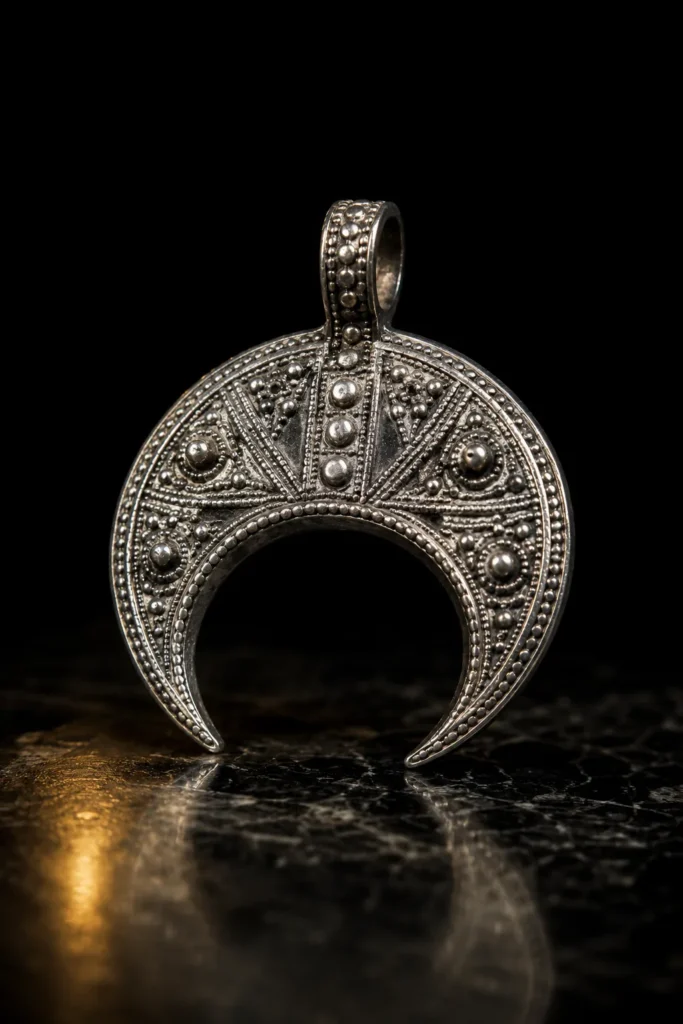
The sign is worn as jewelry. Pendants and other pieces of jewelry bearing the Hand of God pattern are made and worn as signs of protection and belief.
Within the Neo-Slavic movement, Hand of God has a firm place. There it is a sign of belonging and of connection to the revived Slavic ideas.
Beyond these circles, the sign has become known as a general Slavic protective sign. Many people wear it without raising the question of its age.
For religious studies, Hand of God remains an instructive subject. It shows how an apparently ancient sign arises from a find, an interpretation, and a modern movement.
Hand of God is therefore an example that should be named honestly. It is a Slavic protective sign, yet in its present form a largely modern reconstruction that takes an old find as its starting point.
Literature (selection)
Related key terms: Hand of God Ręka Boga Slavic protective sign reconstruction Neo-Slavic movement archaeological evidence tradition interpretation.
iWell Guard and protective traditions
iWell Guard stands within the cultural-historical line of wearable protective objects, to which Hand of God also belongs. A modern companion for people who live with protective symbols: made in Germany, 41 layers of solid gold, platinum, and silver, with a 30-day right of return.
Personal experiences may vary. Not a medical device. No promise of healing.