Protection knot: the blessed cord of Tibetan Buddhism
By Ralf Ittermann · last reviewed on
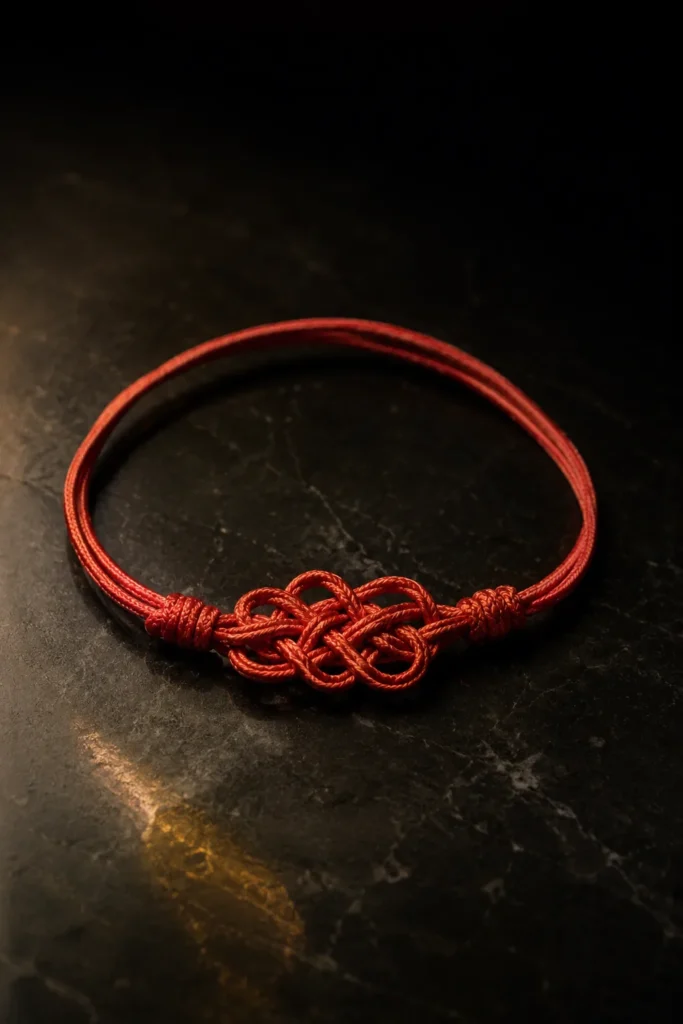
The Tibetan protection knot is a knotted cord that is blessed by a lama. The Tibetan name is Srung-mdud, which means something like protection knot. The blessed cord is worn around the neck or around the wrist and is regarded as a carrier of the blessing and as a means of protection.
Classification
The protection knot is a knotted cord from the Buddhist world of Tibet. Its Tibetan name is Srung-mdud, which means something like protection knot.
It is a cord or a band into which one or more knots are tied. The cord is worn around the neck, around the arm or around the wrist.
What is essential about the protection knot is not the material, but the blessing. The cord is blessed by a lama, that is, by a spiritual teacher, before it is worn.
Through this blessing the simple cord becomes an object of protection. It is then regarded as a carrier of the blessing that the lama has placed upon it.
The protection knot is widespread in Tibetan Buddhism. It is passed on to the faithful during blessing rites, during teachings and on important occasions.
In religious studies the protection knot is a good example of an object of protection whose effect depends on the blessing. It is not the material but the act of blessing that makes the cord a means of protection.
Origin and background
The protection knot joins two old ideas, the idea of the knot and the idea of the blessing. Both reach far back.
The knot is an old and widespread motif. In many cultures the knot is regarded as a means of binding something, holding it fast and thereby securing it or warding it off.
The idea of the blessing belongs to the core of religious practice. A blessing is a spiritual act of favor that bestows good and protection upon a person or an object.
Tibetan Buddhism joins both strands. A knotted cord is connected with the blessing of a teacher, and from this connection the protection knot arises.
In the older religious world of Tibet before Buddhism, ideas of binding and protecting are likewise known. The Buddhist protection knot thus stands on a broad foundation.
The origin of the protection knot therefore shows an interplay. The old motif of the binding knot and the religious idea of the blessing meet in the blessed cord.
The knot as a sign
With the protection knot the knot is not a mere accident of manufacture, but a meaningful sign. The tying itself carries a sense.
A knot binds and holds fast. In the knot something is, as it were, grasped and secured. This quality makes the knot an image of holding fast and of preserving.
With the protection knot the blessing is, as it were, tied into the knot. During the blessing rite the lama speaks prayers and mantras, and the knot holds this blessing fast.
The knot is thus a container of the blessing. As a vessel holds a content, so the tied knot holds the blessing that was spoken over it at its consecration.
At the same time the knot stands for protection in the sense of binding. Harmful influences are, as it were, to be bound and kept away, as the knot holds a band fast.
The knot thus joins two meanings. It is a container that holds the blessing fast, and a sign of binding that is meant to ward off what is harmful. Both meanings work together in the protection knot.
The knot in Tibetan Buddhism
The knot motif is significant in Tibetan Buddhism in several places. The protection knot therefore does not stand alone, but within a larger context.
The best-known knot sign of Buddhism is the endless knot. It is one of the eight auspicious symbols and stands for the interconnection of all things and for endless wisdom.
On the page about the endless knot this sign is presented in detail. The endless knot is a painted or designed emblem.
The protection knot is to be distinguished from it. It is not an emblem, but a real, knotted and blessed object that is worn.
Both, however, belong to the same world of knot motifs. The endless knot as an emblem and the protection knot as a worn object show how significant the knot is in Tibetan Buddhism.
The protection knot is thus the worn, blessed expression of the knot motif. While the endless knot is a teaching sign, the protection knot is a personal object of protection.
The blessing rite of the lama
What is decisive about the protection knot is the blessing rite. Without the blessing of a lama, the knotted cord would not be an object of protection, but merely a band.
The lama is a trained spiritual teacher. He has undergone an education and is authorized to perform blessing rites and to give teachings.
At the consecration of the protection knot the lama speaks prayers and mantras over the cord. Often he ties the knot himself or completes it during the blessing rite.
Through this act the blessing is transferred onto the cord. The protection knot is then regarded as a carrier of the blessing that the lama has spoken.
Protection knots are often passed on at special occasions, for example after a teaching, at a consecration of many people or as a gift to visitors.
The blessing rite thus makes the protection knot what it is. It transforms the cord into an object of protection and connects it with the lama who blessed it.
Wearing and use of the protection knot
The protection knot is worn, and in the wearing its sense unfolds. It is worn close to the body and accompanies the person through everyday life.
Common is wearing it around the neck. The blessed cord is placed like a necklace, sometimes together with a pendant or a small amulet case.
Equally common is wearing it around the wrist or around the upper arm. As a knotted band around the wrist, the protection knot is a constant, unobtrusive companion.
The protection knot is often worn until it comes loose by itself or wears out. Its coming loose is sometimes interpreted to mean that it has fulfilled its task.
With a worn protection knot are associated respect and careful handling. As a blessed object it is not treated carelessly and not simply thrown away.
The use of the protection knot thus shows that it is a personal, worn object of protection. It accompanies a single person and is connected with the blessing that it received for that person.
The working principle of blessed protection
The protection knot follows a working principle of its own. It does not ward off through a frightening image and bears no written formula. It works through the blessing.
According to Buddhist understanding, the knot is connected through the blessing rite with a spiritual power. The blessing of the lama, supported by prayer and mantra, is, as it were, tied into the knot.
The protection therefore does not lie in the material of the cord and not in the form of the knot in itself. It lies in the blessing that was spoken over the cord.
This distinction is important. The protection knot is not powerful in and of itself. Its significance depends on the spiritual act that made it an object of protection.
Thus the protection knot also depends on the trust and the practice of the one who wears it. It is a sign of the connection to the lama and to the teaching to which the wearer holds.
The protection knot is thus a good example of protection through blessing. Not a material and not an image, but a spiritual act gives the simple cord its meaning.
Blessed cords across the cultures
The protection knot can be considered within the larger context of blessed cords and bands. Such protective bands are known in many cultures.
In the Indian world, blessed threads and bands are widespread, which are tied around the wrist during religious rites and are meant to grant protection and blessing.
In other religions and folk traditions as well, knotted or blessed cords are known as means of protection. They are tied around the arm, around the neck or around a child’s cradle.
All these protective bands rest on a similar idea. A simple band becomes an object of protection through a religious act, through a blessing or through the tying.
The Tibetan protection knot is the Buddhist expression of this widespread idea. Its distinctive feature is the blessing rite by the lama, which binds it firmly into Tibetan Buddhism.
The protection knot thus shows that the idea of the blessed cord has been understood across the cultures. The blessed or knotted band is a means of protection that is widespread worldwide.
Reception today
In Tibetan Buddhism the protection knot is to this day a living and a widespread object of protection. It is blessed and worn unchanged.
At teachings, at blessings and on important occasions, protection knots are passed on to the faithful. In the lands of Tibetan Buddhism they are a familiar sight.
Beyond the Buddhist world, the protection knot has also become known in the West along with the interest in Tibetan Buddhism. Whoever attends a teaching sometimes receives a blessed cord.
In this wider dissemination the protection knot may be worn as a keepsake and as an ornament. The exact meaning of the blessing rite then sometimes recedes into the background.
At its core, however, the protection knot remains what it always was, a knotted cord that, through the blessing of a lama, becomes a carrier of the blessing and a means of protection.
The protection knot is thus a striking example of an object of protection that depends on the blessing. In it the old motif of the binding knot and the spiritual act of blessing are joined.
Literature (selection)
Related key terms: protection knot Srung-mdud blessed cord lama Tibet Tibetan Buddhism blessing knot.
iWell Guard and protective traditions
iWell Guard stands in the cultural-historical line of wearable protective objects, to which the protection knot also belongs. A modern companion for people who live with protective symbols: made in Germany, 41 layers of solid gold, platinum and silver, with a 30-day right of return.
Personal experiences may vary. Not a medical device. No healing promise.