The Rowan: Protective Tree and Wood of European Folk Magic
By Ralf Ittermann · last reviewed on
The rowan, also called mountain ash, was regarded in European folk magic as a protective tree. Its wood, its twigs and its bright red berries were credited with a warding power against witchcraft, lightning and harmful magic.
In Central and Northern Europe in particular, the tree was bound up with numerous protective customs. In folkloric terms, the rowan belongs to the protective plants of popular piety. This article presents the origin, custom and interpretation of the protective tree.
Classification
The rowan, botanically Sorbus aucuparia, is a deciduous tree widespread across Europe. In folk magic it was regarded as one of the most important protective trees. It was credited with the power to keep witchcraft, lightning and harmful forces at bay.
The tree bears numerous popular names. Common ones are mountain ash, witch tree, quickbeam and dogberry. The name mountain ash refers to the resemblance of its leaves to those of the ash, while the name witch tree points to its attributed protective function against the night-hag.
In folkloric terms, the rowan belongs to the protective plants, a group of trees and herbs that were credited with warding power. It thus stands in a line with elder, juniper and hazel.
Unlike manufactured protective symbols, the rowan was a living form of protection. The whole tree, individual twigs, the wood and the berries could be used depending on the custom.
The protective meaning was distributed across various parts of the plant. The wood served to make tools and staffs, the twigs to be fixed to house and stable, the red berries as ornament and means of defence.
It should be stressed that the protective effect of the rowan describes a historical belief. The tree is a folkloric testimony, not an effective means of protection in the scientific sense. No healing promises are associated with it.
Origin and History
The rowan grows over almost all of Europe, from the lowlands up into the mountains. Its wide distribution and its conspicuousness through the red berries made it early on a tree that played a special role in popular belief.
Even in pre-Christian times the tree is likely to have had cultic significance, although the source material here is thin. In Norse tradition the rowan appears in connection with the god Thor, which points to an old esteem.
Reliable evidence for the protective customs comes from the Middle Ages and the Early Modern period. In this time the belief in witchcraft was widespread, and the rowan was regarded as a proven means of defence against harmful forces.
The folkloric collections of the nineteenth century document the rowan customs densely. They show that the tree was associated with similar protective ideas in Germany, England, Scandinavia and the Baltic region.
The custom persisted for a long time, especially in rural areas. As late as the nineteenth and, in isolated cases, the twentieth century, rowan twigs were fixed to stables and houses as protection, above all on Walpurgis Night.
The history of the rowan as a protective tree shows a long continuity. It can be traced from the presumed pre-Christian cult tree, through the means of defence of the Early Modern period, to the documented custom of the nineteenth century.
In Anglo-Saxon and Norse tradition, the rowan also appears in the narrative that the tree gave the god Thor a hold while crossing a rushing river.
Such narrative motifs can be grasped only in medieval records and allow no firm conclusions about a pre-Christian cult, but they do show the old connection of the tree with the idea of protection and firmness.
Form, Material and Manufacture
The rowan is a small to medium-sized deciduous tree with pinnate leaves. Striking are the bright red berries that hang in dense clusters in autumn. These red berries play an important role in folk magic.
Various parts of the tree were used. Fresh twigs with leaves and berries served to be fixed in place. They were cut at particular times and attached to doors, windows and stable posts.
The wood of the rowan is tough and elastic. It was worked into tool handles, walking and shepherd’s staffs, whip handles and small implements. Such implements made of rowan wood were credited with a protective quality.
Chains could be threaded from the berries. Strings of red rowan berries were worn as ornament or hung up in the house. The strong red colour was regarded as significant in this.
A special manufacture in the ritual sense was usually not required. Important, however, was the right moment of cutting. Some customs prescribed gathering the twigs on particular days or without iron tools.
The location of the tree also had significance. A rowan growing on a rock or in the fork of another tree, that is, not rooted in the ground, was regarded as especially powerful. Such trees were called flying rowans.
In some places the mountain ash was also regarded as a weather tree, whose set of berries was thought to allow conclusions about the coming winter. According to this belief, a richly bearing tree announced a hard, snow-rich season.
This weather rule has at first nothing to do with the warding function, but it shows how closely the rowan was bound up with rural life as a whole.
Folkloric Background and Beliefs
Underlying the rowan was the idea that certain trees possessed a protective power opposed to witchcraft. The rowan was regarded as one of the most effective of these trees.
The red colour of the berries played a central role. Red was widely regarded in European folk magic as a warding colour that was meant to keep harmful forces and the evil eye at bay. The red rowan berries embodied this protective colour in nature.
The tree was used against various threats. It was meant to ward off witches and their harmful magic, to prevent nightmares and to guard people and livestock against the evil eye. This bundling of functions is typical of protective plants.
Against lightning, too, the rowan was regarded as protection. In this respect it stood in competition and connection with other trees to which lightning protection was attributed. The Norse reference to the thunder god Thor resonates here.
The special esteem for the flying rowan, that is, the tree not rooted in the ground, is explained by a widespread logic of folk magic. What had grown in an unusual way and seemed to stand against the natural order was regarded as especially powerful.
The rowan thus combined several ideas. It was a warding tree against witchcraft, protection against lightning and bearer of the significant red colour. This wealth of meaning made it one of the most important trees of folk magic.
With regard to the harming gaze there was the idea that a person or an animal carrying a rowan twig was withdrawn from the evil eye.
According to this logic, the twig drew the harmful attention onto itself, much like a conspicuous amulet, and thus protected the actual bearer. This idea linked the protective tree with the wide field of warding off the evil eye.
Use and Custom
A widespread custom was the fixing of rowan twigs to house and stable. Especially around Walpurgis Night, when witches were believed to be particularly active, fresh twigs were attached to doors and stable posts.
In the stable the rowan was meant to protect the livestock. Twigs were placed above the stable doors or set inside the stable in order to guard horses and cattle from illness, nightmares and bewitchment.
Implements and staffs of rowan wood had a significance of their own. A shepherd’s staff of rowan wood was meant to protect the herd, a whip handle the draught animals. Churn staffs and stirring implements of this wood were also regarded as advantageous.
At doors and thresholds the rowan was used much like other building protections. A twig wedged in or a piece of wood at the threshold was meant to prevent the entry of harmful forces.
The red berries were threaded into chains and hung around children or animals. These strings of berries combined the protection of the tree with the warding effect of the red colour.
The custom was simple to carry out and tied to no particular person. Every household could cut twigs and fix them in place. This low threshold contributed to the wide spread of the rowan customs.
Also widespread was the custom of churning freshly drawn butter with a churn staff of rowan wood. If the churning failed, this was often interpreted as the work of a witch who had drawn the power from the milk.
A stirring implement of the protective wood was meant to forestall such harmful magic and to secure the success of the work.
Regional Variants and Related Forms
The rowan customs differ by region. In Northern Germany and the Baltic region the emphasis lay on the protection of livestock through fixed twigs. In the low mountain ranges the protection against witches and nightmares was more strongly stressed.
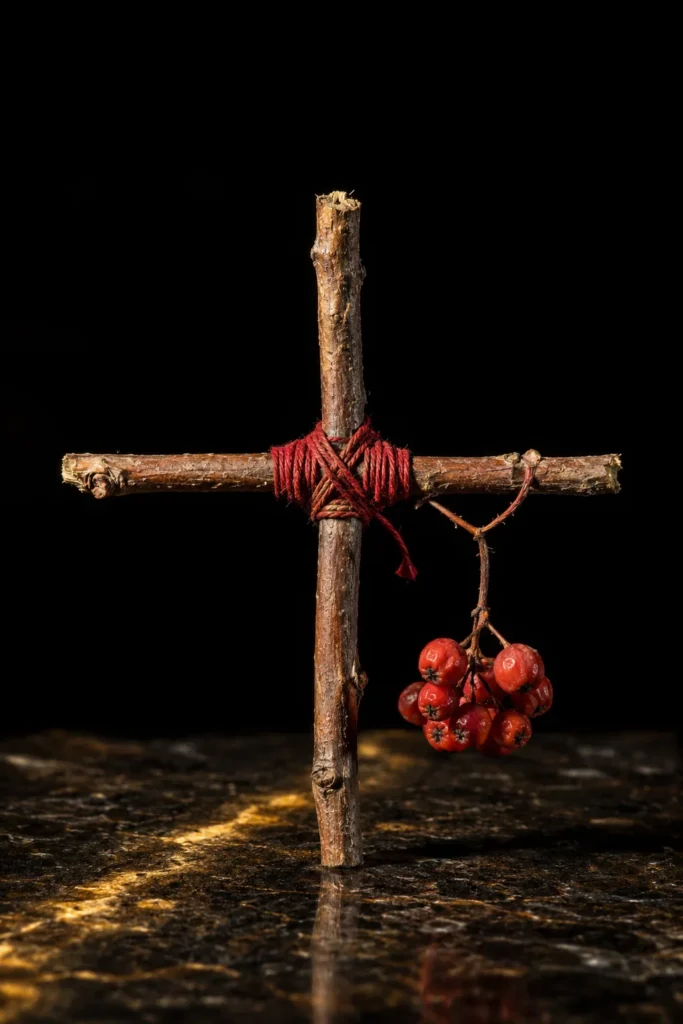
In Scotland and Ireland the rowan, there called rowan, was regarded as an especially powerful protective tree. Crosses bound from two rowan twigs and held together with red thread were a widespread means of defence.
In Scandinavia the rowan was closely bound up with the protection of house and farm. There, too, the flying rowan, the tree growing on other trees, played a special role.
The rowan is related to other protective plants of European folk magic. Elder was regarded as a house tree and protection, juniper as a cleansing incense wood, hazel as a rod with special power.
Like the hag stone, the rowan belongs to the natural objects whose protective power was derived not from human manufacture but from the plant itself. Both stand for a protective magic that draws on nature.
Despite regional differences, a common pattern emerges. Everywhere the red berries are regarded as significant, everywhere the protection is directed against witchcraft and nightmares, and everywhere the tree has a firm place in the protection of house and livestock.
In Wales rowan wood was used for the handles of divining rods and for spindle whorls, and at some churchyards the tree was planted deliberately to secure the rest of the dead.
This use close to the church shows that the rowan, like other protective plants, was employed without contradiction between the folk-magical and the Christian sphere.
Significance as a Means of Protection
The protective significance of the rowan rests on the combination of several ideas. The tree was regarded as opposed by nature to witchcraft, and its red berries bore the warding protective colour.
The protection of livestock played a central role. Since cattle diseases were often interpreted as the consequence of harmful magic, a means of defence believed to be effective was of great importance for the rural economy. The rowan met this expectation.
The protection of the house complemented the protection of livestock. Twigs fixed to doors and windows were meant to secure the whole property against the entry of harmful forces, much like incised warding signs.
The attributed lightning protection extended the protective function to a natural danger. In a time without technical lightning protection, the belief in a lightning-warding tree was of considerable importance for people.
For people the value of the rowan lay in its availability. The tree grew almost everywhere, and its twigs could be cut at no cost. Protection was thus within reach for every household.
It remains to be noted that this protective significance reflects historical beliefs. A real warding off of illness, harmful magic or lightning is not associated with the rowan. Its value lies in the cultural-historical statement about past thinking.
Source Situation and History of Research
The source situation regarding the rowan as a protective tree is dense for the Early Modern period and the nineteenth century, but patchy for older epochs. Much about the pre-Christian period remains conjecture.
For the Norse tradition, the medieval Icelandic writings provide indications of the significance of the rowan in connection with the god Thor. These pieces of evidence are, however, sparse and to be interpreted with caution.
The most important basis is formed by the folkloric collections of the nineteenth and early twentieth centuries. Through surveys, researchers gathered a dense body of material on customs that shows the regional diversity of the rowan customs.
The Concise Dictionary of German Superstition offers a detailed entry on the rowan. It orders the customs systematically and links them with the ideas of witchcraft, nightmares and protective colour.
A methodological difficulty lies in inferring a pre-Christian cult significance from more recent customs. Research here urges caution, since later customs may not be projected back into the distant past without further ado.
The history of research shows that the rowan belongs to the best-documented protective trees of Europe. Folkloric collecting activity has made its manifold role in folk magic comprehensively visible.
A recurring problem of research is the confusion of the rowan with other trees in older texts. The popular names are not unambiguous, and terms such as quickbeam or witch tree were used differently from region to region. Determining exactly which tree is meant in a source therefore requires comparison with regional usage.
Reception Today
The rowan is today known above all as an ornamental and bird-protection shrub. Its red berries are an important food source for birds, which makes it popular for nature-oriented gardens.
In modern natural medicine and esotericism, the rowan is occasionally taken up as a protective tree. Guidebook literature describes it as a tree with warding power. These accounts tie in with the old ideas, but are to be distinguished from the historical tradition.
In the cultivation of customs and in local history, the knowledge of the rowan as a protective tree lives on. In the conveying of regional folk culture, the tree and its old custom are explained.
In Celtic-inspired modern paganism the rowan plays a role under the name rowan. There it is interpreted as a protective tree, whereby historical tradition and modern reinterpretation become mixed.
Those interested in the historical background will find reliable information in folkloric accounts and in the overview of the protective symbols. Esoteric guidebooks often render the historical context only in abridged form.
The reception today thus shows two strands. The rowan is a valued natural shrub, and it lives on as a protective tree in the cultivation of customs and in modern paganism, there however in a reinterpreted form.
Literature (Selection)
Related key terms: mountain ash Sorbus aucuparia protective tree witch tree rowan Walpurgis Night witch defence flying rowan protective wood livestock protection lightning protection.
iWell Guard and Protective Traditions
iWell Guard stands in the cultural-historical line of portable protective objects, to which the rowan also belongs. A modern companion for people who live with protective symbols: made in Germany, 41 layers of solid gold, platinum and silver, with a 30-day right of return.
Personal experiences may vary. Not a medical device. No healing promise.