Dakuwaqa, the vanquished shark of Kadavu
By Ralf Ittermann · last reviewed on
Dakuwaqa is a god of Melanesian tradition.
The shark god who became a reef guardian after his defeat. According to tradition, the subdued shark changed from attacker to guardian of the reefs of Kadavu.
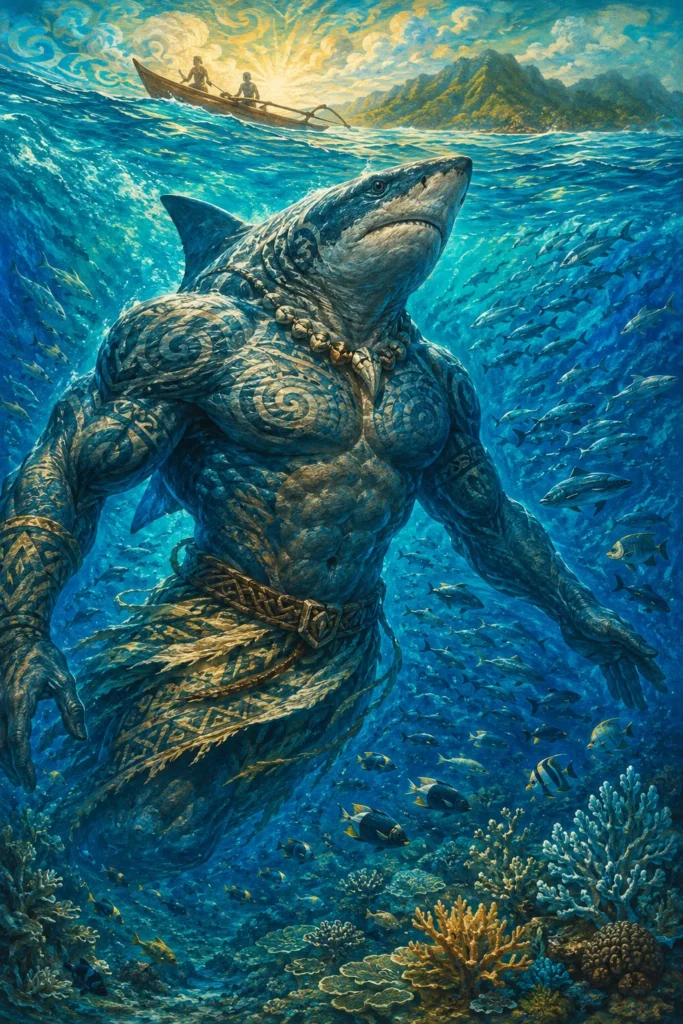
Dakuwaqa is the shark god of the Fiji Islands, protector of fishermen and guardian of the reefs of Kadavu, ever since the goddess Rokobakaniceva once vanquished him.
Type: Shark god, protector of fishermen
Origin: iTaukei tradition, Fiji
Texts: Williams (Fiji and the Fijians), Thomson (The Fijians)
Period: oral, still alive today
Appearance: shape-shifter with a shark’s upper body
Source Context
Period of the Texts
Passed down orally by the iTaukei, recorded ethnographically only late.
Area of Diffusion
Fiji, with a focus on Kadavu, whose reefs he is said to guard.
Sources
Reliability: Williams and Thomson are solid; the octopus legend is above all passed on as popular tradition.
Name and variants
Fijian: Dakuwaqa, also Dakuwanga, popularly derived from daku, back, and waqa, canoe; this is not confirmed.
Appearance and Behaviour
Appearance
A muscular Fijian man with a shark’s upper body, otherwise a shape-shifter in fish or human form.
Effect
Protector of fishermen, formerly a threatening attacker.
Profile: Dakuwaqa
The shark god at a glance.
Oral folk tradition of the iTaukei, tied to Kadavu.
Fishermen and seafarers who seek his favour before setting out.
A muscular man with a shark’s upper body, as a shape-shifter also in fish form.
Guardian of the reefs, though once an attacker threatening the island.
Kava libations into the sea, fish-head offerings and prayers before setting out.
Related is the Hawaiian Kāmohoaliʻi, and similarly the New Zealand Taniwha.
The battle against the octopus of Kadavu
The legend tells how Rokobakaniceva, as an octopus, held the attacking Dakuwaqa fast with eight arms, pulled out his teeth and forced him to vow never to attack Kadavu again. Since then he has been its protective god and the reason for the fishermen’s taboos.
National symbol and ecological narrative
Dakuwaqa is part of Fijian identity, present in tourism and increasingly read as an ecological narrative about humans and the sea. In religious studies he is a protective and ancestral deity whose legend underlies the region’s protected status.
Kava offerings for the shark god
Attested is the libation of kava, the yaqona, into the sea before setting out, along with fish-head offerings and prayers. Amulet, holy water and salt are considered protection at sea.
Shark deities in the Pacific
A counterpart is the Hawaiian Kāmohoaliʻi, likewise a protector and shape-shifter, similar to the New Zealand Taniwha, and further to the Japanese Ebisu and Greek Poseidon.
Frequently asked questions about Dakuwaqa
Is Dakuwaqa evil or good?
Originally an attacker, after his defeat the protective god of Kadavu.
How does one protect oneself at sea?
Through kava offerings and prayers before setting out.
Further links
Further reading:
Literature (selection)
More in the bibliography.
Known as Dakuwaqa, the shark god of the Fiji Islands, he remains the Fijian sea god who turned from attacker into protector of the reefs.