Roane, the Good-Natured Seal Soul of the Gaelic Highlands
By Ralf Ittermann · last reviewed on
Roane is a spirit of Gaelic tradition.
A gentle seal person who never takes revenge on hunters. The entry describes this seal folk as a gentle Soul of the Gaelic Highlands who never takes revenge on hunters.
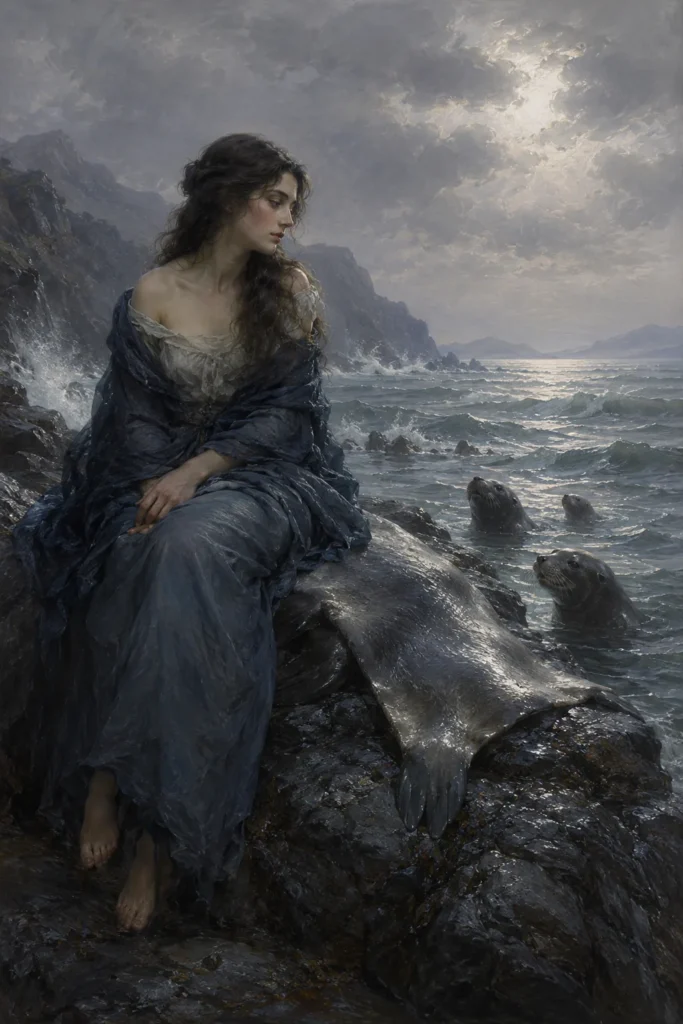
Roane are the seal people of Gaelic-Irish folklore: seals in the sea, beautiful humans on land after shedding their skin. Unlike other water beings, they never take revenge.
Whoever hides the skin binds the Roane until she finds it again.
Type: seal person, revenge-free variant
Origin: Gaelic-Irish folklore of the Highlands
Texts: oral, collected in the 20th century
Period: ancient, documented since the 20th century
Appearance: seal in the sea, beautiful human on land
Region of Origin and Sources
Period of the Texts
Ancient, yet only systematically recorded in the 20th century.
Area of Diffusion
The Scottish Highlands and islands, Orkney, Shetland and Ireland, with parallels in the Faroe Islands.
Sources
Good: standard works by Briggs, Thomson and Marwick.
Name and variants
Old Irish: Roane derives from the Old Irish word for seal, literally seal being.
Form and Effect
Appearance
Barely distinguishable from seals; on land the skin turns her into a beautiful human.
Effect
Roane drowns no one; her defining image is the seal bride: bound by the hiding of the skin, released by finding it again.
Profile: Roane
The key features of the Roane at a glance.
Gaelic-Irish folklore, the gentlest variant of the seal people.
Seal hunters and coastal dwellers of the Gaelic Highlands.
Large seal in the sea, beautiful, melancholic human on land.
Tragic seal-bride legend, no revenge, no threat.
Do not kill seals; the skin determines the bond.
The Seal-Skin Motif of the Gaelic Highlands
Roane literally means seal being, from the Old Irish word for seal: the gentlest of the fairy beings, good-natured enough not to take revenge on seal killers. If the skin is hidden, she must stay with the finder until she finds it again.
Preserved by 20th-Century Folklorists
Briggs, Thomson and Marwick collected the Roane legends of the Highlands.
From a religious-studies perspective, she is a fairy being, not a god. Important clarification: the danger does not come from the Roane, but from the human who steals her skin.
No Warding Spell, but Respect for the Seal
Protection from the Roane is not necessary, as she is considered harmless; possessing the skin keeps her on land. Nonetheless, people wore an amulet as a sign of mindful conduct, scattered salt and trusted in consecrated bells.
Selkie, Merrow and the Celtic Water World
Roane is the mildest variant within the circle of the Selkie, whose legends also know revenge. Related are the Irish Merrow and the Breton Marie Morgane, without the skin motif.
Frequently Asked Questions about the Roane
What distinguishes Roane from Selkie?
Roane is the Gaelic name for the revenge-free type.
Are Roane dangerous?
No, the danger comes from the human who steals her skin.
Literature (selection)
More in the bibliography.
As the seal folk of the Gaelic Highlands, the Roane remain the most conciliatory figure of the water world: a Selkie of Gaelic character who never takes revenge.