Zana, the warlike fairy of the Albanian mountains
By Ralf Ittermann · last reviewed on
Zana is a spirit of Albanian tradition.
The wild mountain fairy who strengthens heroes and can turn them to stone. Zana is a central figure of Albanian legend, dwelling among the mountains.
Zana, or in full zana, is an Albanian mountain fairy and mountain goddess: a wild, beautiful mountain nymph bound to chamois and springs. She is warlike and territorial, strengthens heroes such as Muji in the heroic epic, and can turn people to stone.
She is documented in writing chiefly in the northern Albanian heroic epic Kângë Kreshnikësh and in folk tradition, collected in the 19th and 20th centuries. Her double nature determines how people relate to her: helpful towards respected heroes, but swiftly deadly when boundaries are violated.
Type: mountain fairy and mountain nymph of Albanian mythology
Origin: Albanian-speaking regions, especially northern Albania
Texts: heroic epic Kângë Kreshnikësh, folk tradition
Period: folk tradition, collected in the 19th and 20th centuries
Appearance: wild, beautiful mountain nymph with long hair

Textual history
Period of the Texts
Zana belongs to Albanian folk tradition and the heroic epic; this tradition was collected and written down in the 19th and 20th centuries.
Area of Diffusion
The Albanian-speaking regions, especially northern Albania: the mountain regions, springs and mountain meadows to which Zana is bound.
Sources
The source material is good: Robert Elsie’s dictionary of Albanian religion and folk culture, together with the northern Albanian Kângë epic, form the basis.
Name and variants
Albanian: zanë, southern Albanian zërë, is of pre-Roman, Paleo-Balkan origin and is linguistically regarded as related to Latin Diāna. Zana e malit means fairy of the mountain; the great Zana, Zana e Madhe, is considered a possible Illyrian goddess and counterpart to Artemis and Diana.
Appearance and effect
Appearance
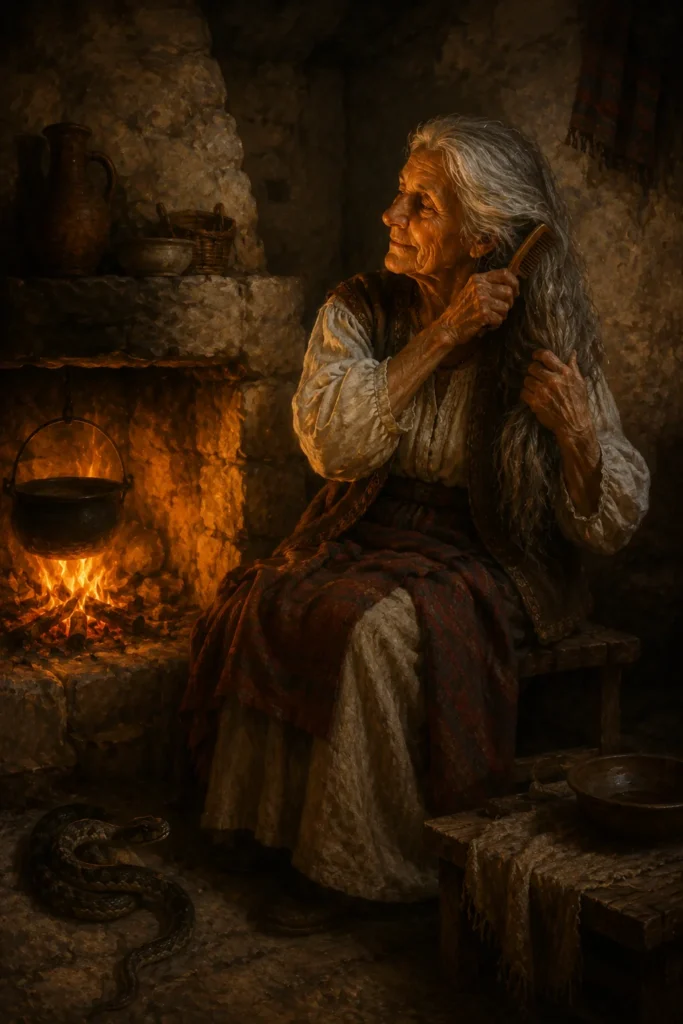
Zana is a wild, beautiful mountain nymph with long, flowing hair, athletic, bound to chamois, wild game, springs and mountain meadows. Her gaze can paralyse or turn a person to stone. She often appears as a triad, related to the Orë, who determines a child’s fate at birth.
Effect
Zana is warlike and territorial and protects her domain. She strengthens heroes: in the epic she grants the hero Muji superhuman strength through her milk. Whoever surprises her while bathing or damages her territory risks being turned to stone.
Profile: Zana
The key aspects of the mountain fairy at a glance.
Albanian folk mythology with a possible Illyrian background: Zana e Madhe is considered a possible Illyrian goddess and counterpart to Artemis and Diana.
Heroes, hunters and mountain regions: Zana watches over her domain of chamois, wild game, springs and mountain meadows and intervenes in the lives of heroes.
Wild, beautiful mountain nymph with long, flowing hair, athletic; her gaze can paralyse or turn a person to stone, and she often appears as a triad.
Protection of her own domain, strengthening of respected heroes through her milk, petrification for boundary violations: helpful and dangerous at the same time.
No ancient temple cult is documented; what survives instead are folk rules of avoidance and respect towards mountain places, springs and wild game.
The Greek Oreads, the Roman Diana and the South Slavic Vila; within the Albanian system, the Orë and the southern Albanian fate fairies, the fatí.
From zanë to Diana: name, epic and Illyrian heritage
Albanian zanë, southern Albanian zërë, is of pre-Roman, Paleo-Balkan origin and is linguistically regarded as related to Latin Diāna; Zana e malit means fairy of the mountain. Zana is a figure of Albanian folk mythology, documented in writing chiefly in the northern Albanian heroic epic Kângë Kreshnikësh and in folk tradition.
The great Zana, Zana e Madhe, holds a special position: she is considered a possible Illyrian goddess and counterpart to Artemis and Diana. In the epic, Zana’s closeness to heroes becomes tangible, most clearly in the tale of how she grants the hero Muji superhuman strength through her milk.
Symbol and classification
Zana is a powerful symbol of Albanian folk culture and identity, present in literature, art and as a woman’s given name.
From a religious-studies perspective, Zana is ambivalent: helpful towards respected heroes, but swiftly deadly and petrifying when boundaries are violated. Some important clarifications: she is not identical with the dragon-like Kulshedra, but is often her adversary. And the connection with Diana is etymological and structural, not one of direct historical descent: a shared Paleo-Balkan, Indo-European heritage, not a Roman import.
Rules of respect instead of a temple cult
No ancient temple cult is documented for Zana; that must honestly be stated. What survives instead are folk rules of avoidance and respect towards mountain places, springs and wild game: whoever respects Zana’s domain has nothing to fear, whoever surprises her while bathing or damages her territory risks paralysis or petrification. Here, protection lies in correct behaviour, not in ritual.
Oreads, Vila and the triad of fairies
Zana corresponds to the Greek Oreads, the Roman Diana and the South Slavic Vila. Within the Albanian system, she is closely related to the Orë, the guardian spirit, and to the southern Albanian fate fairies, the fatí; her triad resembles the Moirai and the Parcae. For the mountain world of neighbouring cultures, compare also the mountain fairy Mari of the Basque Country.
Frequently asked questions about Zana
Who is Zana?
A wild, beautiful Albanian mountain fairy who protects her domain and strengthens heroes. She is bound to chamois, springs and mountain meadows.
How does she help heroes?
In the epic she grants the hero Muji superhuman strength through her milk.
Is Zana the same as the Kulshedra?
No. She is often the adversary of the dragon-like Kulshedra, not identical with her.
Further links
Literature (selection)
Further standard works in the bibliography.
As an Albanian mountain fairy and wild nymph of the mountains, Zana combines beauty and danger: she strengthens the respected hero and turns to stone whoever violates her boundaries.