The Gau: the Tibetan Amulet Capsule and Protection for Travelers
By Ralf Ittermann · last reviewed on
The Gau is the Tibetan amulet capsule, a small portable shrine made of metal. It encloses a blessed core and accompanies its bearer through everyday life and especially on journeys, when the familiar protection of the home is absent.
Classification
The Gau is a protective object from the world of Tibetan Buddhism. It is a small metal capsule that encloses a blessed content. This capsule is worn on the body or carried along. It is a portable shrine that brings the sacred along into everyday life.
The Gau combines two things. On the one hand, it is an artfully crafted container, often made of silver and richly decorated. On the other hand, it is a protective object whose effect depends on what it holds within. The shell and the core belong together.
In religious studies, the Gau is a good example of a widespread type of protective object. It belongs to the amulet capsules, that is, to those containers that protectively enclose a sacred or powerful content. Such capsules are known in many cultures.
The Gau is especially closely connected with travel. Anyone setting out on a journey took the Gau along. It was meant to carry the protection that the altar offered in the home over into the journey. This connection between protective object and path is characteristic of the Gau.
In the Gau, piety and craftsmanship come together. It makes the sacred mobile, for it transforms a blessed image into an object that one can carry on one’s person. This connection of religious meaning and practical portability is the central idea of the Gau.
Name and Distribution
The term Gau comes from the Tibetan-speaking world. It denotes the amulet capsule as an object. In German usage, the Gau is usually described as an amulet container, an amulet capsule, or a portable shrine.
The Gau is found throughout the area of Tibetan Buddhism. This includes Tibet itself as well as the adjacent regions of the Himalayas, where the same religious tradition is alive. Related amulet capsules are also known in the Mongolian world.
In this region the Gau was not a rare object but widespread. People of differing backgrounds carried it. There were simple, plain capsules as well as elaborately crafted pieces. The execution depended on means and occasion.
The Gau thus belongs to the natural equipment of everyday religious life in the Tibetan cultural sphere. It was an object familiar to many people, one that accompanied them through their lives. This broad rootedness makes the Gau a good source for the lived religion of this region.
Within the Himalayan region there are many regional differences in the form and decoration of the Gau. The basic idea remains the same everywhere, yet the design follows local preferences. This diversity also makes the Gau a record of the different artistic traditions of the region.
Form: the Amulet Capsule
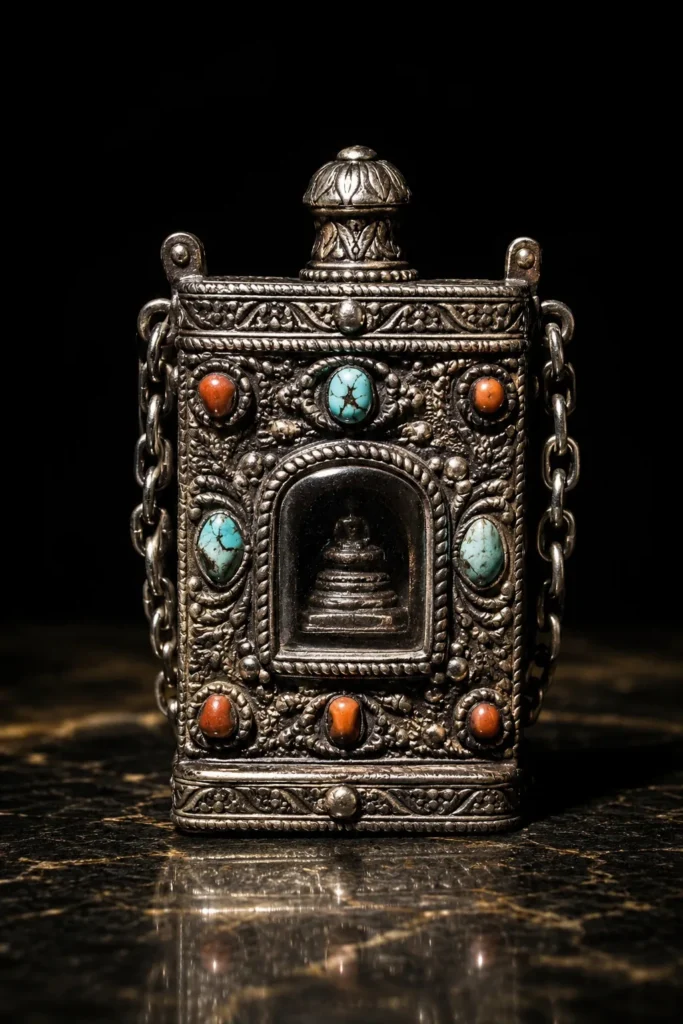
The Gau is usually a small, box-shaped container made of metal. The shape can be rectangular, square, or rounded, often with a curved upper edge. The sizes range from small capsules worn on the body to larger pieces for the household altar.
The front of the Gau is usually artfully designed. It often bears an openwork or glazed window. Through this window the contents are visible, for instance the image of a deity. The back is often kept simpler and can be opened to insert the contents.
Eyelets or rings are attached to the capsule, through which a cord or a chain is drawn. In this way the Gau can be worn around the neck. Larger pieces are hung over the shoulder on a band. The capsule is thus designed for being carried on the body.
The form of the Gau follows a clear central idea. It protects a precious content and at the same time makes it portable. The Gau combines the solidity of a container with the mobility of a pendant. This combination is the precondition for its task as a traveling protective object.
The window on the front of many Gau has a twofold effect. The bearer can see the sacred image inside, and at the same time the image looks outward, as it were. The gaze works in both directions, and the sacred remains visibly present.
The Sacred Content
What is truly effective about the Gau is not the capsule but its content. The shell protects and carries, yet the protective power proceeds from what lies within. This content is always a blessed or sacred object.
The content of a Gau can vary greatly. Often it is a small image of a deity or of a venerated teacher. It can also be an inscribed strip bearing a protective text or a mantra. Also widespread are small sacred images formed from clay and blessed substances.
Knotted protective cords blessed by teachers can also be kept in the Gau. What all these things have in common is that they have received a blessing power through a ritual or through their connection with a sacred person. The Gau preserves this power.
In this construction a widespread pattern becomes apparent. What is effective is concealed and protected by a shell. The same pattern appears in the Japanese Omamori and in the inscribed amulets of other cultures. The Gau is the Tibetan form of this idea found around the world.
Decisive for the effectiveness of the Gau is the blessing. A teacher consecrates the content, and only through this does the capsule become an effective protective object. Without this blessing the Gau remains empty in the proper sense, however artfully it may be crafted on the outside.
Protection for Travelers
The Gau held a special meaning for travelers. Anyone setting out on a journey left the protected space of the home. In the home there was an altar at which the sacred images were venerated. On the journey this fixed place of the sacred was absent.
The Gau filled this gap. It was, as it were, a piece of the household altar that could be taken along. In the capsule the traveler carried the image of his deity or a blessed object. In this way he remained connected to the sacred even while on the road.
Precisely in the Tibetan cultural sphere this function was significant. The paths led through high mountains, through trackless and dangerous terrain. Travel was arduous and could become dangerous. The Gau accompanied the traveler through these dangers and was meant to preserve him.
The Gau thus belongs to the protective objects that relate to travel. It shares this orientation with other protective signs, for instance with the Icelandic Vegvisir or with the Christopher medal. In all these cases what is at stake is the protection of the person who leaves the familiar, secured space.
Life on the Tibetan highland was for a long time marked by movement. Caravans, pilgrims, and nomads were on the move over great distances. For them the Gau was indispensable, for it brought the protection of the sacred along on every path.
Craftsmanship and Material
The Gau is often an artistically demanding object of craftsmanship. The most widespread material is silver, alongside which copper and other metals are used. The surface is decorated with chased and engraved patterns.
Colored stones are frequently inlaid in the Gau. Particularly popular are turquoise and coral, which enjoy high esteem in the Tibetan region. These stones themselves have a protective meaning and reinforce the character of the Gau as a protective object.
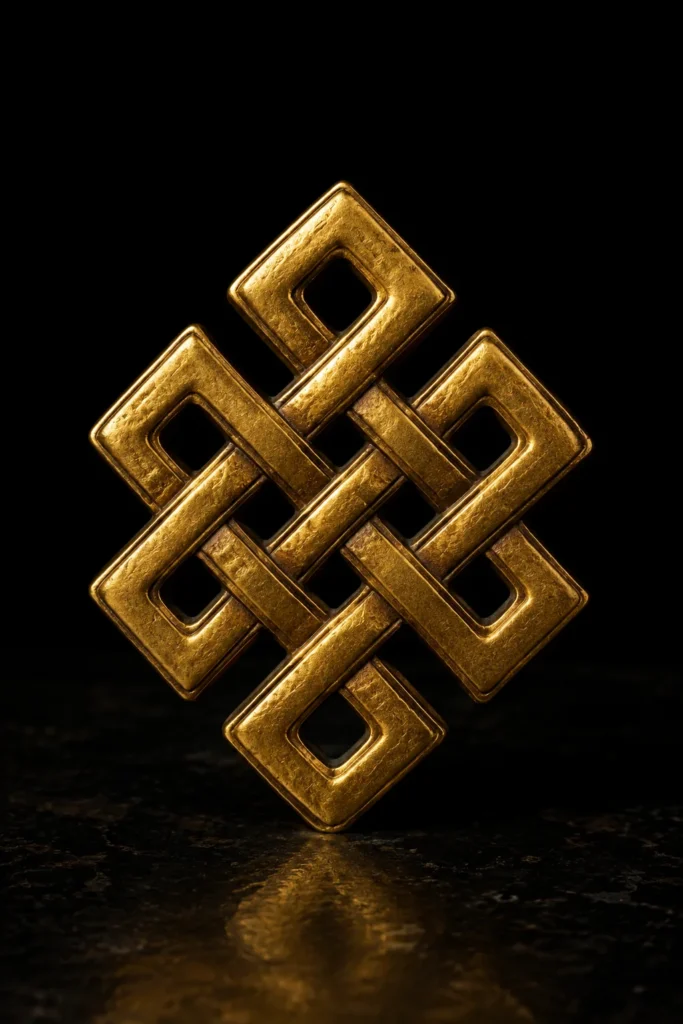
The decorations are not arbitrary. The eight auspicious symbols, the endless knot, and further signs of the Buddhist visual world frequently appear. Dragons and other protective figures also occur. The capsule thus already bears on its surface a whole web of protective and blessing signs.
The artful design of the Gau has a purpose. It shows the esteem for the sacred content. A blessed image deserves a worthy container. The Gau is thus a protective object, and at the same time it reflects the high craftsmanship of the Tibetan cultural sphere.
Turquoise and coral, which are frequently inlaid in the Gau, are themselves regarded as protective stones in the Tibetan region. The protective meaning of the capsule is thereby doubled. It protects through its blessed content and at the same time through the stones with which its surface is adorned.
The Gau in the Home and on the Body
The Gau is used in two ways, on the body and in the home. Both uses belong together and complement one another. The size and execution of the Gau depend on which use it is intended for.
Smaller Gau are worn on the body. They hang on a cord around the neck or are fastened to the clothing. In this form they are the personal protection of an individual person who carries them with him at all times.
Larger Gau have their place in the home. They are set up on the household altar and belong to the furnishing of the domestic sanctuary. In this form they protect not an individual person but the dwelling and the family that lives in it.
In this twofold use a pattern becomes apparent that is found in many cultures. A protective sign mounted on the house stands alongside a worn, personal amulet. The Gau covers both areas. It can be the protection of the home and the protection of the individual person at the same time.
Larger Gau often form the center of the household altar. They stand at an elevated, honored place and are the point of reference for domestic devotion. In this form the Gau is less a travel companion than a resting center of the family’s religious life.
The Gau and Related Amulet Capsules
The Gau belongs to a type of protective object found around the world, the amulet capsule. This type rests on a simple but effective idea. A sacred or powerful object is placed in a container that protects it and makes it portable.
Related amulet capsules are known from many cultures. In the Islamic world, small cylindrical capsules hold an inscribed protective text. In the Christian tradition there were containers for relics that were worn on the body. The Japanese Omamori too, the brocade pouch with a concealed core, follows the same central idea.
What all these objects have in common is that what is effective is concealed. The shell is visible, the core remains within. Often the notion holds that the container should not be opened without reason. What is concealed is the sacred, and the concealing is part of its protection.
The Gau is the Tibetan expression of this widespread idea. It shows that the protective traditions of the world are related to one another. A fundamental answer to the desire for protection, the portable container for a sacred interior, is found in many cultures, each in its own form.
The Gau shares with other amulet capsules not only the concealed sacred core but often also the custom of not opening the container without reason. What is concealed is regarded as the sacred, and the concealing itself belongs to the protection. This idea connects the Gau with protective objects of many cultures.
Reception Today
The Gau is still in use today in the Tibetan cultural sphere. In the religious practice of Tibetan Buddhism it has retained its established place. It continues to be made, provided with blessed content, and worn.
Beyond its religious use, the Gau is also valued as an object of craftsmanship. The artfully worked silver capsules with their stone inlays are impressive examples of Tibetan metalwork. In this respect, Gau are collected and shown in exhibitions.
With a Gau that is no longer in religious use, one should remain aware of its original meaning. The Gau was a container for the sacred. A mindful handling takes this origin into account, even when the capsule is today regarded as an art object.
The Gau thus remains a striking example of a portable protective object. It combines high craftsmanship with a clear protective function and with the idea of the concealed sacred core. In it we see vividly how the desire for protection and the veneration of the sacred come together in a single object.
Today Gau are also found in museums and collections, where they are shown as examples of Tibetan metalwork. With such a piece it remains appropriate to be aware of its sacred origin. The Gau was first a container for the consecrated and only afterward an object of collection.
Literature (Selection)
Related key terms: Gau amulet capsule Tibet portable shrine travel protection silver turquoise blessing Himalayas.
iWell Guard and Protective Traditions
iWell Guard stands in the cultural-historical line of portable protective objects to which the Gau also belongs. A modern companion for people who live with protective symbols: made in Germany, 41 layers of solid gold, platinum, and silver, with a 30-day return right.
Personal experiences may vary. Not a medical device. No healing promise.