The Brigid's Cross: the woven protective cross of Ireland
By Ralf Ittermann · last reviewed on
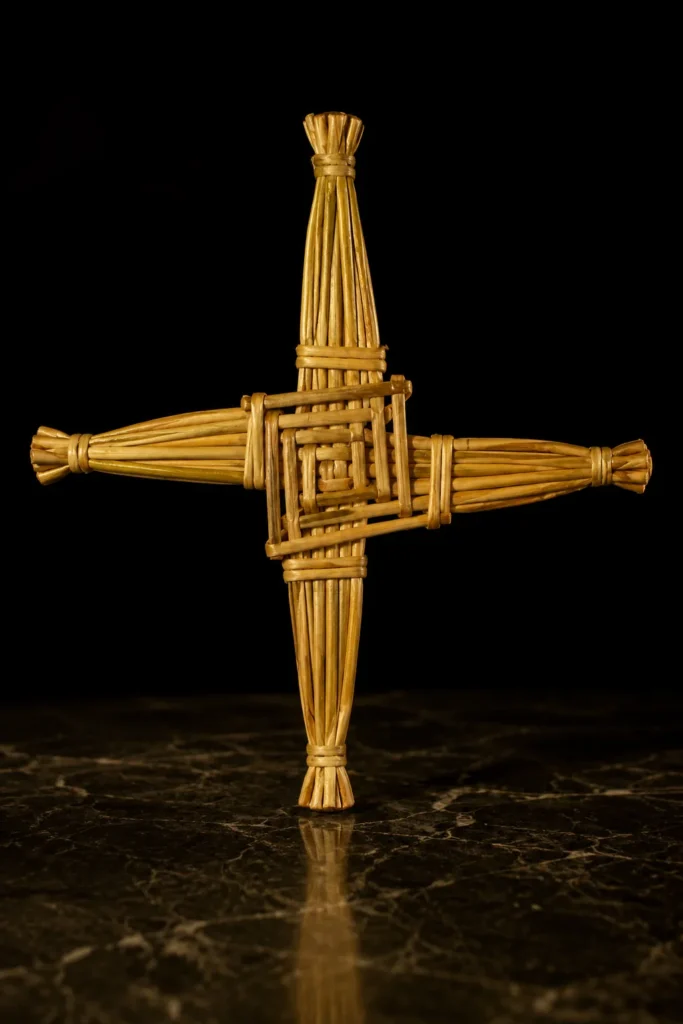
The Brigid’s Cross is a cross woven from rushes, with an offset central square and four arms. In Ireland it is woven anew each year and placed above the door to protect house and farm.
Classification
The Brigid’s Cross is a protective sign from Ireland and belongs to the Celtic cultural world. It is woven from rushes or straw and has an unmistakable form.
The cross consists of an offset, almost square central field from which four arms extend. These arms are tied together with bands or threads. The overall form is immediately recognisable.
The Brigid’s Cross is a protective object for the home. It is placed above the door, on the wall or in the byre, and is meant to guard house, family and livestock against misfortune.
A fixed custom is associated with the Brigid’s Cross. It is traditionally woven anew on a particular day of the year, the feast day of Saint Brigid at the beginning of February.
In religious studies and in folklore studies the Brigid’s Cross is a well-attested example of a woven protective sign made from natural material. It stands at the meeting point of pre-Christian and Christian tradition.
This connection of old and Christian heritage is characteristic of the Brigid’s Cross. It is closely bound up with the figure of Brigid, and this figure carries a double meaning, both ancient and Christian.
Brigid: Goddess and Saint
The Brigid’s Cross bears the name of Brigid. This figure has a double meaning in Ireland. There is the ancient goddess Brigid and the Christian Saint Brigid of Kildare.
The goddess Brigid belongs to the pre-Christian tradition of Ireland. She is associated with fire, with poetry, with the healing arts and with the smith’s craft. She was a significant figure in the Irish world of the gods.
Saint Brigid of Kildare is one of the most important saints of Ireland. She is venerated alongside Saint Patrick and is regarded as the founder of a significant monastic community.
There are striking correspondences between the goddess and the saint. Both are associated with fire, both with care and protection. Scholarship has discussed the relationship between the two figures at length.
The Brigid’s Cross stands at this meeting point. It is connected with Saint Brigid and her feast day, and at the same time it carries features that may reach back into pre-Christian times.
This double anchoring makes the Brigid’s Cross a good example of the encounter between old and Christian heritage in Ireland. Both layers are present in it.
Form of the Cross
The Brigid’s Cross has a peculiar, unmistakable form. Its distinguishing feature is the offset central field, which is created by the interweaving of the stalks.
At the centre of the cross lies an almost square, woven field. The stalks are interlaced there in such a way that a dense, woven square is formed.
From this central field four arms extend. They point in the four directions, but they are not arranged exactly alike; rather, they are slightly offset. This gives the cross its almost rotating appearance.
The arms are tied together at their ends with threads or bands. This binding holds the weave together and gives the cross its firm form.
There are various variants of the Brigid’s Cross. Some have three arms, most have four. The number and arrangement of the arms can differ somewhat from region to region.
The basic form, however, the woven central field with the offset arms, is the same everywhere. By it the Brigid’s Cross can be recognised at once, and it distinguishes it from every other form of cross.
Woven from Rushes
The Brigid’s Cross is made from simple natural material. Rushes are used, that is, the stalks of certain marsh and meadow plants, and straw as well.
These materials were readily available in the countryside. The Brigid’s Cross was therefore not a precious object but a protective sign that any household could make from the means of its surroundings.
The weaving of the cross follows a particular technique. The stalks are laid around one another step by step and interlaced until the central field and the four arms are formed.
The weaving was often a communal activity. Within families the Brigid’s Cross was made together, and the knowledge of the weaving technique was passed on from one generation to the next.
Because the Brigid’s Cross consists of perishable natural material, it is not meant to last. The rushes dry out and become brittle over time.
This very transience belongs to the custom. The Brigid’s Cross is not kept forever but woven anew each year. This annual renewal is an essential feature of the custom.
The Day of Brigid
The Brigid’s Cross is traditionally woven on a particular day, the feast day of Saint Brigid. This day falls at the beginning of February.
The same point in the year was an important festival in pre-Christian Irish tradition. It marked the transition from winter to the beginning of spring, the time when the livestock began to lamb again.
The feast day of Brigid thus lies at a significant turning point of the year. It is the time when the light increases and life stirs again after winter.
On this day the Brigid’s Cross is woven anew. The old cross of the past year is taken down, and a fresh cross takes its place.
This binding to a fixed day of the year gives the Brigid’s Cross a clear place in the course of the year. It is a sign connected with a particular time and with a particular festival.
The Brigid’s Cross therefore belongs to those protective objects that are bound into an annual cycle. Like the Japanese Omamori or the Daruma doll, it is renewed regularly.
Protection of House and Farm
The task of the Brigid’s Cross is the protection of the house and the farm. It is meant to guard the people, the livestock and the property against misfortune.
The Brigid’s Cross is placed at important points of the house. Its most frequent place is above the entrance door. There it secures the threshold, where misfortune might enter.
The Brigid’s Cross is also placed inside the house and in the byre. In the byre its protection was directed especially at the livestock, which was of great importance for a farming household.
The Brigid’s Cross was credited with protecting against various dangers. Above all fire, illness and general misfortune are named. The cross was meant to guard the property comprehensively.
The connection with protection against fire is revealing. Brigid, both the goddess and the saint, is associated with fire. The cross of the fire saint was meant to protect the house against fire in particular.
The Brigid’s Cross is thus a classic protective sign of the farming home. It belongs in the series of signs that, like the horseshoe or the pentagram, were meant to secure the property.
Ancient and Christian Heritage
With the Brigid’s Cross the question arises of the age and the origin of the custom. This question calls for a careful, balanced answer.
The woven cross as a custom is well attested. The custom of weaving a cross on the day of Brigid and placing it above the door is documented in Ireland over a long period and is alive to the present day.
The question is how far this custom reaches back. The Brigid’s Cross combines Christian and possibly pre-Christian features. The feast day coincides with an ancient annual festival, and Brigid has a forerunner in the old goddess.
Some interpretations see in the Brigid’s Cross an ancient solar or seasonal sign that was only later given a Christian meaning. Others emphasise the Christian character of the custom.
The Christian-shaped custom can be attested with certainty. A continuous line back into pre-Christian times, by contrast, cannot be strictly proven, even though the connection with the ancient annual festival is striking.
An honest account therefore holds both points firmly. The Brigid’s Cross is a living, well-attested custom of Christian character, and at the same time it carries features that may reach back into an older time. Both layers belong to it.
The Woven Sign
The Brigid’s Cross is a woven sign, and the weaving itself contributes to its meaning. The interlacing and joining of stalks is an ancient, meaningful activity.
In many cultures weaving, knotting and binding are credited with a protective meaning. An interlaced, firm weave is regarded as an image of order and security.
In the Brigid’s Cross this idea is combined with the form of the cross. The woven central field is densely and firmly interlaced, and from it the four arms extend in the four directions.
The four arms can be read as a reference to the four cardinal directions. The cross thereby encompasses the whole space, all the directions from which misfortune might come.
The fresh, living material reinforces the meaning. The Brigid’s Cross is woven from stalks just cut, at the time when life awakens anew after winter.
Thus several meanings come together in the Brigid’s Cross. The firm weave, the four directions, the fresh material and the reference to the awakening year work together and make the cross a sign of protection and of new beginning.
Reception Today
The Brigid’s Cross is to this day a living custom in Ireland. It can be seen on many doors, and the weaving on the day of Brigid is still practised in families, in schools and in communities.
The Brigid’s Cross has become a well-known sign beyond Ireland. It is regarded as a symbol of Ireland and of Irish culture and is associated with Saint Brigid and with the Irish heritage.
In more recent times the day of Brigid has taken on an additional significance in Ireland, and with it the Brigid’s Cross has come back into view. It is a sign that links past and present.
In Christian piety too, the Brigid’s Cross has kept its firm place. It is blessed, woven and placed above the door, as a sign of protection under the intercession of Saint Brigid.
For folklore studies the Brigid’s Cross is a valuable example. It shows a living protective custom that combines weaving from natural material, the binding to a feast day and the veneration of a saint.
The Brigid’s Cross thus remains an impressive protective sign. Woven from simple rushes, renewed each year and placed above the door, it is a living testimony of the Irish tradition of protection.
References (selection)
Related key terms: Brigid’s Cross Brigid Imbolc woven rushes protective cross Ireland house protection.
iWell Guard and Protective Traditions
iWell Guard stands in the cultural-historical line of portable protective objects to which the Brigid’s Cross also belongs. A modern companion for people who live with protective symbols: made in Germany, 41 layers of solid gold, platinum and silver, with a 30-day right of return.
Personal experiences may vary. Not a medical device. No healing promise.