The Kabbalistic amulet: Jewish protection through names and signs
By Ralf Ittermann · last reviewed on
The Kabbalistic amulet, called kamea in the Jewish tradition, is a protective object made of written names of God, angel names and signs. It belongs to the written talismans and was meant to guard against misfortune.
The Kabbalistic amulet is Jewish protection made of sacred names and signs.
Classification
The Kabbalistic amulet is a protective object from the Jewish tradition. In the Hebrew language, such an amulet is called kamea.
The amulet consists essentially of writing. It bears written names of God, names of angels, verses from the Bible and special signs. It thus belongs to the group of written talismans.
The Kabbalistic amulet is directed against misfortune. It was meant to protect its bearer from illness, from the evil eye, from harmful powers, and especially to protect mother and child during childbirth.
The amulet is closely connected with the Kabbalah, the mystical current of Judaism. More precisely, it belongs to an area known as practical Kabbalah.
In religious studies the Kabbalistic amulet is a good example of a written talisman whose effect is bound to sacred names. It is well attested through numerous surviving pieces.
The amulet thus belongs to a large, cross-cultural family. Written talismans bearing sacred names and words are widespread in many religions. The kamea is the Jewish form of this basic pattern.
The Kabbalah and practical Kabbalah
To understand the amulet, one must know the Kabbalah. The Kabbalah is the mystical current of Judaism. It is concerned with the hidden meaning of the sacred texts and with the nature of God.
Within the Kabbalah several directions can be distinguished. One direction is the contemplative, philosophical Kabbalah, which devotes itself to knowledge and to mystical vision.
Alongside it there is an area known as practical Kabbalah. This area is concerned with the application of the transmitted knowledge, for instance with protection, with healing and with the warding off of misfortune.
The Kabbalistic amulet belongs to this practical Kabbalah. It is the application of the knowledge of the sacred names and signs to the concern of protection.
Practical Kabbalah did not stand unchallenged in the Jewish tradition. There was reticence and criticism, for handling the sacred names was regarded as delicate and not permitted to everyone.
The Kabbalistic amulet thus moves within an area that was treated with seriousness and with caution. It was not an arbitrary object but required particular knowledge and particular authorization.
The content: names and signs
The decisive thing about the Kabbalistic amulet is its content. On the amulet stand written words and signs, and from them its protective effect is derived.
At the center stand the names of God. The Jewish tradition knows various names and name forms of God, to which great holiness and power are ascribed.
Alongside these, the amulet often bears names of angels. A protective task was ascribed to the angels, and their names on the amulet were meant to secure their assistance.
Verses from the Hebrew Bible also belong to the content. Verses that speak of protection and preservation were especially written on the amulets.
In addition there are special signs. There are magic squares of numbers or letters, rearrangements of sacred names, and distinct characters to which a power was ascribed.
From all these components, the names of God, the names of angels, the verses and the signs, the Kabbalistic amulet is composed. Its protection rests on the power of these sacred words and signs.
Form and material
The Kabbalistic amulet appears in various forms. One widespread form is written parchment or paper.
On this writing material the names, verses and signs were written. The written sheet was then folded and kept in a casing, often in a small capsule.
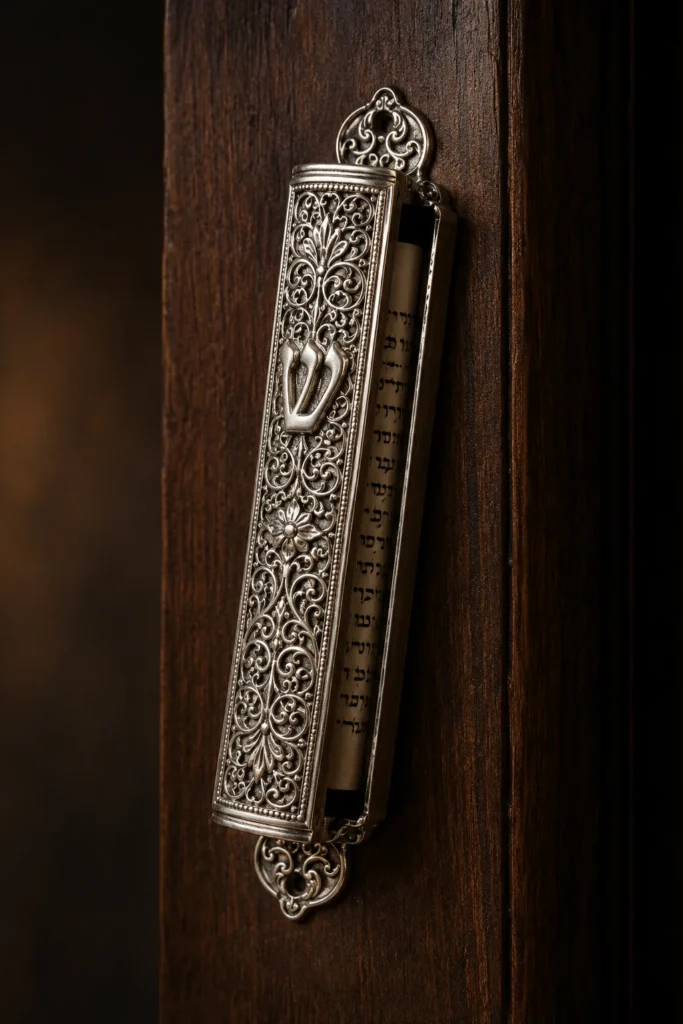
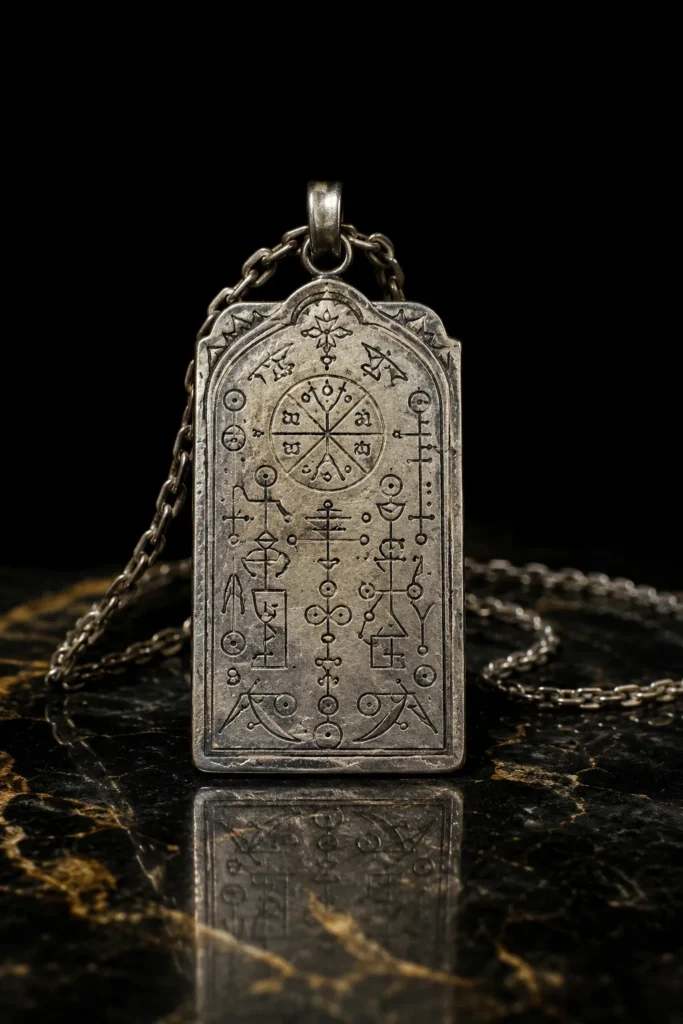
Another form is the amulet made of metal. On thin sheets, often of silver, the inscriptions were incised or engraved. Such metal amulets were more durable than the written sheets.
The metal amulets could be artfully fashioned. They bore the inscriptions, often arranged in several fields, and could additionally be ornamented.
The Kabbalistic amulet was worn on the body, on a cord or chain. It could also be placed at a particular spot, for instance in the room of a woman in childbed.
In the form of the enclosed capsule the Kabbalistic amulet follows a widespread pattern. As with the Islamic taʿwiz or the Tibetan gau, the actually effective part, the written core, is protected within a casing.
Who makes the amulet
A Kabbalistic amulet was not made by just anyone. Its production was reserved for persons who possessed the necessary knowledge and the necessary authorization.
Such persons were designated in the Jewish tradition by various terms. Well known is the term Baal Shem, which roughly means master of the name.
A Baal Shem was an expert who had mastered the sacred names and their use. The capability to handle this delicate knowledge was ascribed to him.
The making of the amulet required precise knowledge. The names had to be written correctly, the verses chosen correctly, the signs set correctly. An error was considered dangerous.
The production was often bound up with prescriptions and with a particular attitude. Writing the sacred names was a serious act surrounded by rules.
That the Kabbalistic amulet was made by capable experts is important for understanding it. According to the conception of the tradition, its power rested not only on the words but also on the knowledge and the authorization of the one who wrote them.
Protection for mother and child
The Kabbalistic amulet was directed against various dangers. A particularly important application concerned the protection of mother and child during childbirth.
In earlier times childbirth was a dangerous hour. The woman in childbed and the newborn were regarded as threatened, and the wish for protection was especially urgent in this situation.
For this protection there were special amulets. They were placed in the room of the woman in childbed, hung on the bed or given to the child.
These birth amulets were often directed against a particular harmful power, against the figure of Lilith. In Jewish tradition Lilith was associated with the endangerment of the woman in childbed and the infant.
The amulets against Lilith bore special names and formulas meant to keep her away. On the page about the Lilith protective amulet this special form is presented in more detail.
The protection of mother and child through the Kabbalistic amulet fits into the widespread pattern. In very many cultures the most important protective objects are directed at childbirth and earliest infancy.
The power of the sacred names
The protective effect of the Kabbalistic amulet rests on the sacred names. In the Jewish tradition an extraordinary holiness and power was ascribed to these names.
Underlying the conception is the idea that the names of God are not arbitrary words but closely connected with God himself. Whoever writes the name invokes the power connected with it.
Likewise the names of the angels were considered effective. They were meant to secure the assistance of the protective angelic powers.
The Kabbalistic amulet is thus an example of the widespread operative principle of the powerful sacred word. Many religions know this principle.
At the same time, handling the sacred names was delicate in the Jewish tradition. The names of God were considered too sacred for casual use. For this reason the production of the amulets was bound to knowledge and authorization.
In this tension the seriousness shows itself with which the Jewish tradition treated the Kabbalistic amulet. It was an effective means of protection and at the same time an object whose production demanded care and responsibility.
Written talismans in the religions
The Kabbalistic amulet belongs to the large family of written talismans. By this are meant protective objects whose effect is bound to a written word or a name.
Such written talismans are widespread in many religions. In Islam the taʿwiz bears Quranic verses and names of God. In East Asia the Chinese fu talisman and the Korean bujeok bear written signs.
All these talismans share the same basic idea, the idea of the effective word. A sacred or powerful word, written and worn, is meant to protect its bearer.
The Kabbalistic amulet is the Jewish form of this basic pattern. Its distinctive feature lies in the sacred names of God and of the angels that form its content.
The form too, the enclosed capsule with the written core, the Kabbalistic amulet shares with protective objects of other cultures. The concealment of the sacred content is a widespread trait.
The Kabbalistic amulet thus shows that the protective traditions of the world are related to one another. The written talisman is a worldwide basic pattern, and the Jewish kamea is one of its forms.
Reception today
The Kabbalistic amulet is today above all a historical and a religious-historical object. In the collections of many museums such amulets are preserved, especially the artful metal amulets.
These surviving pieces are a valuable source. They give insight into practical Kabbalah, into Jewish popular piety and into the protective conceptions of past centuries.
In parts of Judaism the custom of protective amulets has remained alive into the present, especially in certain pious and mystically shaped currents.
As in the past, the handling of such amulets is also judged differently today. Some currents cultivate it, others stand reticently toward it.
A factual account names the Kabbalistic amulet for what it is, a seriously regarded protective object of practical Kabbalah, borne by the belief in the power of the sacred names.
The Kabbalistic amulet is thus a striking example of a written talisman. In it are joined the holiness of the names of God, the knowledge of the experts and the widespread need for protection of life and of childbirth.
References (selection)
Related key terms: Kabbalistic amulet kamea Kabbalah names of God angel names written talisman Baal Shem Judaism.
iWell Guard and protective traditions
iWell Guard stands in the cultural-historical line of portable protective objects to which the Kabbalistic amulet also belongs. A modern companion for people who live with protective symbols: made in Germany, 41 layers of solid gold, platinum and silver, with a 30-day right of return.
Personal experiences may vary. Not a medical device. No healing promise.