Pixiu: the winged mythical creature that preserves wealth
By Ralf Ittermann · last reviewed on
Pixiu is a winged mythical creature from the Chinese tradition. As a protective figure, it is credited with attracting and preserving wealth while at the same time warding off misfortune and harmful spirits. As a figure, it stands in houses and at entrances.
Classification
Pixiu is a mythical creature from the tradition of China. It is not a real animal but an invented being, thought of as composed of elements from several animals.
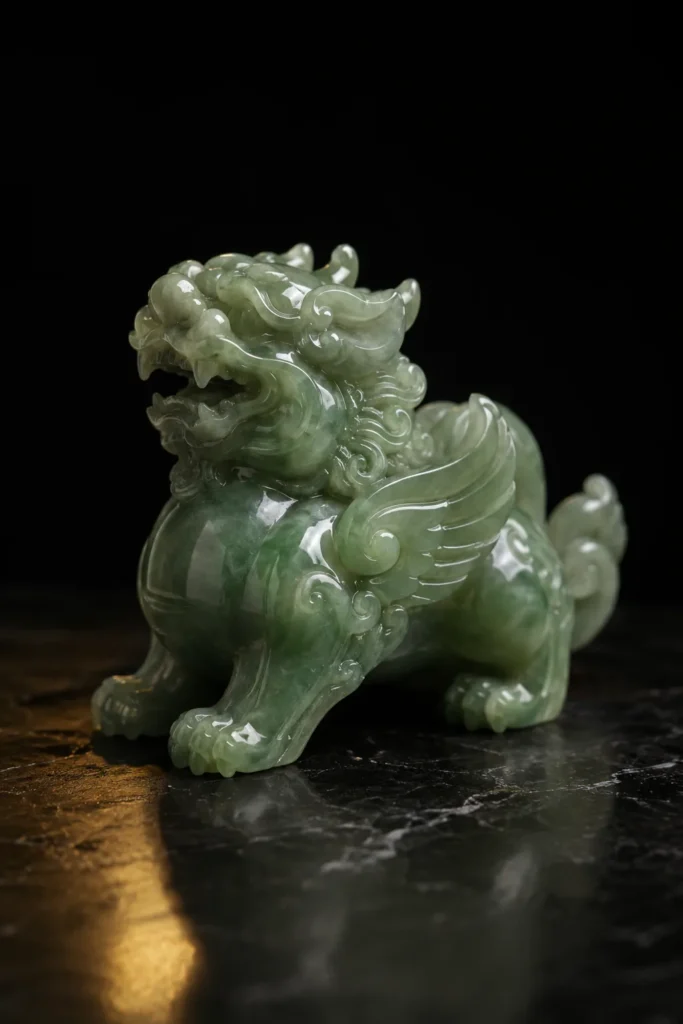
The creature is depicted with the head of a lion-like or dragon-like animal, with a powerful body and often with wings. It has a powerful, imposing appearance.
Pixiu is regarded as a protective figure with a dual task. On the one hand it attracts wealth and preserves it, on the other hand it wards off misfortune and harmful spirits.
As a protective figure, Pixiu appears above all in the form of figures made of stone, bronze, wood or jade. These figures stand in houses, in shops and at entrances.
In religious studies, Pixiu is a good example of a protective being that combines several meanings. The preservation of wealth and the warding off of misfortune belong together in it.
This page presents Pixiu as a protective figure. It describes its form, its meaning and its use, and places it within the protective tradition of China.
A being of Chinese lore
Pixiu belongs to the mythical creatures that grew over a long period in Chinese lore. Such creatures are numerous in Chinese culture.
Chinese lore knows a whole world of mythical animals. Alongside the dragon and the phoenix there are many further creatures, each of which is given its own meaning.
Pixiu has been mentioned in this world of mythical creatures for a long time. Ideas of such a powerful, protective animal reach far back into Chinese history.
Over time, the ideas about Pixiu have shifted and taken shape. Various traditions describe the creature with different traits, and not all details are uniform.
An honest account names this uncertainty. Pixiu is not a clearly defined creature with a single, fixed form but a notion that has changed and grown denser over the course of history.
What has remained the same over time is the basic trait. Pixiu was always regarded as a powerful, protective creature to which a connection to wealth and to the warding off of misfortune was attributed.
Form of the winged creature
Pixiu has a distinctive form, though one that varies in its details. It is a composite creature formed from the traits of several animals.
Pixiu often bears the head of a dragon-like or lion-like animal. The head appears powerful and at times fearsome, with an open mouth and strong features.
The body is powerful and compact, often resembling that of a lion or another large animal. The legs are strong, the paws furnished with claws.
A frequent feature is the wings. Pixiu is in many cases depicted with wings on its back, which lend its powerful body an additional, supernatural note.
A particular tradition concerns the mouth of Pixiu. According to a widespread idea, the creature has a large mouth but no anus. It can take in but cannot give back out.
This idea of the mouth without an exit is important for the meaning of Pixiu. It is the image with which Chinese lore explains why Pixiu not only attracts wealth but also preserves it.
Pixiu as preserver of wealth
The one great meaning of Pixiu is its connection with wealth. Pixiu is regarded as a creature that attracts and preserves wealth.
This meaning is explained with the idea of the mouth without an exit. According to this idea, Pixiu takes in wealth through its large mouth but cannot lose it again.
From this idea arises the image of a creature that, as it were, gathers prosperity within itself and holds it fast. What comes to Pixiu stays with it.
Therein lies the difference from a mere sign of good fortune. According to this idea, Pixiu brings good fortune and, beyond that, preserves prosperity, once gained, from loss.
For this reason Pixiu is a popular figure especially in shops, in banks and in places of commerce. There the wish to gain prosperity combines with the wish to keep it.
Pixiu is thus a protective being of its own kind. Besides warding off misfortune, it preserves a further value, prosperity, from loss and dwindling.
Pixiu as warder-off of misfortune
The second great meaning of Pixiu is its warding-off task. Pixiu is regarded as a preserver of wealth; at the same time it is seen as one that wards off misfortune and harmful spirits.
This meaning derives from the powerful form of the creature. Pixiu appears strong and fearsome, and such a creature is, according to a widespread idea, suited to frightening off harmful powers.
Pixiu thus belongs to the guardians. Like the guardian lion in front of buildings, Pixiu too stands as a figure at entrances and thresholds in order to keep evil away from the interior.
In this task Pixiu resembles other guardian-like animal figures of the Chinese tradition. They all use the powerful appearance of the animal to scare off harmful influences.
Two Pixiu figures are often set up as a pair, one on each side of an entrance. In this way they together form a guard that secures the access from both sides.
The warding-off and the preserving meaning of Pixiu complement one another. Pixiu keeps misfortune outside and prosperity inside. It thus protects a house or a shop on both sides.
The figure in house and shop
Pixiu appears as a protective figure in houses and in shops. The figures are made of various materials, of stone, bronze, wood or jade.
In the house Pixiu is set up in a considered place. The figure often stands near the entrance or in a place to which a particular meaning is attached with regard to prosperity.
In shops and in places of commerce Pixiu is especially widespread. There the wish for prosperity combines with the wish for the preservation of the gain acquired.
Usually the figure is positioned so that its head points outward, toward the entrance or the window. In this way, according to this idea, Pixiu can take in wealth from outside.
Pixiu also appears in small form, as a pendant or as a piece of jewelry, often made of jade. In this form the creature is worn on the body and accompanies its wearer.
In all of these uses Pixiu fulfills the same dual task. As a large figure or as a small amulet, it is meant to attract and preserve wealth and at the same time to ward off misfortune.
Pixiu and the teaching of favorable arrangement
Pixiu has a firm place in the Chinese teaching of the favorable arrangement of living and business spaces. This teaching deals with the arrangement of rooms and objects.
According to this teaching, the right arrangement of objects can promote favorable influences and ward off unfavorable ones. Protective figures such as Pixiu belong to the means of this teaching.
Within this teaching there are recommendations for the placement of Pixiu. They concern the location, the orientation and the number of figures.
It is often recommended to orient the figure toward the entrance or the window, so that Pixiu can take in prosperity from outside. The sleeping room and certain other places are also considered in the recommendations.
It should be noted in factual terms that many of these detailed recommendations are of more recent date. They belong to a modern, heavily elaborated form of the teaching, which can differ from older traditions.
Pixiu thus shows how an old mythical creature has entered a modern, widely disseminated teaching. The basic idea is old, the precise instructions on location and orientation are often of more recent origin.
Pixiu in the protective tradition of China
Pixiu belongs to a rich protective tradition of China. In this tradition animals and mythical creatures play an important role.
The Chinese tradition knows numerous protective animals and mythical creatures. The guardian lion, the dragon and further creatures serve, each in their own way, to ward off misfortune and to entreat the good.
Pixiu occupies a distinct position within this tradition. While some creatures above all ward off, Pixiu combines the warding off of misfortune with the preservation of wealth.
Pixiu thus belongs to a group of protective beings whose action is warding-off and favorable at once. It frightens off evil and at the same time attracts the good, here prosperity.
Pixiu often does not stand alone but beside other means of protection. A house or a shop may bear guardian lions, a coin sword and a Pixiu figure at the same time.
Pixiu is thus a readily graspable example of the Chinese protective tradition. In it is shown how a mythical creature can unite the warding off of misfortune and the preservation of prosperity in a single figure.
Reception today
Pixiu remains a well-known and popular protective figure into the present. In China and in the Chinese communities throughout the world the creature continues to be used.
Pixiu is especially present in connection with the wish for prosperity. In shops, in offices and in homes, Pixiu figures are frequently to be seen.
As jewelry and as a pendant, in many cases made of jade, Pixiu is likewise widespread. In this small form the creature is worn on the body by many people.
Within the modern teaching of favorable space design Pixiu has gained a firm place. This teaching has contributed to the wide renown of the creature.
For religious studies, Pixiu is an instructive example. It shows how an old mythical creature remains alive over time and enters into new contexts.
Pixiu is thus a striking example of a Chinese protective being. In it the powerful form of the winged mythical animal, the preservation of wealth and the warding off of misfortune combine into a single protective figure.
Literature (selection)
Related key terms: Pixiu mythical creature protective figure wealth prosperity warding off misfortune guardian animal China Feng Shui.
iWell Guard and protective traditions
iWell Guard stands in the cultural-historical line of portable protective objects to which Pixiu also belongs. A modern companion for people who live with protective symbols: made in Germany, 41 layers of solid gold, platinum and silver, with a 30-day right of return.
Personal experiences may vary. Not a medical device. No healing promise.