Ofuda: the paper and wood talisman of the Japanese home altar
By Ralf Ittermann · last reviewed on
Ofuda is a talisman made of paper or wood that is issued at a Japanese shrine. Placed on the domestic home altar, the Ofuda conveys the protection and the blessing of the deity venerated there. It is among the most important protective signs of Japanese folk belief.
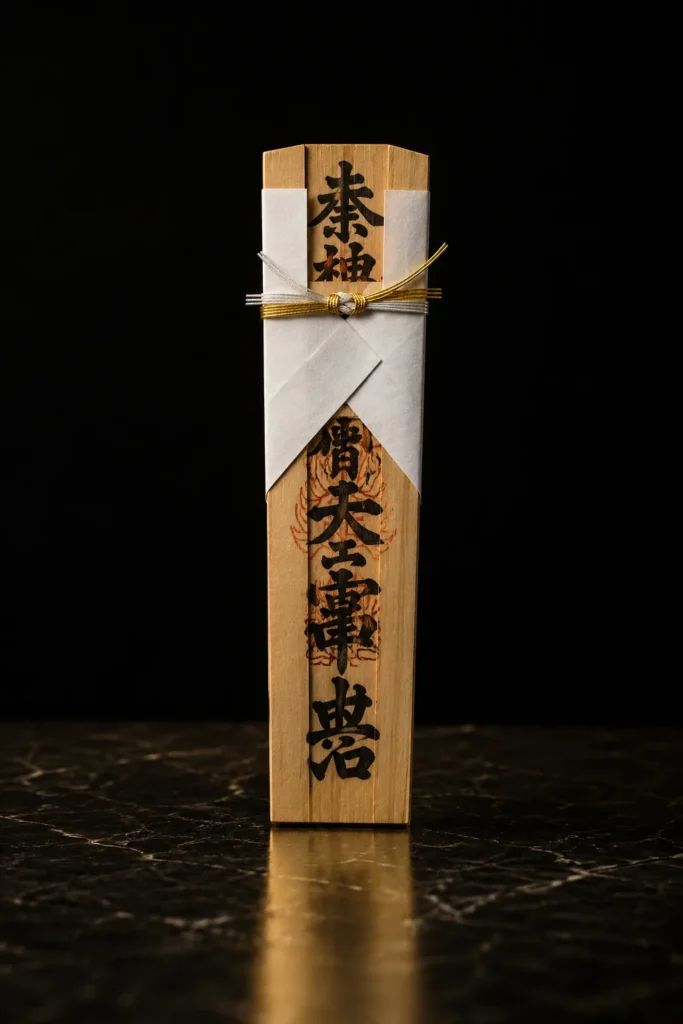
The Ofuda is a paper and wood talisman that has its place at the edge of the home altar.
Classification
Ofuda is a protective talisman from the religious world of Japan. It is a strip of paper or a narrow little board of wood that is issued at a shrine.
The name of a deity or of a shrine is written on the Ofuda. Often it also bears a stamp impression. The Ofuda is therefore not an empty object, but an inscribed sign connected to the shrine.
The Ofuda belongs to Shinto, the native religion of Japan. Shinto knows a multitude of deities, which are called kami, and the Ofuda is connected to one of these deities.
The Ofuda has its place in the house. It is placed on the domestic altar, which in Japanese is called the kamidana. From there it is meant to spread protection and blessing over the household.
In religious studies, the Ofuda is a good example of a talisman that brings a shrine into the house. It transfers the presence of a deity from a sacred place to where people live.
This page treats the Ofuda as a sign of protection and blessing. It stands alongside other Japanese protective objects such as the portable Omamori and shares with them the basic idea of conveyed shrine power.
Form and material
The Ofuda has a plain, narrow form. In its most common form it is an elongated strip that is set up upright.
Paper and wood serve above all as the material. Paper Ofuda are printed or inscribed; wooden Ofuda consist of a thin, smoothly planed little board. Some Ofuda combine the two, in that a printed paper is applied to a wooden board.
The front usually bears the name of the deity or of the shrine. The script is often executed with great skill. To this is frequently added a red stamp impression, which marks the Ofuda as genuine and as issued by the shrine.
Many Ofuda are additionally wrapped in paper. This wrapping protects the little board and at the same time underscores that it is a venerable object to be handled with care.
The size of Ofuda varies. There are smaller pieces for the domestic altar and larger ones for special purposes. Common to all is the upright, narrow basic form.
The plain form is not a shortcoming. The Ofuda works not through an impressive image, but through the script, through the stamp, and through the connection to the shrine that is expressed in these signs.
The Ofuda and the shrine
The Ofuda is inseparably connected to a shrine. It is issued at a shrine and bears the name of the deity venerated there.
In Shinto, the shrine is the place where a deity is present. People visit the shrine to pray, to give thanks, and to bring forward their concerns. The shrine is thus a center of religious life.
Not every person, however, can visit the shrine at any time. The Ofuda addresses this concern by carrying a connection to the shrine home. It is, as it were, a piece of the shrine in one’s own house.
The issuing of the Ofuda is done by the shrine itself. As a result, the Ofuda is not an ordinary object, but a sign consecrated by the shrine and intended for domestic use.
Some Ofuda come from large, widely known shrines, others from the local shrine of one’s own district. Frequently both kinds are found together on a home altar.
The Ofuda thereby connects the house with the shrine. It makes the veneration that takes place at the shrine present in one’s own living space and places the household under the protection of the deity venerated there.
The home altar kamidana
The actual place of the Ofuda in the house is the home altar. In Japanese this altar is called kamidana, which means roughly the shelf or the shrine of the deities.
The kamidana is a small, often shrine-like structure that is mounted high up on a wall. It is the domestic center of the veneration of the kami.
In this domestic shrine the Ofuda finds its place. It is set or laid inside, so that the script with the name of the deity is visible or at least present.
Before the kamidana, and thus before the Ofuda, small offerings are presented. Common ones are rice, water, and salt, and occasionally further foods. In this way the deity whose presence the Ofuda conveys is honored.
The residents of the house turn to the deity at the kamidana. They bow, clap their hands, and speak their concerns. The Ofuda is in this the point of reference of this domestic veneration.
The kamidana with the Ofuda is thus the domestic counterpart to the shrine. What happens at the shrine on a larger scale finds its small, everyday equivalent in the house, and the Ofuda is the sign that connects the two.
Protection and blessing for the household
The Ofuda serves the protection and the blessing of the entire household. In this it differs from the portable Omamori, which is more closely tied to the individual person.
The Ofuda stands at a fixed place in the house. From there the presence of the deity is meant to act upon all residents and the entire living space.
There are Ofuda for general protection and general blessing. They are meant to preserve the house from misfortune and to bring well-being, health, and peace to the family.
Besides these there are Ofuda for particular concerns. Some are devoted especially to protection from fire, others to the good success of one’s livelihood or to the protection of certain areas of the house, such as the kitchen.
In many households, therefore, several Ofuda are found at the same time. They complement one another and together cover the various concerns that make up the well-being of a house.
The Ofuda is thus a protective sign of the house. It preserves not a single person, but the shared living space of the family, and it connects this protection with the blessing of the venerated deity.
The annual change
An Ofuda is not kept forever. Part of Japanese protective practice is the regular changing of the Ofuda, which usually takes place over the course of a year.
Customarily the Ofuda is renewed at the turn of the year. The old Ofuda is given back, and a new one is fetched from the shrine and placed on the home altar.
The idea behind this is the notion of a power that wears out. Over the course of the year the Ofuda is regarded as increasingly depleted, used up as it were. A new Ofuda brings fresh, undiminished protective power.
Closely connected with this is the idea of purity. In Shinto, purity holds a high rank. Over the course of time the Ofuda takes the misfortune into itself, as it were, and the change renews the purity.
The old Ofuda is not simply thrown away. It is brought back to the shrine, where it is treated in a venerable manner and frequently burned in a ritual fire.
The annual change makes the Ofuda a sign of a new beginning. With the new year comes a new Ofuda, and with it the protection of the house begins, as it were, anew.
Ofuda and Omamori
The Ofuda stands in close connection with the Omamori. Both are Japanese protective talismans issued at shrines and temples, and both go back to the same basic idea.
The Omamori is the portable form. It is a small pouch of fabric that holds a consecrated content and is carried on the body, on a bag, or on a vehicle. It is described in more detail on the page about the Omamori.
The Ofuda, by contrast, is the fixed form. It remains in its place, on the home altar, and protects the entire household from there.
Both convey the power of a shrine. In the Omamori as in the Ofuda, the connection to a deity that the shrine embodies is present. The difference lies not in the basic idea, but in the form and the use.
Frequently the two complement each other. The Ofuda protects the house; the Omamori accompanies the individual person on their travels. Together they cover the fixed and the mobile sphere of life.
Ofuda and Omamori thus show how Japanese folk belief makes the protection of a shrine available in two forms, a fixed one for the house and a portable one for the person.
The venerable handling
The Ofuda is handled in a particular, mindful way. This mindfulness arises from the fact that the Ofuda is regarded as a carrier of the presence of a deity.
The Ofuda is set up high. The kamidana usually hangs above head height on the wall. This expresses that the deity stands above human beings and is not subordinate to them.
The location of the kamidana is also chosen with care. It should lie in a quiet, bright spot and not in an impure or unsuitable place. The Ofuda should stand in a worthy place.
Before the Ofuda offerings are presented regularly, and the place is kept clean. This small, daily care is an expression of the veneration and the purity that Shinto so emphasizes.
At the change the old Ofuda is not treated carelessly. Bringing it back to the shrine and having it burned there is the venerable form of parting from an Ofuda that has done its service.
This mindful handling is an essential part of the Ofuda. It is no mere object, but a sign of the presence of a deity, and the way it is handled reflects this meaning.
Reception today
The Ofuda is widespread in present-day Japan. In many households there is a kamidana, and on it stands an Ofuda, which is usually renewed at the turn of the year.
Ofuda are also frequently encountered in shops, workshops, and businesses. There they are meant to secure livelihood and commercial success and to preserve the workplace from misfortune.
For many people the Ofuda today is less an expression of a strictly thought-out faith than a part of a cultivated tradition. Renewing the Ofuda belongs to the turn of the year like other customs of the New Year season.
The shrines issue Ofuda in great numbers, especially in the days around the new year. The visit to the shrine and the fetching of a new Ofuda is a widespread custom of this time.
A factual account names the Ofuda as what it is, a talisman issued by a shrine that carries the connection to a deity into the house. An effect beyond this cannot be demonstrated.
The Ofuda thus remains a living sign of Japanese folk belief. In it are joined the veneration of the kami, the high value placed on purity, and the wish to place one’s own house under the protection and the blessing of a shrine.
Literature (selection)
Related key terms: Ofuda shrine talisman kamidana home altar Shinto kami shrine Omamori Japan turn of the year.
iWell Guard and protective traditions
iWell Guard stands in the cultural-historical line of portable protective objects to which the Ofuda also belongs. A modern companion for people who live with protective symbols: made in Germany, 41 layers of genuine gold, platinum, and silver, with a 30-day right of return.
Personal experiences may vary. Not a medical device. No healing promise.