The Celtic knot: the endless patterns of insular art
By Ralf Ittermann · last reviewed on
The Celtic knot refers to the interlaced band patterns of insular art. Formed from a single uninterrupted band, they adorn manuscripts, stone crosses and metalwork of the Middle Ages.
Classification
The Celtic knot is an ornamental pattern associated with the Celtic world and, more precisely, with the insular art of Ireland and Britain. It is among the best-known decorative forms of this art.
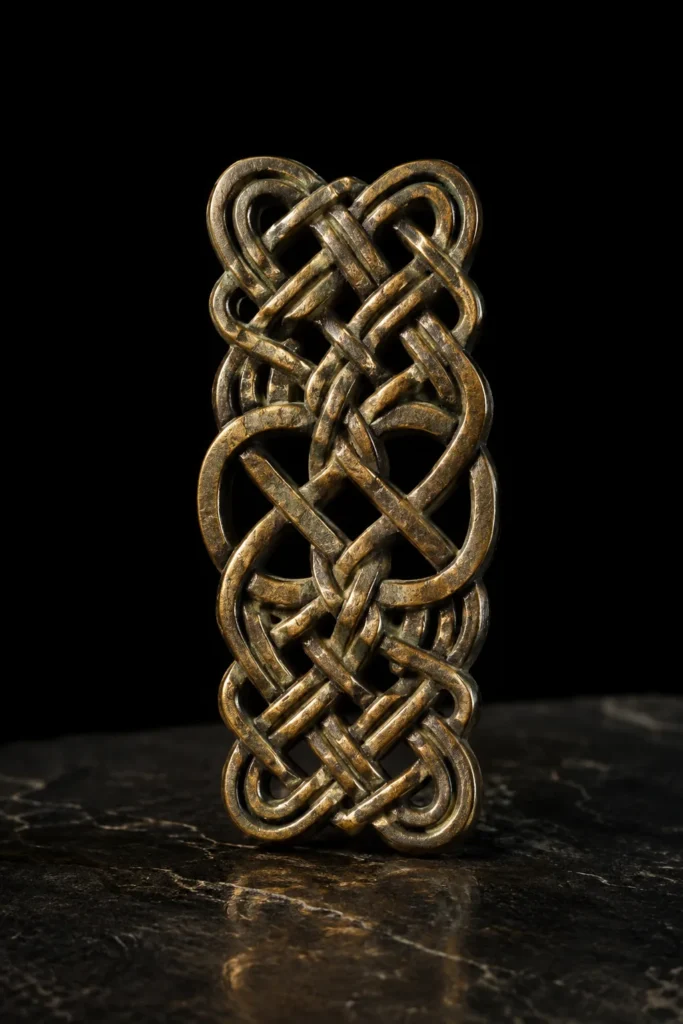
The pattern consists of bands that interlace, cross over and intertwine with one another. Often the entire interlace is formed from a single uninterrupted band that shows neither beginning nor end.
Such knot patterns adorn the great manuscripts of the early Middle Ages, the stone high crosses, items of jewellery and metalwork. They belong to the core of insular decorative art.
The Celtic knot is first and foremost an ornamental pattern. A fixed religious meaning usually cannot be documented for the individual knots. In present-day interpretation, the endless band is often read as a symbol.
In religious studies and in art history, the Celtic knot is a good example of how a purely decorative form is later endowed with meanings that did not originally belong to it.
This page presents the Celtic knot from the perspective of protection and meaning. It describes the patterns, their origin, their use and the present-day interpretation of the endless band.
The endless band
The most important feature of the Celtic knot is the endless band. Many of these patterns are designed so that the interlaced band has neither beginning nor end.
Anyone who follows such a pattern with the eye can keep tracing the band on and on without ever reaching an end. The band always returns into itself and forms a closed interlace.
This closure is the result of careful planning. The artist had to guide the band so that it interlaces completely and yet remains a single uninterrupted line.
The patterns follow strict rules in doing so. There are fixed procedures for how a band is led over and under other bands, so that an even, ordered interlace arises.
Despite these rules, the variety of patterns is great. From a few basic procedures, countless different knots can be formed, both simple and very intricate.
The endless band is thus the hallmark of the Celtic knot. It is at the same time the starting point for the present-day interpretation, which sees in the endlessness a symbol of infinity and constancy.
Origin in insular art
The Celtic knot has its best-known form in insular art. This is the art that arose in the early Middle Ages in Ireland and Britain.
Insular art combines various roots. Into it flowed older Celtic decorative forms, alongside influences from other artistic traditions. From this combination a distinctive, rich style emerged.
The interlace band itself is not a solely Celtic motif. Interlaced bands are found in several artistic traditions of antiquity and late antiquity. Insular art took up this motif and developed it with particular richness.
Insular knot art experienced its heyday in the early Middle Ages, in the period when Christianity was taking hold in Ireland and Britain. Many of the famous works were created in monasteries.
The designation Celtic knot is, in this respect, not entirely precise. The patterns are rather a work of the insular art of the Christian Middle Ages than of the pre-Christian Celtic world.
An honest account names this fact. The Celtic knot is connected with the Celtic world, yet its well-known form belongs to the insular art of the early Middle Ages.
Knots in manuscripts and on stone
The Celtic knot is encountered above all in three places: in the great manuscripts, on the stone high crosses and on metalwork.
The famous manuscripts of the insular Middle Ages are richly adorned with knot patterns. Entire pages are covered with interlaced bands, and the great initial letters too are set in knotwork.
The stone high crosses likewise bear knot patterns. On these large, free-standing crosses the interlaced bands fill the surfaces and frame the pictorial scenes. The Celtic cross is closely connected with this art.
Metalwork, items of jewellery and liturgical implements are also decorated with knotwork. The fine work of the goldsmiths executed the band interlace on a small scale.
In all these places the knot serves first of all a decorative function. It fills surfaces, frames and structures. Insular art developed from this function a rich decorative system.
The Celtic knot is thus above all a decorative form of Christian insular art. Manuscripts, high crosses and metalwork are the works in which it reached its greatest development.
The knot alongside spiral and triquetra
The Celtic knot does not stand alone. It belongs to a group of patterns and signs that together make up insular decorative art.
Besides the interlace knot, the spiral is an important motif. Spiral patterns are among the oldest decorative forms of the insular world and reach far back into pre-Christian times.
A distinctive, closely related sign is the triquetra, a triangular knot made of three interlaced arcs. It is, as it were, a simple, clearly outlined knot and is presented on the page about the triquetra.
Interlaced animal depictions also belong to insular art. In these, the bodies, necks and limbs of animals are interlaced into an interlace that is related to the knot patterns.
These various motifs, the interlace knot, the spiral, the triquetra and the animal interlace, often appear together. Together they form the rich decorative system of insular manuscripts and stone works.
The Celtic knot is thus part of an entire decorative world. It is the most intricate and perhaps best-known element of this world, yet it always stands in connection with spiral, triquetra and animal interlace.
The question of the original meaning
An important and frequently asked question is that of the original meaning of the Celtic knot. Did the pattern have a fixed religious meaning for its creators?
The honest answer is that such a fixed meaning usually cannot be documented for the individual knots. The artists have handed down no interpretations of their patterns.
Much suggests that the knot was first and foremost a decorative form. It filled surfaces, adorned and structured. Its value lay in its beauty and in the craftsmanship it demanded.
Some researchers have surmised that the interlaced band also carried an averting sense. The idea that an interlace confuses and binds misfortune is known from other cultures.
Such an averting meaning cannot, however, be securely documented for the Celtic knot. It remains a conjecture that rests on comparisons, not on transmitted statements.
A factual account names this situation openly. The Celtic knot is secured as a decorative form. A fixed religious or protective meaning cannot be documented for the period of its origin.
The knot motif and the idea of protection
Even though no certain protective meaning can be documented for the Celtic knot itself, the idea of the protective knot is well attested in other cultures.
In numerous traditions the knot was regarded as a means of protection. The idea behind it is vivid. An intricate interlace holds fast, binds and confuses.
According to this notion, misfortune becomes entangled in the windings of the knot. It cannot follow the interlaced paths and does not reach what the knot surrounds.
An endless, uninterrupted band reinforces this idea. It forms a closed line without a gap through which misfortune could enter.
It is possible that insular knot art too was touched by such notions. This, however, cannot be securely documented. The idea of protection remains a well-founded conjecture.
The Celtic knot is thus a good example of the caution that a factual account requires. The knot motif is connected with protection elsewhere. For the Celtic knot itself this is not secured.
The modern interpretation of the knot
Beyond its documentable history, the Celtic knot has received a rich interpretation in modern times. This modern interpretation is to be distinguished from medieval art.
In the modern understanding, the endless band is frequently read as a symbol of infinity. The knot without beginning and end then stands for the eternal, for the constant and for that which never ceases.
Also widespread is the interpretation as a sign of connectedness. The interlaced band is understood as an image of an indissoluble bond between people, for example between two lovers.
In this interpretation the Celtic knot has become a popular sign at weddings and in relationships. The endless band stands for the lasting, unbroken connection.
These interpretations are not wrong, yet they are modern. They construe the endless band in a way that is not documented for the medieval artists.
An honest account thus distinguishes two levels. The Celtic knot is a medieval decorative form. The interpretation as a sign of infinity and connectedness is a later, modern ascription.
Present-day reception
The Celtic knot is today one of the best-known and most popular signs from the Celtic sphere. It is widespread far beyond Ireland and Britain.
As jewellery the Celtic knot is especially popular. Rings, pendants and bracelets with knot patterns are produced and worn in great numbers.
The Celtic knot also has significance as a sign of origin. In Irish communities worldwide it is an emblem of recognition that expresses the connection to the region of origin.
In modern use, the interpretation as a sign of infinity and connectedness is usually in the foreground. The Celtic knot has become a popular sign at weddings.
For art history and religious studies, the Celtic knot remains instructive. It shows how a medieval decorative form is charged with new meanings in modern times.
The Celtic knot is thus a striking example of a sign with two histories. It is a rich decorative form of insular art, and it is a modern symbol of infinity and connectedness.
Literature (selection)
Related key terms: Celtic knot knot pattern insular art endless band interlace high cross triquetra spiral knot sign Middle Ages.
iWell Guard and protective traditions
iWell Guard stands in the cultural-historical lineage of wearable protective objects, to which the Celtic knot also belongs. A modern companion for people who live with protective symbols: made in Germany, 41 layers of genuine gold, platinum and silver, with a 30-day right of return.
Personal experiences may vary. Not a medical device. No promise of healing.