The Himmelsbrief: Worn Protective Letter of European Folk Piety
By Ralf Ittermann · last reviewed on
The Himmelsbrief is a written or printed letter to which a protective power was attributed in European folk piety. It was meant to preserve its bearer from dangers such as fire, water, war, and sudden death.
It was widespread from the Middle Ages into the 20th century, especially among soldiers and travellers. In folkloric terms the Himmelsbrief belongs to the text-based means of protection. This article presents the origin, content, and interpretation of the protective letter.
The Himmelsbrief is a worn protective letter of European folk piety.
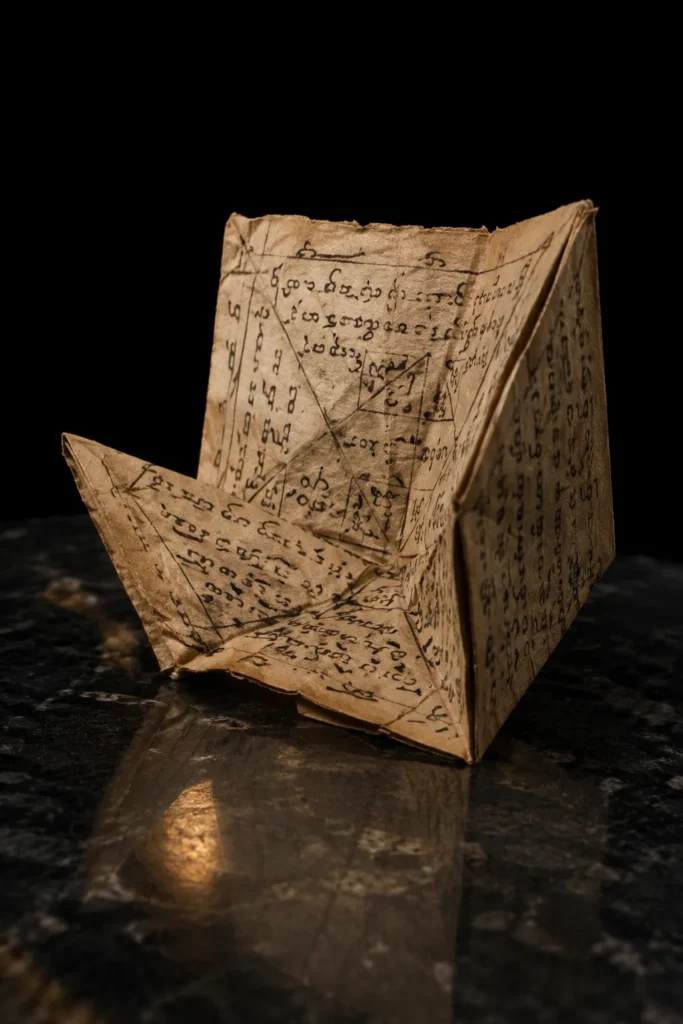
Classification
The Himmelsbrief is a document to which protective power was attributed. Its name derives from the claim that the letter had fallen from heaven or been written by God himself. This supposed heavenly origin grounded its alleged effectiveness.
The letter bears various names. Widespread are Himmelsbrief, Schutzbrief (protective letter), Segensbrief (letter of blessing), and, in connection with soldiers, also Schlachtbrief (battle letter) or Wehrbrief (defence letter). The variety of names reflects the different contexts of use.
In folkloric terms the Himmelsbrief belongs to the text-based means of protection. It stands in a line with blessing slips, Breverls, and other inscribed objects to which a warding power was attributed.
Unlike a carved or painted sign, the Himmelsbrief took effect through the text itself. The written word, above all holy words and names, was regarded as the carrier of the protective power. The letter thus belongs to the family of protective symbols of folk piety.
Characteristic is the close connection of Christian piety and folk-magical practice. The Himmelsbrief invokes God, Christ, and the saints throughout, yet links this invocation with a protective effect conceived in magical terms.
It should be emphasised that the protective effect of the Himmelsbrief describes a historical belief. The letter is a folkloric testimony, not an effective means of protection in the scientific sense. Church doctrine repeatedly rejected it.
Origin and History
The notion of a letter fallen from heaven is old. Already in late antiquity texts are attested that presented themselves as a heavenly message, often tied to the admonition to keep Sunday holy.
In the Middle Ages such letters spread in many versions across all of Europe. They were copied and passed on, frequently with the call to reproduce the letter, since this brought blessing and its omission misfortune.
A particularly well-known version is the so-called Sunday letter, which had allegedly fallen from heaven in Jerusalem or Rome. Alongside it arose versions that expressly promised protection against specific dangers.
With the spread of printing, Himmelsbriefe were printed and sold in large numbers. They belonged to the popular printed wares that were distributed at markets and by pedlars. In this way the letter reached broad sections of the population.
The Himmelsbrief reached a peak as a soldier’s letter in the wars of the 18th, 19th, and early 20th centuries. Soldiers carried it as protection against bullet and blow. Such letters were still widespread in the First World War.
The history of the Himmelsbrief shows a remarkable longevity. From late antiquity through the printed market sheet to the soldier’s letter of the 20th century, the basic idea remained alive over many centuries.
The Himmelsbrief acquired a distinct layer of influence through the Reformation and the confessional tensions of the early modern period. While the letters circulated in Catholic and Protestant regions alike, the churches of both confessions warned against them equally.
It is precisely this ecclesiastical resistance that is well documented and shows how deeply the custom was rooted in the population.
Form, Material, and Production
The Himmelsbrief is a textual document. In earlier times it was copied by hand, later printed. The material was paper or parchment, the format usually small enough to be folded and carried.
The text follows recurring building blocks. At the beginning there is often the account of the heavenly origin, then follow admonitions, blessing formulas, and concrete promises of protection. The conclusion is often formed by the call to pass the letter on.
Central components are holy names and words. The names of God, of Christ, and of the Three Kings, short Bible verses, and Latin formulas were regarded as especially powerful. They formed the core of the attributed effect.
Printed Himmelsbriefe were often decorated with images. Depictions of the Crucifixion, of the Holy Family, or of patron saints adorned the sheet and underlined its pious character.
For carrying, the letter was folded several times so that it formed a small packet. It was frequently sewn into a piece of cloth or kept in a capsule, similar to an amulet and talisman.
A special consecration was not strictly required, since the letter drew its power, according to belief, from the text and the heavenly origin. Some bearers nonetheless had the letter additionally blessed to strengthen the effect.
Some versions were furnished at the margin with crosses, small stars, or rows of letters that were regarded as additional protective formulas. Such signs reinforced the pious impression of the sheet and visibly linked the letter with the broader family of written and drawn means of protection of folk piety.
Folkloric Background and Beliefs
The Himmelsbrief rests on the belief in the power of the written holy word. Holy names and Bible words were regarded not merely as a message but as an effective power that protected through their very presence.
The claimed heavenly origin was decisive for the effect. A letter written by God himself had, by this logic, to be infallible. The account of the letter falling down grounded and secured its authority.
The Himmelsbrief promised protection against a series of concrete dangers. Frequently named are fire, water, lightning, war, weapons, plague, and sudden, unprepared death. This list reflects the greatest fears of premodern society.
Sudden death without the sacraments was regarded as especially feared, since it threatened the salvation of the soul. The Himmelsbrief promised protection here, which explains its importance for soldiers and travellers who were exposed to such dangers.
The call to pass the letter on followed a logic of its own. Whoever copied and spread the letter was to receive blessing, whoever neglected it, misfortune. This chain structure ensured the ongoing spread of the text.
The ecclesiastical attitude toward the Himmelsbrief was critical. Theologians rejected the claim of heavenly origin as a fraud and warned against the magical use of holy words. Nevertheless the letter held on tenaciously in folk piety.
Remarkable is the inner tension of the letter. It invokes the authority of the Church and holy words, yet at the same time withdraws from this authority by promising protection independently of confession, Mass, and priest.
This self-sufficiency in relation to the Church’s mediation of salvation was one of the main reasons for the theological rejection.
Use and Custom
The Himmelsbrief was worn on the body. It frequently sat in the breast pocket, was sewn into the clothing, or hung in a capsule around the neck. Closeness to the body was regarded as important for the protective effect.
The letter was especially widespread among soldiers. Before setting out to war, many received a Himmelsbrief from relatives, often from the mother or the wife. It was meant to keep the bearer unharmed through bullet and blow.
Travellers, seafarers, and people in dangerous occupations also carried the letter. Those who exposed themselves to dangers they could hardly avoid sought an additional security in the Himmelsbrief.
In the house the Himmelsbrief was sometimes kept or hung up to protect the entire property. In this use it stood alongside other means of protection for buildings within folk piety.
The letter was frequently given as a gift. Presenting a Himmelsbrief to a departing soldier or traveller was an act of care and of good wishes. The custom of giving contributed to its spread.
The call to reproduce the letter led to many letters being copied by hand. The copying was itself regarded as meritorious and at the same time secured the continuous passing on of the text.
In military use, belief in invulnerability to bullets could also have immediate consequences. Reports from the 18th and 19th centuries tell of soldiers who behaved carelessly in reliance on the letter. It was precisely this disappointed expectation that contributed to the Himmelsbrief losing credibility over time even within the troops.
Regional Variants and Related Forms
The Himmelsbrief was spread across all of Europe and existed in many linguistic and substantive versions. The German-language variants differ by region in wording and presentation.
A well-known version is the letter that allegedly fell from heaven near Holstein. Other versions name Magdeburg, Jerusalem, or Rome as the place of finding. The place name lent the letter local credibility.
The Himmelsbrief is closely related to the Sunday letter, which admonished above all to keep Sunday holy. The two texts overlapped and were at times joined into mixed forms.
Also related is the Breverl, a folded protective packet from the southern German and Alpine region. It contained blessing slips, small images, and relic particles, and was worn like the Himmelsbrief.
Within the wider family of text-based means of protection stand blessing slips with individual prayers, inscribed slips in amulet capsules, and magical letters against particular illnesses. All share the belief in the power of the written word.
Despite regional diversity, a common pattern emerges. Everywhere the letter invokes a heavenly origin, everywhere it promises protection against concrete dangers, and everywhere it combines Christian piety with an effect conceived in magical terms.
Beyond the Christian West, related notions are also known in other written cultures. Texts that present themselves as a heavenly message and whose copying promises blessing are found in various religious contexts. The European Himmelsbrief is thus the regional expression of a more widely spread phenomenon of the powerful, supernaturally authenticated document.
Significance as a Means of Protection
The protective significance of the Himmelsbrief rests on the belief in the power of the holy written word. Holy names, Bible verses, and the claimed divine authorship together formed the attributed effect.
The letter promised a comprehensive protection. Unlike a means directed against a single danger, it covered a whole list of threats, from fire and water through war to sudden death.
Especially significant was the promised protection against unprepared death. In an age in which the salvation of the soul depended on a good death provided with the sacraments, this promise carried great weight.
For soldiers the value of the letter lay in the hope of bodily invulnerability. The belief of being bulletproof through the letter gave a spiritual support in a hopeless situation.
The function of the letter was thus also psychological. Whoever carried a Himmelsbrief felt less defencelessly exposed to danger. This calming effect was independent of the question of a real protective performance.
It must be noted that this protective significance reflects historical beliefs. A real warding off of bullets, fire, or death is not connected with the Himmelsbrief. Its value lies in the cultural-historical statement about past fears and hopes.
It is striking that the Himmelsbrief bound its protective effect not to a person but to the document itself. Whoever passed the letter on or lost it thereby also relinquished the attributed protection. This firm binding of power to the object distinguishes the letter from a personally spoken blessing.
State of Sources and History of Research
The source situation for the Himmelsbrief is favourable, since many examples have been preserved as printed sheets and handwritten copies. Collections and archives keep numerous versions from several centuries.
The oldest evidence for the notion of a heavenly letter reaches back to late antiquity. Medieval manuscripts transmit early versions that spread across all of Europe.
The printed Himmelsbriefe of the early modern period and the 19th century are especially well documented. They belong to the popular printed graphic art that is collected and studied by scholarship.
The Handwörterbuch des deutschen Aberglaubens (Concise Dictionary of German Superstition) offers a detailed entry on the Himmelsbrief. It orders the various versions and describes the customs of carrying and giving.
Ecclesiastical sources are also instructive. Theological writings and pastoral letters that warned against the Himmelsbrief at the same time document its spread and the official rejection of the custom.
The history of research shows that the Himmelsbrief is a well-studied phenomenon. Folklore studies, book studies, and church history have together drawn a detailed picture of its long history.
Helpful for research is that many Himmelsbriefe bear a place of printing and a publisher’s name. Through these details, printers, print runs, and channels of distribution can be reconstructed. It thus becomes apparent that the Himmelsbrief was not only a religious but also an economic phenomenon that secured an income for entire workshops.
Present-Day Reception
The Himmelsbrief has largely disappeared from use as a worn means of protection. With the World Wars and the social change of the 20th century, the soldier’s letter lost its broad spread.
In museums and collections, Himmelsbriefe are valued objects today. They illustrate the folk piety of past centuries and the fears with which people lived, in an impressive way.
In research the Himmelsbrief is regarded as a textbook example of the close interweaving of religion, magic, and print transmission. It is treated in folkloric and book-historical accounts.
A distant kinship exists with modern chain letters. The call to pass on, combined with the promise of fortune and the threat of misfortune, recurs in today’s chain messages.
Those interested in the historical background will find reliable information in folkloric accounts and in the overview of protective symbols. The connection of writing and protection can be traced there in context.
Present-day reception thus shows a clear change. The protective letter once taken seriously has become a historical collector’s item whose significance today lies in its cultural-historical statement.
In folkloric teaching the Himmelsbrief often serves as an example of how a custom remains stable over centuries while at the same time adapting to new conditions. From the handwritten Sunday letter through the printed market sheet to the forwarded chain message, the same basic structure appears in ever-changing form.
Literature (Selection)
Related key terms: protective letter, letter of blessing, Sunday letter, soldier’s letter, Breverl, folk piety, blessing formula, patron saints, sudden death, holy word, warding off harm.
iWell Guard and Protective Traditions
iWell Guard stands in the cultural-historical line of portable protective objects to which the Himmelsbrief also belongs. A modern companion for people who live with protective symbols: made in Germany, 41 layers of solid gold, platinum, and silver, with a 30-day right of return.
Personal experiences may vary. Not a medical device. No healing promise.