Ganesha, god of the Hindu tradition
By Ralf Ittermann · last reviewed on
Ganesha is a god of the Hindu tradition.
The elephant-headed god, remover of obstacles and lord of beginnings. Ganesha is one of the most beloved gods of Hinduism, not for his might but for his wisdom and humorous benevolence.
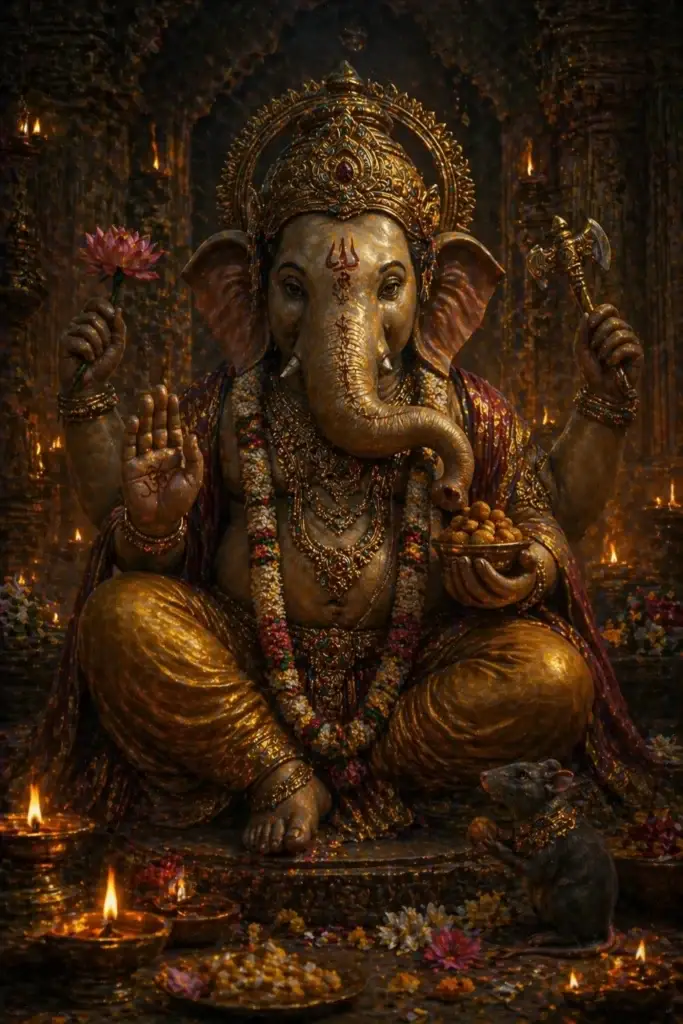
With his massive elephant head, his ample, gentle body and the mouse *Mooshika* at his feet, he embodies everything that is reassuring and at the same time cosmically surprising.
No Hindu undertaking begins without Ganesha’s blessing, whether a letter, a journey, or a business. He is the scribe of the Mahabharata, the companion of every beginning.
Ganesha is patron of the removal of obstacles and tutelary deity of new beginnings.
Ganesha
Short Profile: Ganesha
Type: Major Hindu deity, god of the removal of obstacles and of wisdom
Pantheon: Hinduism (Shaivism, Smartism, venerated across all Hindu traditions)
Function: Remover of obstacles, patron of learning, presiding deity at the beginning of every undertaking
Main attributes: elephant head, four arms, broken tusk, modaka (sweet dumpling)
Principal cult sites: Mumbai (Siddhi-Vinayak), Pune, Sri Lanka (Tamil tradition)
Buddhist identification: Vinayaka (in Vajrayana Buddhism)
Context
Period of the Texts
Ganesha is attested iconographically from the 5th century CE; in literature, an elephant-headed deity is absent from the oldest Vedic texts such as the Rigveda, and an identification of Ganesha with Brahmanaspati is not established. He rises to a leading deity during the Gupta period (4th to 6th centuries CE).
The main cultic season today is the Ganesha Chaturthi festival week (August/September), especially in Mumbai and Maharashtra. In the 19th century Bal Gangadhar Tilak elevated him to a political and cultural symbol of Indian identity.
Geographic Distribution
Principal cult sites in India: Mumbai (Siddhi-Vinayak temple, one of the most visited Hindu temples worldwide), Pune (Dagdusheth Halwai Ganpati), the Ashtavinayaka pilgrimage route (eight Ganesha temples in Maharashtra), Tirupati as a subordinate sanctuary.
Internationally: the Tamil diaspora in Sri Lanka, Singapore, Mauritius, Malaysia. In Hindu temples around the world a Ganesha statue usually stands at the entrance.
State of the Sources
Central sources: the Ganesha Purana (the main source), the Mudgala Purana, the Ganapati Atharvashirsha (a Vedic-style hymn), and sections of the Skanda Purana and Brahma Purana. Secondary literature: Brown, Ganesh: Studies of an Asian God; Courtright, Gañeśa: Lord of Obstacles, Lord of Beginnings; Bailey, Ganeshapurâna.
Names and Spellings
Ganesha is depicted as a rotund, good-natured god with the head of a red or grey-blue elephant. One tusk is frequently damaged or broken off, in keeping with a story according to which he sacrificed it in order to complete his manuscript.
He often wears a plain garment or a tiger skin. Around him are placed modaka (sweet dumplings), flowers and incense. At his feet sits his mouse Mooshika, who appears insignificant yet, in Ganesha Tantra, can be read as the totality of his being.
Description
Ganesha is venerated before any other god, whether at a private altar or in the temple. The motto-prayer Om Gam Ganapataye Namaha wards off obstacles. In schools and universities Ganesha statues are installed for blessing ceremonies at the start of term.
The mouse beneath his feet symbolises the ego, which must be tamed. Ganesh Chaturthi is a festival of colours, music and public processions in which colossal statues are immersed in rivers.
Appearance and Symbolism
Ganesha bears a heavy, red elephant head on a human, corpulent body with four arms. A single tusk is missing. He often holds a quill, a staff, a sweet rice cake or a noose. The mouse is his mount. This iconography joins intellect, wisdom, prosperity and humility.
Profile: Ganesha
The most important aspects of Ganesha at a glance. The following fields summarise origin, function, appearance, veneration, symbols and parallels.
Ganesha is the son of Shiva and Parvati. In the best-known myth Parvati forms him from sandalwood paste to guard her door. Shiva, who does not recognise him, beheads him in anger.
At Parvati’s plea, Shiva replaces the lost head with that of the first available animal, an elephant. He is the brother of the war-god Skanda/Murugan and, in some traditions, the consort of Riddhi and Siddhi.
Vighnaharta (“Remover of Obstacles”). He is invoked before every new undertaking: weddings, journeys, the signing of contracts, the beginning of studies, the inauguration of offices and homes. He is the patron of scribes, teachers and students.
In the Tantra tradition he is a key deity for the Mūlādhāra chakra (root chakra). In the arts and in dance he is patron of literary and musical inspiration.
An elephant-headed figure with a thick human belly and four (sometimes six, eight or ten) arms. Skin colour red, gold or ivory. One broken tusk (in the Mahabharata tradition he broke it off in order to write the Mahabharata down).
His mount (vahana) is the mouse Mushika, a striking contrast to the elephant form. Attributes (in the four-armed form): axe, noose, modaka sweet, lotus. The seated posture is Lalitâsana (relaxed pose); he is often shown dancing.
Sphere of efficacy: Ganesha is the most frequently invoked Hindu deity in everyday life. Before every new undertaking the formula „Om Gam Ganapataye Namaha“ is recited. Pupils pray to him before examinations. Business owners install Ganesha statues at the entrance of the shop and at the till.
Ganesha Chaturthi (a ten-day festival in August/September) is one of the largest Hindu festivals, with processions and the ritual immersion of clay statues in water. Internationally he is also popular in modern spiritual movements.
Elephant head, broken tusk, four arms, modaka (sweet dumpling), axe (or Pasha noose), lotus, mouse (vahana), serpent as a belt, ample belly (cosmic abundance), the Om symbol. Flower: red hibiscus. He turns around himself (in one mythology he circles Shiva and Parvati as the entire universe, depicted as a sibling race with Skanda).
Vinayaka (“Supreme Leader”; Buddhism, the Vajrayana adoption), Kangiten (Japan, in the Vajrayana schools), Hermes (Greece, patron of paths and beginnings), Janus (Rome, the threshold god with two faces), the heraldic threshold guardians (Mesopotamia, winged bulls). In a wider comparison: Bes (Egypt) as a household protector and easer of difficulty, who is likewise invoked at thresholds.
Practical Means of Protection
Rituals of Veneration
Ganesha is the remover of obstacles (Vighnaharta, “Remover of Obstacles”). Before every new beginning (the founding of a business, moving into a house, taking up writing, a wedding) a Ganesha-pūjā is performed.
The principal festival is Ganesh Chaturthi (in the month of Bhadrapada, August/September) with ten days of veneration, especially celebrated in Maharashtra (Pune, Mumbai), where monumental Ganesha murtis are set up and immersed in the sea on Anant Chaturdashi (cf. Brown, Ganesh: Studies of an Asian God).
Modaka (sweet rice dumplings) are his preferred food offering.
Mantras and Invocations
The Ganesha bīja mantra “Gam” and the mūla mantra “Om Gam Ganapataye Namaḥ” stand at the opening of almost every Hindu ritual. The Ganesha Atharvashirsha (an Upanishadic text) is his central liturgical hymn. The Sankashtahara Stotra is recited on Sankashti Chaturthi (the fourth lunar night of each month) for release from obstacles.
Amulets and Protective Symbols
Small Ganesha statuettes in brass, silver or sandalwood at house entrances, in cars and on desks. His vahana (mount) is the mouse, symbolising suppressed desires. Yantra diagrams with Ganesha at the centre, engraved on copper plates, serve as vāstu-shānti protection. The symbol of the broken half-tusk is worn as a keepsake pendant.
Ganesha: Parallels in Other Cultures
Ganesha resembles the Greek Hermes (god of writing and rhetoric) and the Egyptian Thoth (god of wisdom and writing). His ample, gentle figure recalls humorous figures from traditions worldwide: the reassuring sage who instructs through absurdity. In modern Western esoteric circles Ganesha is popular as a symbol of overcoming obstacles and of humorous letting-go.
The Lost Head: The Birth Myths of Ganesha
No other aspect of Ganesha has preoccupied the transmission as much as his elephant head. The best-known version is found in the Shiva Purana: Parvati formed the boy from the rubbings of her own body and placed him as a guard before her bath.
When Shiva sought entry and the boy did not recognise him, the god struck off his head in anger. In order to console Parvati’s grief, Shiva had the head fetched from the first creature found sleeping with its face turned northward, and it was an elephant.
The Brahmavaivarta Purana tells the story differently: here Ganesha is begotten jointly by Shiva and Parvati, yet the gaze of the planetary god Shani, which by virtue of a curse burns up everything it looks upon, incinerates the original head of the child.
Vishnu then procures the replacement. Other texts, including passages of the Linga Purana, have Ganesha come into the world already with an elephant head in order to fulfil a cosmic mission.
This variety is not a contradiction to be resolved. Indology, for example in the works of Paul Courtright (Gaṇeśa: Lord of Obstacles, Lord of Beginnings, 1985) and Robert Brown (ed., Ganesh: Studies of an Asian God, 1991), reads the competing birth myths as layers belonging to different sects and periods.
The guardian myth emphasises the separation of mother and son and the reception of the son into the masculine order of the gods through a violent act of initiation.
The Shani variant shifts the responsibility away from the father onto an impersonal cosmic force. In both cases the exchange of heads marks the transition from a shaped creature to a fully divine being.
The broken tusk, another standard feature of the iconography, has its own narratives: sometimes Ganesha loses it in combat with Parashurama, sometimes he breaks it off himself in order to write down the Mahabharata dictated to him by the sage Vyasa.
Iconography and Material Culture
Ganesha’s pictorial formula has remained remarkably stable over the centuries and at the same time rich in carriers of meaning. The pot-bellied body, the elephant head with one whole and one broken tusk, the usually four arms and the small mount, a rat or mouse (mūṣika), form the core.
The hands carry varying attributes: an axe or an elephant goad (aṅkuśa), a noose (pāśa), a bowl of sweets (modaka) and frequently a gesture of fearlessness or of granting boons. The elephant goad refers to the guidance of the mind, the noose to the catching of obstacles.
The earliest securely identified Ganesha images come from the Gupta period, that is, the fourth to sixth centuries.
Older depictions of elephant-headed beings are disputed; some scholars point to vināyaka figures in pre-classical texts who were regarded as malevolent obstacle-makers and only later coalesced into a single benevolent god. This transformation from a feared into a venerated figure is one of the central themes of scholarship.
In material culture the spectrum reaches from monumental temple sculptures through household shrines to mass-produced objects. The pictorial practice becomes especially visible at the festival of Ganesha Chaturthi, when clay figures are made, venerated and finally dissolved in bodies of water.
The colossal, often plaster-cast festival figures of modern Maharashtra have given rise to an environmental debate of their own, because the materials pollute the water.
Outside India Ganesha is found in the art of Southeast Asia, for example in Java and Cambodia, where regional pictorial types developed, and in Tantric contexts in Tibet and Japan, where he appears as Kangiten in a double-figured embracing form.
Theological Standing and the Rank of First-Invoked Deity
Ganesha occupies a special place in the Hindu household of gods that overrides his relatively late entry into the canon. As Vighneshvara, lord of obstacles, he can both erect and remove impediments.
From this follows the ritual practice of invoking him first before every undertaking, every journey, every temple construction and every recitation of texts. This precedence holds across sectarian lines and makes him one of the few gods venerated equally by Shaivites, Vaishnavites and Shaktas.
Within Shiva’s family, Ganesha is the son of Shiva and Parvati and the brother of Kartikeya, the war-god, who in southern India enjoys a great cult of his own as Murugan.
Several myths recount the contest of the brothers, the best known being the race around the world: while Kartikeya circles the globe on his peacock, Ganesha merely walks around his parents, arguing that they are for him the entire world, and so wins the prize.
The story also founds his reputation as the clever rather than the swift son.
A theological tradition of its own, the Ganapatya current, raised Ganesha during the medieval period to the highest deity and produced in the Ganapati Atharvashirsha a text that identifies him with the absolute Brahman. This school remained regionally limited, above all in Maharashtra, but it has lastingly shaped the philosophical elevation of Ganesha.
In its symbolism the elephant head is read as great understanding, the trunk as the faculty of discernment and the mouse as desire that has been tamed, an allegorical reading which derives above all from more recent commentaries.
Reception from the Colonial Period to the Present
Ganesha’s modern reception history is closely bound up with political and cultural upheaval. At the end of the 19th century the nationalist Bal Gangadhar Tilak turned the festival of Ganesha Chaturthi in Maharashtra into a large public event.
The previously largely domestic celebration became a communal occasion which, under British rule, made possible assembly and collective identity. Part of the public visibility of the festival that persists to this day stems from this politicisation.
In the 20th and 21st centuries Ganesha became arguably the most internationally recognised Hindu deity. His diffusion in global popular culture, in yoga studios, on consumer goods and in advertising, has repeatedly given rise to debates about appropriation and disrespectful treatment.
Hindu organisations have protested on several occasions against the use of his image on shoes, on swimwear or in contexts connected with alcohol.
Within India too, Ganesha remains politically and socially charged. The Pancha Ganapati celebration in the Hindu diaspora and the discussion of environmentally sustainable festival figures both show that the tradition is continually renegotiated.
In scholarship, Paul Courtright’s psychoanalytically inflected reading of individual myths triggered fierce controversies in the 2000s and thereby also raised the question of who may write about religious images and by what methods.
To this extent the reception history of Ganesha is also a history of the dispute over who owns a god who has become global.
The Textual Tradition: Where Our Knowledge Comes From
Unlike the case of the great Vedic gods, Ganesha’s source situation can be dated comparatively precisely, and it is exactly this that makes him interesting for the history of religions.
In the oldest Vedic texts a single elephant-headed deity is absent. Early mentions of vināyaka refer to a group of obstacle-demons, for example in the Mānava-Gṛhyasūtra, a ritual text that describes procedures for placating these beings.
The transition to the familiar god takes place in the Puranas of the first centuries of the first millennium and afterwards. The Yājñavalkya-Smṛti already knows a single Vinayaka as lord of obstacles.
The Shiva Purana, the Skanda Purana and above all the Ganesha Purana as well as the Mudgala Purana systematically build out the biography. The latter two are pure Ganesha-Puranas and belong to the Ganapatya tradition; they are comparatively late, often dated to the second millennium.
For scholarship the result is a clear picture of a god forming before our eyes.
Studies by Yuvraj Krishan (Gaṇeśa: Unravelling an Enigma, 1999) and the contributions in the volume edited by Robert Brown have shown how a unified profile condensed from several strands: the Vedic obstacle-demons, a possible popular animal cult, and the integration into Shiva’s family.
Inscriptions, coin finds and datable sculptures supply the archaeological control. Where texts and pictorial works diverge in date, scholarship remains cautious, for instance on the question whether certain early elephant-headed reliefs already refer to Ganesha or still to older local deities.
Ritual Practice: Invocation, Festival and Everyday Veneration
Ganesha’s veneration ranges from the brief opening formula to the multi-day festival. In everyday domestic life the pūjā stands at the centre, the offering of water, flowers, incense, lamp-light and food.
Ganesha is especially associated with modaka, a filled sweet dumpling, and with the red hibiscus, as well as with the grass dūrvā, which is presented to him in bundles. Before examinations, the founding of a business, house inaugurations and weddings he is invoked first, often with the formula oṃ gaṃ gaṇapataye namaḥ.
The annual Ganesha Chaturthi in the month of Bhadrapada is the moment of greatest ritual density. A clay figure is brought to life through recitation (prāṇapratiṣṭhā), venerated over hours or days and finally dissolved in a body of water (visarjana).
The temporary presence of the god and the deliberate dissolution of the figure are theologically significant: the god is a guest, not a permanent possession. In Maharashtra this has given rise to public pavilions, processions and competitions.
In addition there are specialised practices. Tantric schools know their own mantra and yantra procedures for Ganesha, for example for the removal of obstacles before magical and ritual undertakings. The Ashtavinayaka pilgrimage to eight self-arisen Ganesha sanctuaries in Maharashtra binds regional piety into a fixed network of routes.
The weekday Tuesday and certain lunar days are also considered especially dedicated to him. Common to all these forms is the function that gives meaning to the entire practice: Ganesha is invoked so that a beginning may succeed.
Further Links
Literature (Selection)
Frequently Asked Questions about Ganesha
Who is Ganesha in Hinduism?
Ganesha (Sanskrit Gaṇeśa, Lord of the Gaṇas, that is, of the divine retinues) is one of the most popular gods of Hinduism, the elephant-headed son of Shiva and Parvati. He is regarded as guardian of thresholds, remover of obstacles (Vighnaharta) and patron of beginnings, of the art of writing and of wisdom.
Before every important undertaking, a wedding, a business opening or the start of a book, Ganesha is invoked. His mount is a small mouse (Mooshika), which produces a striking tension with the size of the elephant.
Why does Ganesha have an elephant head?
The central myth: Parvati made the boy Ganesha from sandalwood paste to stand guard while she bathed. When Shiva came home and the unknown boy refused him entry, Shiva struck off his head in anger.
When he realised that this was Parvati’s son, he promised to take the first head his servant could find, and it was the head of an elephant. The story is iconographically central, but it also has a deep symbolic meaning: Ganesha unites animal and god, intellect (the elephant counts as wise) and humility.