Nammu and the clay of the first humans
By Ralf Ittermann · last reviewed on
Nammu is a goddess of the Mesopotamian tradition.
Primeval sea and primordial mother, who prompts the creation of the first humans from clay.
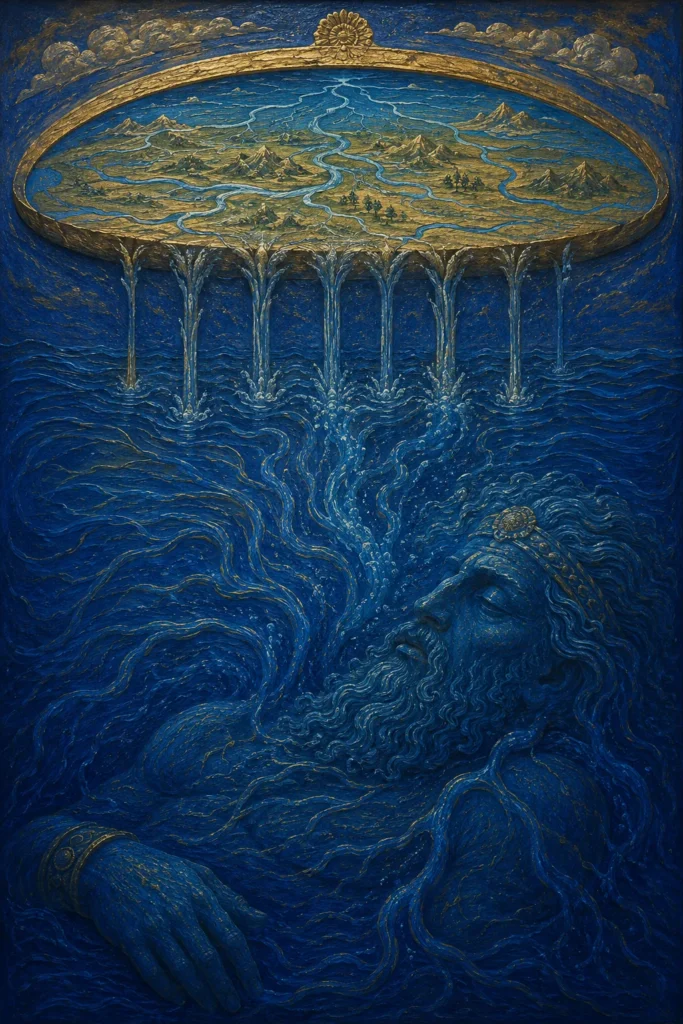
Nammu is the Sumerian primordial mother goddess, the embodiment of the primeval sea; her name and the element share the same cuneiform sign.
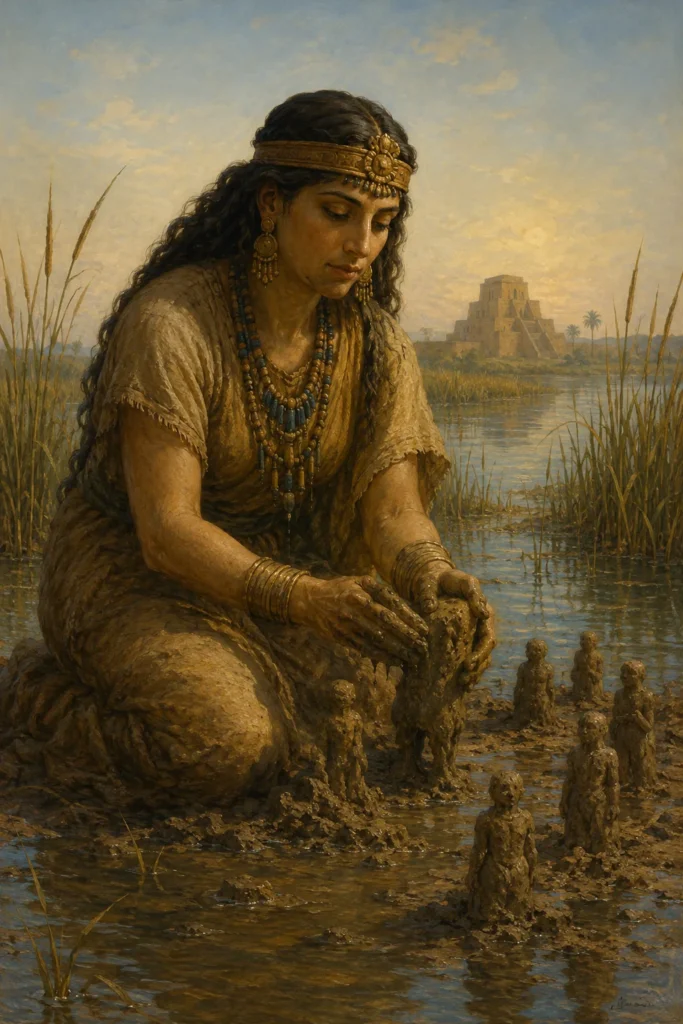
As Enki’s mother she wakes him in the myth Enki and Ninmah; he forms the first humans from clay together with Ninmah and seven helper goddesses.
Type: primordial mother goddess, embodiment of the primeval sea
Origin: Early Dynastic period, myth Enki and Ninmah
Texts: Sumerian texts, god lists
Period: Early Dynastic to Old Babylonian
Appearance: barely worshipped, a temple in Ur is attested
Context of Tradition
Period of the Texts
Attested from the Early Dynastic period, central to the myth Enki and Ninmah; from the Old Babylonian period on, also regarded as the mother of An and Ki.
Area of Diffusion
Southern Mesopotamia: Ur, Nippur, Babylon; widespread worship is not recorded.
Sources
Sumerian texts and god lists, less frequently attested than other primordial deities.
Name and variants
Language: Nammu is usually translated as creator; her name shares the sign for the fresh-water deep. The best-known reference is the royal name Ur-Nammu, servant of Nammu.
Being and effect
Appearance
Nammu embodies the primordial waters and the fertile marshland of southern Mesopotamia.
Effect
Unlike chaotic primordial figures, she bears maternal traits and instigates the creation of the first humans from clay.
Profile: Nammu
The key aspects of the primordial mother goddess at a glance.
Sumerian cosmogony, the oldest layer, predating the god lists.
The primeval sea and the creation of the first humans from clay.
No fixed iconography; conceived as water and as a kneading hand.
Origin of the generations of gods, initiator of the creation of humankind.
A temple in Ur is attested, otherwise scarcely any cult activity.
How the first humans arose from the primordial waters
Nammu is regarded as a primordial mother goddess; her name shares the sign for the freshwater deep, and she is the mother of Enki.
In the myth Enki and Ninmah, she wakes her son, who has her shape humans from clay together with Ninmah, that is, Ninhursag. In Old Babylonian tradition she is also the mother of An and Ki.
A forgotten primordial mother, read with caution
Nammu is received in modern goddess and matriarchy literature as a forgotten primordial mother; this reception goes beyond the thin source material and should be treated with caution. In religious studies she stands for the primordial water as the origin of all being.
A temple in Ur, otherwise little cult
Nammu was not widely venerated in cult; a temple dedicated to her in Ur is attested in the Old Babylonian period, along with texts from Nippur and Babylon. The royal name Ur-Nammu is understood to mean ‘servant of Nammu’. Holy water, salt and amulet draw on this tradition.
Primordial mothers and primordial waters compared
Frequently asked questions about Nammu
Who created humans according to the Sumerians?
According to Enki and Ninmah, Nammu instigates creation; Enki shapes humans from clay with Ninmah and seven goddesses.
How are Nammu and the Abzu connected?
Her name denotes the same freshwater deep as the Abzu.
Further links
Further reading:
Literature (selection)
Further standard works in the bibliography.
Nammu, goddess of the primordial waters, Sumerian primordial mother of gods and humans, is the origin from which the first humans were shaped in clay.