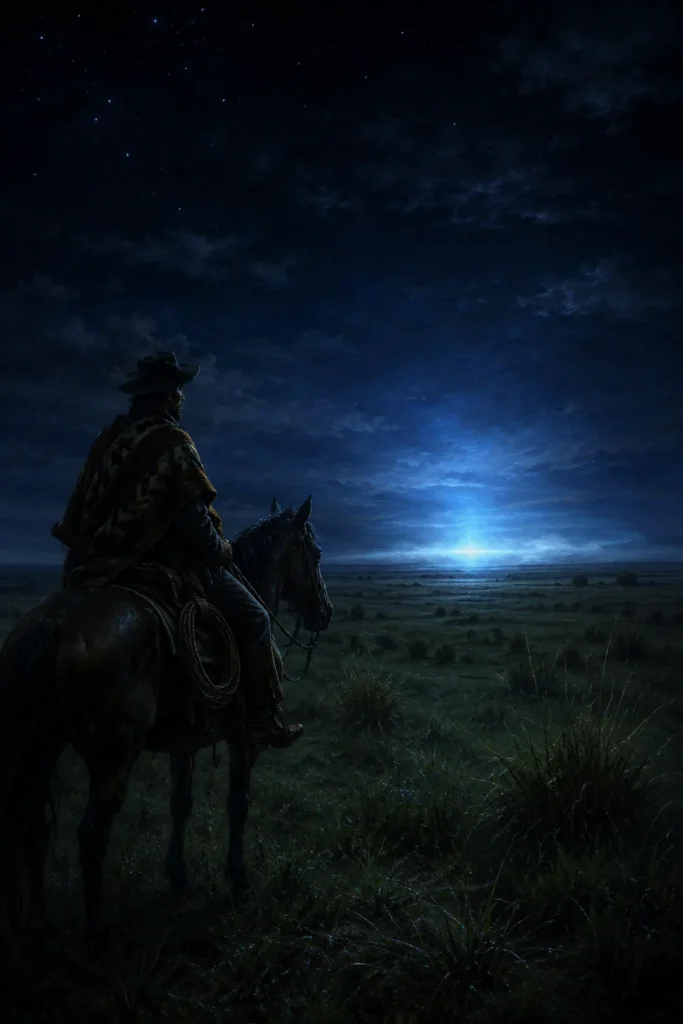
The Luz Mala is a spirit of Argentine tradition.
The evil light of the pampas, the manifestation of an unredeemed soul. The entry warns that anyone who meets the Luz Mala must withstand its glow without fleeing or answering its call.
Luz Mala, the evil light, is a ghost light of the pampas in Argentina and Uruguay. It hovers at night low over the ground and is regarded as the appearance of an unredeemed soul, for instance someone without a Christian burial or someone who died tragically.
Concrete warding customs oppose it: biting the knife blade, praying the Lord’s Prayer and standing one’s ground. The tradition knows two types: the soul-Luz of a poor soul and the treasure-Luz, which marks buried gold or silver.
Type: ghost light, appearance of an unredeemed soul
Origin: Gaucho folklore of the Río de la Plata with Iberian roots
Texts: Argentine folklore studies, including Coluccio and Vidal de Battini
Period: since the 19th century
Appearance: bright, low-hovering, often bluish light
The Luz Mala has been widespread since the 19th century, with accounts dating from the era of the civil wars between unitarios and federales.
The pampas of Argentina and Uruguay; the accounts belong to the Gaucho folklore of the Río de la Plata.
Good: Argentine folklore studies have recorded customs and accounts, including those by Coluccio and Vidal de Battini.
Spanish: luz mala means evil or bad light; in popular belief it is equated with the will-o’-the-wisp, fuego fatuo. Its roots lie in the Spanish and Portuguese belief in will-o’-the-wisps and poor souls.
Appearance
The Luz Mala appears at night as a bright, often bluish-phosphorescent light low over the ground, which may stand still, wander, or pursue travellers. The tradition knows two types: the soul-Luz of a poor soul and the treasure-Luz, which marks buried gold or silver.
Effect
The Luz Mala is regarded as the appearance of an unredeemed soul, for instance someone without a Christian burial or someone who died tragically. Looking directly at the light is said to harm one’s eyesight; running away is said to attract it. Standing one’s ground is considered the correct behaviour.
The key aspects of the ghost light at a glance.
Gaucho folklore of the Río de la Plata, in which Iberian will-o’-the-wisp and poor-soul beliefs merge with the landscape of the pampas.
Nocturnal travellers and gauchos: the light appears to them, follows them, or marks buried treasure.
A bright, often bluish-phosphorescent light that hovers low over the ground, stands still, wanders, or pursues.
Unsettling of nocturnal travellers: looking at it directly is said to harm one’s eyesight, running away is said to attract the light.
Biting the knife blade or the knife sheath, praying the Lord’s Prayer, crossing oneself, and not fleeing but standing one’s ground.
The English will-o’-the-wisp, the German Irrlicht, the Scandinavian Lyktgubbe, and the Boitatá in its light aspect.
Spanish luz mala means evil or bad light; in popular belief it is equated with the will-o’-the-wisp, fuego fatuo. The apparition belongs to the Gaucho folklore of the Río de la Plata, with Iberian roots in the Spanish and Portuguese belief in will-o’-the-wisps and poor souls.
It has been widespread since the 19th century, with accounts dating from the era of the civil wars between unitarios and federales. The light of the pampas thus has its own profile: it is not a light of the moors but of the open grassland, linked to unredeemed souls and buried treasure.
The Luz Mala is a firm part of Argentine-Uruguayan popular culture, present in the travel anecdotes of long-distance drivers, in literature, and in televised legend formats.
From a religious-studies perspective, the Luz Mala links the European will-o’-the-wisp and poor-soul beliefs with the landscape of the pampas. In natural-history terms, the light is usually interpreted as chemiluminescence from decaying organic matter or as an optical illusion; this fuego-fatuo interpretation explains many, but not all, sightings, for instance in dry terrain. Folklore and natural explanation should not be equated.
Specific warding customs are recorded: biting the knife blade or the knife sheath, a Gaucho custom, praying the Lord’s Prayer and crossing oneself, and not fleeing but standing one’s ground. In the case of the treasure-Luz, the brave dig for coins at the spot. These customs are documented in the folklore literature; the iron knife blade links the custom with the classic protective means iron.
The Luz Mala is a classic will-o’-the-wisp motif, related to the English will-o’-the-wisp, the German Irrlicht, and the Scandinavian Lyktgubbe. In South America, it is closely related to the Brazilian Boitatá in its light aspect; at the other end of the world, the Australian Min Min Light belongs to the relatives of the motif.
What does Luz Mala mean?
Evil or bad light; in popular belief the apparition is equated with the will-o’-the-wisp, fuego fatuo.
How is it warded off?
By biting the knife blade, praying the Lord’s Prayer, crossing oneself, and not fleeing but standing one’s ground.
What is the treasure-Luz?
A type of Luz Mala that marks buried gold or silver; at the spot, the brave dig for coins.
Recommended internal links:
Further standard works in the bibliography.
As the evil light, the Luz Mala has become part of Gaucho folklore and remains at the same time the best-known will-o’-the-wisp of the pampas: an apparition that, according to tradition, one does not flee from but stands firm against.
Against its influence, cross-cultural tradition names these protective means:
Compare in the Protection Compass →Recommended protective means
The simplest protective means in this collection: 41 layers of fine gold 999, platinum, silver and silicon, manufactured in Ruhla, Thuringia. It requires no activation, is bound to no person, and is effective within a radius of around 50 meters, even without being worn.

Related Beings

The Sumpall, ambivalent water people of the Mapuche. Origin in the serpent myth, reciprocity and ...
Enji (Zjarri, I Verbti), the reconstructed fire god of Albanian tradition. Origin, the hearth cul...

The Silkie, the north English house spirit in white silk. Origin, the distinction from the Selkie...
Lamia, the child-bed demoness of the Greek tradition. Seductress and child-snatcher, the dark sid...
Rise from city god to imperial god, victory over Tiamat, Esagila temple, Akitu festival, 50 names...

Orisha cult, Ifa divination and Egungun mask cult of the Yoruba: explained on a sound religious-s...
