The Celtic Cross: High Cross and Christian Symbol of Protection
By Ralf Ittermann · last reviewed on
The Celtic cross combines the form of the cross with a ring around the point where the beams intersect. It derives from the stone high crosses of Ireland and Britain and ranks among the most impressive Christian monuments of the early Middle Ages.
Classification
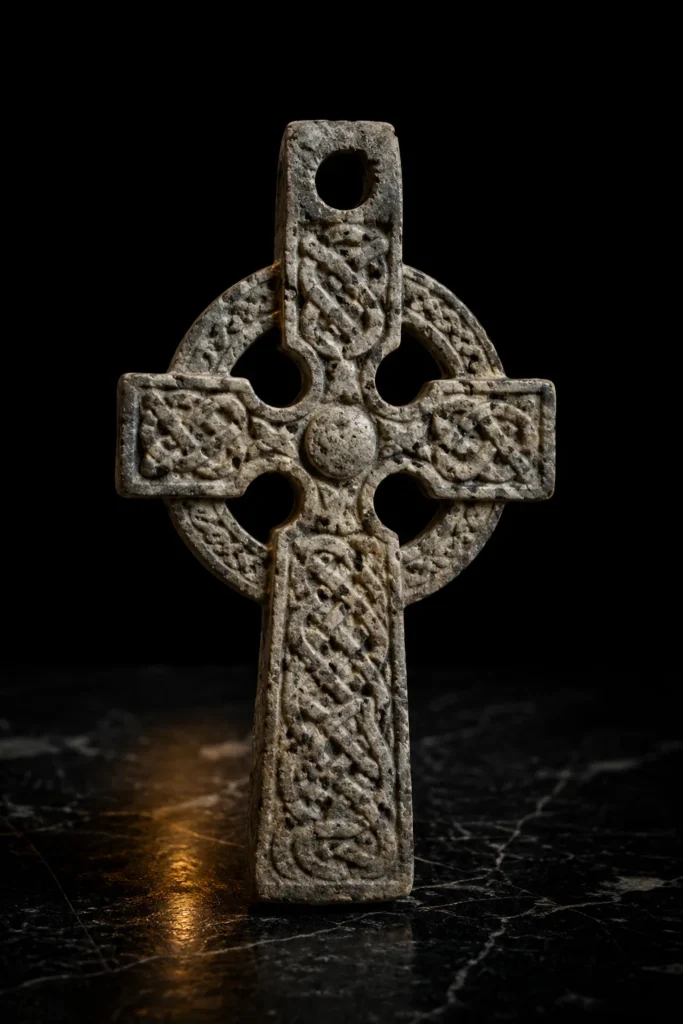
The Celtic cross is a particular form of the Christian cross. Its distinguishing feature is a ring that encloses the point where the vertical and horizontal beams intersect. This combination of cross and ring makes the sign unmistakable. It ranks among the best known signs associated with the Celtic world.
The Celtic cross has its origin in the stone high crosses of Ireland and Britain. These crosses arose in the early Middle Ages and rank among the great testimonies of insular Christian art. The Celtic cross was thus first a monument and only later became a worn sign.
In art history the Celtic cross is well researched. Its history can be traced through the surviving stone crosses. This good source situation allows for a precise account. In this respect it differs from signs whose origin remains obscure.
As a symbol of protection the Celtic cross belongs to Christianity. According to the Christian understanding it protects because it shows the cross of Christ and points to his victory over death.
The ring is added as a further element. The Celtic cross is thus an independent expression of the general Christian sign of the cross.
Form: Cross and Ring
The basic form of the Celtic cross is quickly described. It is a cross whose four arms are intersected or enclosed by a ring. The ring sits exactly where the vertical beam and the horizontal beam cross. It connects the four arms with one another.
The proportions can vary. In some Celtic crosses the vertical beam is markedly lengthened, so that the basic form recalls the Latin cross. In others the arms are roughly equal in length, which comes close to the Greek cross. The ring remains in all cases the connecting feature.
There are various considerations regarding the meaning of the ring. In purely structural terms the ring gave support and stability to the widely projecting arms of a stone cross. It prevented the free-standing arms from breaking off. This practical explanation is readily understandable.
Beyond its structural purpose the ring could also be interpreted. The interpretation as a sign of eternity or as a symbolic image of the sun and of light is widespread.
Which interpretation the builders had in mind is not always recorded. What is certain is that the ring lends the Celtic cross its distinctive, closed form.
The High Crosses of Ireland and Britain
The true home of the Celtic cross is the high crosses. This term denotes the large, free-standing stone crosses that were erected in the early Middle Ages in Ireland and in parts of Britain. Some of these crosses reach a considerable height.
The high crosses arose over several centuries. Their great period lay in the early and high Middle Ages. They were set up at monasteries, churches and important places. Many of them survive to this day and still stand in their original location.
These stone crosses are skilfully worked. Their surfaces are covered all over with carving. Alongside the interlaced ribbon work that is characteristic of insular art, many high crosses bear figural depictions. They rank among the most significant pictorial works of their era.
The high crosses are that from which the Celtic cross as a sign emerged. Every later use of the form, whether as a gravestone or as a pendant, ultimately goes back to these stone monuments. Whoever wishes to understand the Celtic cross must begin with the high crosses.
Function of the Stone Crosses
The high crosses had several tasks in early medieval life. One important function was that of a preaching cross. The community could gather at such crosses, and their pictorial works served to convey Christian teaching. The cross was thus a place of proclamation.
Other high crosses marked boundaries. They indicated the extent of monastery grounds or of a consecrated precinct. Whoever reached such a cross knew that they were entering a special, protected space. The cross secured and designated this boundary at the same time.
The high crosses also served as monuments and as memorial signs. Some were erected in remembrance of persons or events and bore corresponding inscriptions. They held fast the memory and placed the designated location under the sign of Christ.
In all these functions the Celtic cross was more than an ornament. It ordered the space, conveyed matters of faith and secured precincts. This combination of meaning and practical use is characteristic of the medieval world. The high cross was a religious sign and a useful marker in one.
The Pictorial Programmes of the High Crosses
Many high crosses bear extensive pictorial programmes. On their surfaces whole series of scenes are depicted, carefully arranged into panels. These images are not assembled at random but follow a thought-out structure.
The depictions mostly show scenes from the Bible. Narratives from the Old and the New Testament are placed side by side. The scenes were often chosen so that they refer to one another and together yield a theological statement. The high cross thus became a picture book in stone.
For the people of the early Middle Ages these pictorial programmes had an important task. Many could not read, and the images conveyed to them the central narratives of the faith. The high cross was thus a means of proclamation that managed without writing. It spoke through the image.
These pictorial programmes make the high crosses valuable sources. They show which biblical scenes were important to the people of that time and how they were interpreted. The Celtic cross is thus not only a sign but also a rich bearer of images and meanings.
The Legend of the Origin
There is a well known legend about the emergence of the Celtic cross. It attributes the combination of cross and ring to Saint Patrick, the missionary of Ireland. According to this narrative Patrick joined the Christian cross with a circle that represented a pre-Christian sign of the sun.
The sense of this legend is clear. It interprets the Celtic cross as a sign of encounter. The new Christian cross and an old sign dedicated to the sun are said to have been joined together in it. In this way Patrick is held to have brought the new faith closer to the people.
Like many origin legends, this narrative too is to be regarded with caution. It is an interpretive story, not a secure historical account.
Whether the ring form actually arose from a sign of the sun cannot be proven. The structural explanation, which sees in the ring a support for the stone arms, is at least equally convincing.
The legend is nonetheless revealing. It shows how the Celtic cross was interpreted over the course of time, namely as a bridge between old and new religion. Such narratives belong to the history of a sign’s reception. They are not historically reliable, but they reveal much about the image people formed of the Celtic cross.
Christian Sign and Protection
The Celtic cross is at its core a Christian sign. Its protective meaning derives from the general meaning of the cross. The cross points to Christ and to his victory over death, and from this reference its role as a symbol of protection grows.
Like the simple cross, the Celtic cross too could place places and people under the protection of Christ. The high crosses secured monastery precincts and paths. In smaller form the Celtic cross could stand at graves and designate and protect the resting place.
The ring adds its own trait to this protective meaning. As a closed form that returns into itself, the circle stands in many cases for eternity and for unbroken duration. In combination with the cross, the ring can express the idea of a constant, comprehensive protection.
As with every Christian sign, the ecclesiastical view applies here too, that the cross does not work of its own accord. It protects as a sign that orients people toward Christ. The Celtic cross is thus not a magical amulet but a sign of faith whose protection remains bound to belief.
The Celtic Revival
After the Middle Ages the Celtic cross receded for a long time. Its great return began in the 19th century. In this period a new, strong interest in the Celtic past arose, which is called the Celtic Revival.
In the course of this movement the Celtic cross was rediscovered and used anew. It became especially widespread as a form of gravestone. In many cemeteries, above all in Ireland and in the countries shaped by Irish emigrants, the Celtic cross became a frequent grave monument.
At the same time the Celtic cross became a sign of identity. It now stood for belonging to Irish or more generally Celtic culture. From a medieval monument a sign had emerged with which people expressly avowed an origin and a tradition.
The Celtic Revival shapes today’s image of the Celtic cross into the present. Much of what is associated with the sign today stems not from the Middle Ages but from this later revival. A precise account therefore distinguishes the medieval high crosses from their modern revival.
Reception Today
The Celtic cross is today a widely known and widespread sign. It appears as a gravestone, as a pendant and as a motif in design. Above all in connection with Irish culture and with the Christian faith it has a firm place.
For many people the Celtic cross is a religious sign. It combines the Christian cross with the particular tradition of the insular church. For others it stands above all for a connection to Celtic and Irish origin. Both meanings lie close together and do not exclude one another.
Like other old signs, the Celtic cross too is not protected from appropriation. It has happened that the form was used by groups whose concerns have nothing to do with its Christian and cultural meaning. Whoever depicts the Celtic cross should show it in its historical context.
At its core, however, the Celtic cross remains what it has been since the early Middle Ages, a Christian sign in an unmistakable form.
The stone high crosses of Ireland and Britain still stand today and bear witness to this origin. They are the most impressive testimony of a sign that joins cross and ring into a lasting unity.
Literature (Selection)
Related key terms: Celtic cross high cross ring cross insular art stone cross Patrick preaching cross Christian sign.
iWell Guard and Protective Traditions
iWell Guard stands in the cultural-historical line of portable protective objects to which the Celtic cross also belongs. A modern companion for people who live with protective symbols: made in Germany, 41 layers of solid gold, platinum and silver, with a 30-day right of return.
Personal experiences may vary. Not a medical device. No healing promise.