The Fascinum: the Roman protective amulet against the evil eye
By Ralf Ittermann · last reviewed on
The Fascinum was one of the most widespread protective amulets of ancient Rome. It was directed against the evil eye and was meant to deflect misfortune through its striking, attention-drawing form.
Classification
The Fascinum was a protective amulet of ancient Rome. It was among the most widespread amulets of the Roman world and is well attested through numerous finds and through ancient written sources.
The Fascinum was directed against the evil eye. The Latin term fascinum denoted both this harmful gaze itself and the amulet that was meant to protect against it.
The amulet was worn on the body, attached to vehicles and hung in various places. It was ubiquitous in Roman daily life.
Children in particular wore the Fascinum. Like the bulla and the lunula, it belonged to the means of protection used to safeguard childhood, which was felt to be at risk.
In religious studies, the Fascinum is a good example of an amulet that worked through a striking image that captured attention. It follows a clearly identifiable operative principle.
The Fascinum thus belongs to the apotropaia, the objects of misfortune aversion. It is one of the most revealing examples of Roman protective practice against the evil eye.
The evil eye in the Roman world
The Fascinum can only be understood if one knows the belief in the evil eye. This belief was firmly anchored in the Roman world.
According to this notion, a gaze could cause harm. The evil eye was frequently associated with envy. Anyone who looked upon something beautiful, healthy or successful with ill will could, according to this notion, harm it.
The Romans had their own term for this harmful effect. The word fascinum and related words denoted bewitching, the harmful incantation and the damaging power of the gaze.
Those who drew attention to themselves were considered especially at risk, that is, children, successful people and everything that appeared enviable. The victorious general in the triumphal procession was also considered at risk.
People sought protection against this danger. There were gestures, formulas and above all amulets meant to ward off the evil eye. The Fascinum was the most important of these amulets.
The belief in the evil eye was not a Roman peculiarity. It is widespread across the entire Mediterranean region and the Near East. The Fascinum is the Roman form of warding off this widespread belief in harm.
Form of the amulet
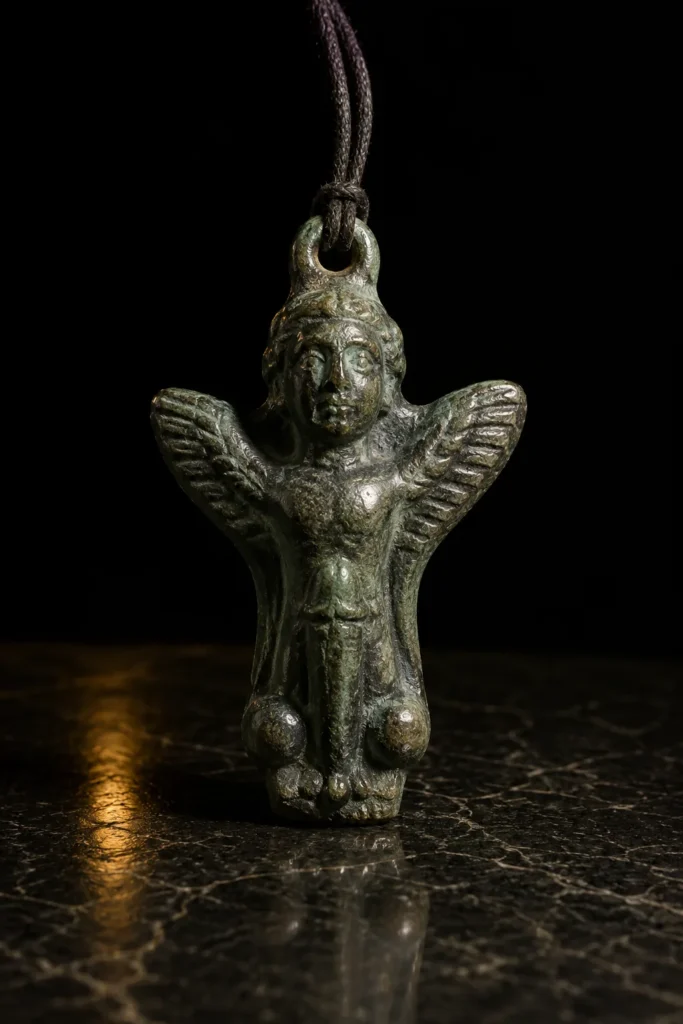
The Fascinum had a characteristic form. In many cases it depicted a male genital organ, often furnished with wings.
This depiction is at first disconcerting for the modern observer. For the religious-studies classification, however, it is to be considered matter-of-factly, as a widespread element of the ancient visual language of misfortune aversion.
In the ancient world this depiction was regarded not as offensive but as effective. The freely and conspicuously displayed image was meant to draw the gaze to itself and thereby divert it from the protected person.
The Fascinum was frequently made of bronze. It existed as a small pendant, as a bell amulet and in larger versions for houses and workshops.
Fascinum amulets with bells were also widespread. Small bells hung from them that rang when moved. The sound was meant to strengthen the protective effect, for a warding-off power was also attributed to sound.
The form of the Fascinum was thus designed for a single effect. It was meant to stand out, to bind attention and through its conspicuousness to divert the harmful gaze.
The operative principle: diverting the gaze
The Fascinum follows a clear operative principle. It wards off the evil eye not through terror but through distraction. It draws attention to itself.
The evil eye was considered dangerous because it was directed at a person. The Fascinum placed itself in this line of sight. Instead of striking the child or the person, the harmful gaze was meant to fall on the conspicuous amulet.
The unusual, freely displayed form of the Fascinum was decisive for this effect. An image that inevitably drew the gaze to itself, as it were, intercepted the harmful gaze.
Laughter was also part of the distraction. The conspicuous, at times comic-seeming form of the Fascinum could provoke a smile or a laugh. Laughter was regarded as a means of breaking the power of envy and of the evil eye.
The Fascinum thus warded off the evil eye through attraction, not through deterrence. In this it differs from the gorgoneion, which repels through a terrifying image.
In this respect the Fascinum resembles the blue eye amulet of the Mediterranean region. The nazar boncuğu, too, catches the gaze instead of repelling it. The Fascinum belongs to this family of intercepting protective objects.
The Fascinum and children
The Fascinum was especially closely associated with the protection of children. Children were considered at risk, and it was precisely to them that the amulet was given.
Ancient sources report that children had the Fascinum hung around them. It could also be contained within the bulla, the container amulet of boys. The hidden protective object inside the bulla was frequently a Fascinum.
Two protective ideas thus worked together. The bulla was the visible container, the Fascinum the hidden, protective core. The truly effective element lay within.
This connection shows that the Fascinum was regarded as an especially effective means of aversion. It was used where protection seemed most urgent, inside the child’s amulet.
The protection of children through the Fascinum fits into the widespread pattern. In very many cultures the most important protective objects are directed at the most vulnerable phase of life.
The Fascinum was thus a central means of Roman child-protection practice. Together with the bulla and the lunula it safeguarded the period of childhood, which was felt to be dangerous.
The Fascinum in public life
The Fascinum protected not only individual persons but was also present in public life. It was attached in many places where protection was desired.
The Fascinum was widespread on houses and workshops. It was attached to walls and above entrances and was meant to preserve the building and those working there from misfortune.
The Fascinum was also to be found on vehicles. It could be attached to wagons to protect the travellers and the journey.
A well-known tradition connects the Fascinum with the Roman triumphal procession. The victorious general was considered especially at risk in the moment of his greatest success through envy and the evil eye. Sources report that a Fascinum was attached to his wagon.
This tradition is revealing. It shows that the evil eye threatened the weak and precisely also the successful. Those who stood at the summit of success needed protection especially.
The Fascinum was thus an ever-present protective object. Its use ranged from the child’s amulet to the wagon of the triumphator. It belonged to the familiar picture of the Roman world.
The god Fascinus
The Fascinum was an amulet and was, beyond that, associated with a divine power. The Roman tradition knows a god Fascinus.
Fascinus was the divine power that was present in the Fascinum. He was regarded as a protective deity who acted against the evil eye and against envy.
Ancient sources report that the cult of Fascinus was tended by the Vestals, the priestesses of the goddess Vesta. Fascinus was thus integrated into the official cult of the Roman state.
That a protective power against the evil eye had its own deity and a cult tended by the Vestals shows how seriously the Romans took the evil eye.
The Fascinum was thus more than a popular amulet. It was associated with a deity and integrated into the state cult. Protection against the evil eye was a recognised religious concern.
This integration into religion and state cult distinguishes the Fascinum from many purely popular protective signs. It shows that the aversion of the evil eye in Rome had its place on all levels, from the child’s cradle to the state cult.
The Fascinum and ancient protective practice
The Fascinum belongs to a whole world of protective objects and protective customs with which the ancient world met the evil eye.
Alongside the Fascinum there were protective gestures. Certain hand positions were considered effective against the evil eye. Protective formulas and incantations were also used against it.
Beside these stood further amulets. The eye as counter-image, the conspicuous colour and the sound were regarded as means of aversion. Ancient protective practice possessed a rich repertoire.
Within this repertoire the Fascinum was the most widespread and most effective amulet against the evil eye. It captured the operative principle of distraction in a particularly clear form.
This ancient protective practice lived on beyond the end of Rome. The belief in the evil eye and the means of warding it off remained alive in the Mediterranean region, up to the present day.
The Fascinum itself disappeared with Roman antiquity, yet the concern it served remained. Later amulets against the evil eye, such as the coral-red horns and the blue eye amulet, continued this tradition.
Reception today
The Fascinum as a Roman amulet is no longer a living custom today. It is a protective object of the past that disappeared with Roman antiquity.
Nevertheless the Fascinum is well known. It is attested through numerous finds and represented in the collections of many museums. For the study of Roman everyday religion it is an important source.
The Fascinum shows how seriously the Roman world took the evil eye. It attests a comprehensive protective practice that ranged from the child’s amulet through the house to the state cult.
The Fascinum is also revealing in linguistic terms. From the Latin word fascinum derive words that in several modern languages denote enchanting and fascinating. In these words the old notion of the binding, captivating gaze lives on in faded form.
The Fascinum is thus a striking example of an ancient protective amulet. It shows the operative principle of distraction in clear form and belongs to the great, cross-cultural family of protective objects against the evil eye.
In it are combined the widespread belief in the evil eye, a clear operative principle and the integration into religion and everyday life. The Fascinum was one of the most important answers that ancient Rome gave to the fear of the harmful gaze.
References (selection)
Related key terms: Fascinum evil eye apotropaion Fascinus bulla triumphal procession envy Rome.
iWell Guard and protective traditions
iWell Guard stands in the cultural-historical line of portable protective objects to which the Fascinum also belongs. A modern companion for people who live with protective symbols: made in Germany, 41 layers of solid gold, platinum and silver, with a 30-day right of return.
Personal experiences may vary. Not a medical device. No healing promise.