The Protective Candle: Light Against Dark Influence
By Ralf Ittermann · last reviewed on
Candles burn in nearly all cultures at ritually significant places: on altars, at graves, in sickrooms, before thresholds and in spaces meant to be cleansed. This prevalence is no coincidence.
The candle unites several qualities that tradition links with a protective effect: it produces light in the darkness, it burns in a controlled way over a defined period, and it can be furnished with intention, a blessing or symbols. It is thus both a source of light and a ritual tool.
As part of the means-of-protection category Sound and Light, the protective candle stands between the open fire of the old threshold customs and the sober everyday lighting.
It is smaller and more controllable than the protective fire, but more deliberate and more charged than an ordinary light source. The tradition describes the candle above all as a means of individual and domestic protection.
The protective candle sets light against dark influence and makes the protective space visible.
Quick Overview
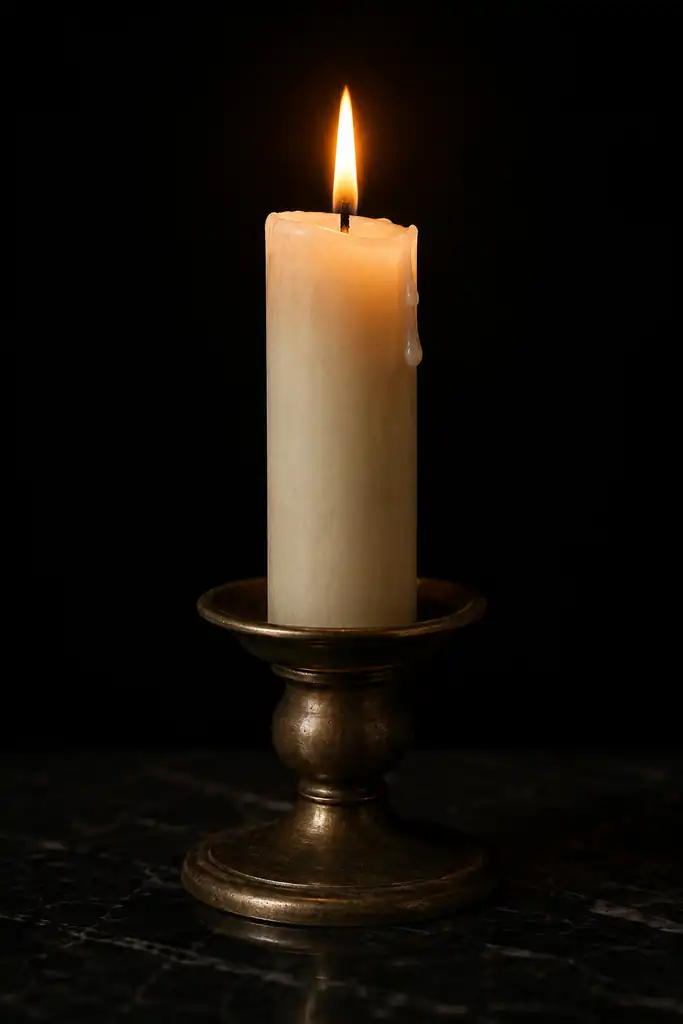
In tradition, the candle is regarded as protection that brings light into the darkness which harmful beings prefer. It is blessed, joined with prayers or furnished with symbols in order to strengthen its effect.
Consecrated candles hold particular significance in the Christian tradition, yet equivalents are found in Jewish, African American, syncretic and folk-magical contexts worldwide. The protective effect unfolds in the burning, not in the mere placing. If the flame goes out unintentionally, many traditions regard this as a warning or as the end of the protection.
Origin and Tradition
In Christian Europe, the protective candle developed out of the interplay of church ritual and folk belief. The consecration of candles at Candlemas, on 2 February, produced a particularly sought-after protective object: the consecrated Candlemas candle.
In the folk belief of many German-speaking regions it was set out or lit during thunderstorms to keep lightning and evil spirits away. It was placed in the hands of the dying so that the light might accompany the transition and keep evil beings away from the deathbed.
In the Ashkenazi Jewish tradition, the Havdalah candle burns at the close of the Sabbath as a multi-flamed torch that marks the difference between sacred time and the everyday.
In parallel, candles were used at graves and at Yahrzeit rites to honor the souls of the deceased and to secure their rest. The tradition here distinguishes between candles that burn for the protection of the living and those dedicated to the dead.
In the Afro-Brazilian religion Candomble and in other African American traditions, candles in particular colors are lit for specific Orixas, that is, deities.
White candles are dedicated to protection and purification, while other colors are chosen deliberately for protection against particular influences. This practice combines African origins with Catholic depictions of saints and forms a tradition of protection in its own right.
In Mexico and Central America, candles play a central role in Dia de los Muertos and in curanderismo practices. According to folk description, the candle opens a channel between the worlds and keeps harmful influences away from the space as long as it burns.
Working Principle According to Tradition
The tradition describes the protective effect of the candle on several levels. The simplest is the physical: light drives away the darkness in which harmful beings act. This idea is found from Greek antiquity down to present-day folk magic.
Beyond this, the tradition links the candle flame with sacred warmth and divine presence. According to this conception, a consecrated candle carries a blessing within it that is released in the burning.
The flame is not only light but also a medium that carries prayers and intentions into another level of reality. In shamanic and folk-magical contexts, gazing at the flame is regarded as a way to receive information or to focus intentions.
A third explanation is symbolic in nature: the candle stands for vital force, wakefulness and continuity. The deliberate lighting of a candle as an act of protection is an affirmation of occupying one’s own space and not surrendering it to the darkness.
According to folk conviction, this symbolic content strengthens the effect, because the intention of the one acting is regarded as part of the protection.
Cross-Cultural Prevalence
Central Europe: Candlemas candles, baptismal candles, Easter candles. According to folk belief, the baptismal candle accompanies the child through life and is lit in threatening situations. In some regions, the baptismal candle was also lit again at the person’s death.
Scandinavia: St. Lucia candles and Advent customs link light with protection in the darkest time of the year. In Nordic folk tradition, candlelight was deliberately placed in windows in winter to keep away evil guardians of winter.
Eastern European traditions: In Slavic and Greek Orthodox folk religions, blessed candles play a key role in healings, exorcisms and funerals. The candle marks the boundary between the ritual space and the outside world.
African American syncretisms: Candomble, Santeria, Vodou and related traditions use candles as the primary means of communication with protecting spirits and deities. The practice is highly differentiated: color, length, timing of the lighting and accompanying formulas are all encoded.
Southeast Asia and East Asia: In the Buddhist temples of Southeast Asia and in the Daoist cult sites of China, candles and oil lamps burn as a sign of the connection to gods and ancestors. In folk belief they are regarded as protection against spirits that are active at night or on particular days.
What It Is Used Against
The tradition describes the protective candle as especially effective against certain categories of harmful influence:
Spirits of the deceased that cling to places or persons. The candle at the bed of a sick or dying person was regarded in many European regions as protection against harmful souls or demons befalling the weakened person.
Nocturnal beings, that is, entities that require darkness as a condition of their activity. In European folk tradition these include the Alp, the Mare and similar figures, which are described as shunning the light.
Evil eye and the influence of envy. In Mediterranean, Near Eastern and Latin American traditions, the candle is used as protection against the evil eye, often in combination with other means of protection.
General harmful magic. In folk-magical practice, the candle is lit to cleanse a space of clinging bad energy before other means of protection are employed.
For specific associations with beings from the lexicon, the Protection Compass points to the relevant connections.
Application and Limits
The tradition recommends the deliberate use of the candle at particular times and in particular places: at the entrance of the house, at the bed, on the altar, at the threshold.
According to most traditions, the candle should be allowed to burn down completely when it has been lit for protective purposes. Blowing it out is regarded in many places as discourteous toward the kindled protection; pinching it out or letting it burn down is the expected procedure.
The limits lie in the temporal constraint imposed by the burning. A candle that has gone out no longer protects.
Several traditions describe the sudden extinguishing without a draft as a sign that the protective effect was drawn upon by something or that the threat was particularly strong. Whether this is interpreted as a success or a warning depends on the respective context.
Not all harmful influences are regarded as sensitive to light. Beings associated with fire or intense light cannot be warded off by candlelight. And the effect of consecrated candles is rated higher in the tradition than that of unconsecrated ones: the blessing is regarded as a strengthening ingredient.
Literature (Selection)
Related key terms: protective candle candle protection light ritual blessed.
iWell Guard and Traditions of Protection
The candle as a means of protection embodies a principle that cultures discovered independently of one another: the deliberately kindled light as a sign of self-assertion in the face of the unknown.
From the Candlemas candle in the Alpine region to the ritual candle in African American traditions, the lighting presupposes intention and concentration. The iWell Guard carries this synthesis of various traditions of protection as a worn object and accompanies the wearer even when no flame is burning.
Personal experiences may vary. Not a medical device. No promise of healing.