Aed, the fire behind the names of Ireland
By Ralf Ittermann · last reviewed on
Aed is a bearer of name and meaning in the Irish tradition.
The personified fire in the names of Ireland.
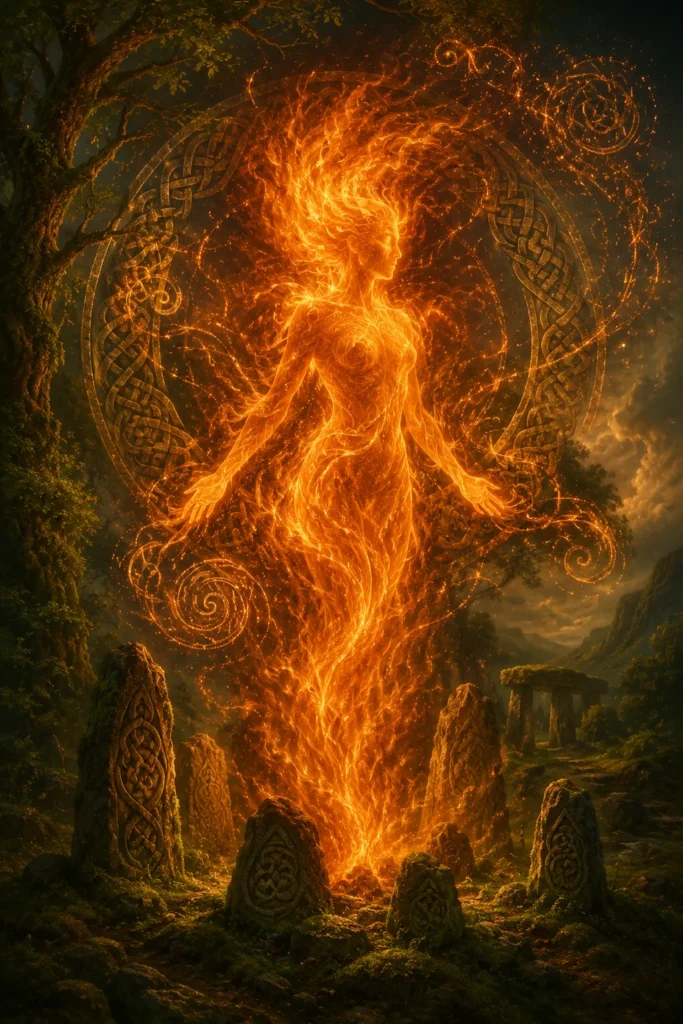
Aed, Old Irish áed, means fire and is at the same time the name of numerous figures of Irish mythology and history. As personified fire, Aed appears in sagas and genealogies; in terms of content, Aed is close to the fire and hearth goddess Brigid.
Aed has no fixed form of his own. He is one of the most common name elements in Ireland and occurs as the name of kings, saints and mythical figures, among them Aed, a son of Lir from the saga of the Children of Lir.
Type: Personified fire, mostly appearing as the name of mythical figures
Origin: Ireland, Celtic cultural area
Texts: Middle Irish literature, mythological and historical names
Period: Middle Irish literature through to present-day first names
Appearance: no fixed form, fire as the core of the name and its meaning
Region of origin and sources
Period of the Texts
Middle Irish literature: Aed is widespread in mythological and historical names and appears in sagas and genealogies.
Area of Diffusion
Ireland and the Celtic cultural area; as a name element, áed is spread throughout the whole of Irish tradition.
Sources
Moderate: Aed often appears as a name element and in sagas; established from the encyclopaedias of Ó hÓgáin and MacKillop.
Name and variants
Old Irish: áed, fire. It is one of the most common name elements in Ireland and occurs as the name of kings, saints and mythical figures. In terms of content, the name is close to the fire and hearth goddess Brigid.
Being and effect
Appearance
Aed has no fixed form of his own, but appears as a name and core meaning of fire. In the sagas, figures of various roles bear the name; the unifying symbolism is fire as life force, passion and warmth.
Effect
As personified fire, Aed stands for glow and life force. Those who bear the name act in the sagas according to their own individual role; the fire element remains present as a background meaning.
Profile: Aed
The key aspects of the fire name at a glance.
Irish mythology and onomastics: an element term that became the name of kings, saints and figures of saga.
The world of saga and names in Ireland: Aed carries fire as a layer of meaning in genealogies and mythological narratives.
No fixed form: Aed is personified fire and mostly becomes tangible as the name of mythical figures.
Embodies fire as life force, passion and warmth; appears as an epithet and as a figure in sagas.
An independent cult of Aed is not attested; Irish fire veneration is concentrated in Brigid and her sacred fire of Kildare.
The fire and hearth goddess Brigid as well as the fire names of other Indo-European traditions.
From element word to king's name
Old Irish áed means fire. It is one of the most common name elements in Ireland and occurs as the name of kings, saints and mythical figures, such as Aed, a son of Lir from the saga of the Children of Lir.
The meaning of fire closely links the name to the fire and hearth goddess Brigid: in her figure the fire veneration of Celtic Ireland is concentrated. Aed himself, by contrast, remained above all a bearer of the name and its meaning.
Afterlife and classification
Aed lives on today in Irish first names, for example in the forms Aodh and the anglicised Hugh. In mythology, he is present as the name of the Children of Lir and of numerous figures of saga.
From a religious-studies perspective, Aed is an example of how an element term, fire, becomes the name and layer of meaning of mythical figures without developing a cult of its own. In Ireland, the sphere of fire is concentrated in cultic terms in Brigid.
Fire veneration without its own cult
An independent cult of Aed is not attested. The fire veneration of Celtic Ireland is concentrated in the figure of Brigid, whose sacred fire was tended at Kildare. Aed himself is above all a bearer of the name and its meaning, not an object of cult.
Fire names and fire figures in comparison
As a linguistic personification of fire, Aed corresponds to the Irish naming principle that turns elements such as fire into personal names. In content, he is close to the fire and hearth goddess Brigid as well as the fire names of other Indo-European traditions. Within the Celtic pantheon, the smith god Goibniu and the Gaulish healing god Grannus also belong to the sphere of fire.
Frequently asked questions about Aed
What does Aed mean?
Old Irish áed means fire; it is also a very common Irish name.
Did Aed have a cult?
No. Celtic fire veneration is concentrated in the goddess Brigid.
Who is called Aed in the sagas?
Among others, one of the Children of Lir turned into swans, as well as numerous kings and saints.
Further links
Further reading:
- Celtic – all beings of the Celtic cultural area
- Brigid – the fire and hearth goddess
- Goibniu, Grannus – further fire figures of the Celtic world
- Protective candle, Amulet, Salt – traditional protective means
- Protection Compass – protective means at a glance
Literature (selection)
Further standard works in the bibliography.
Aed shows how an Irish fire lends its name to legendary figures and to kings alike: as a Celtic fire name, áed carries the glow of the world of saga through to present-day first names such as Aodh and Hugh.