The Vegvísir: the Icelandic protective sign against losing one's way
By Ralf Ittermann · last reviewed on
The Vegvísir is an Icelandic magical sign whose name means roughly that which points the way. Whoever carries it is said not to lose their way even in bad weather and on unfamiliar paths. Its origin, however, does not lie in the Viking Age.
Classification
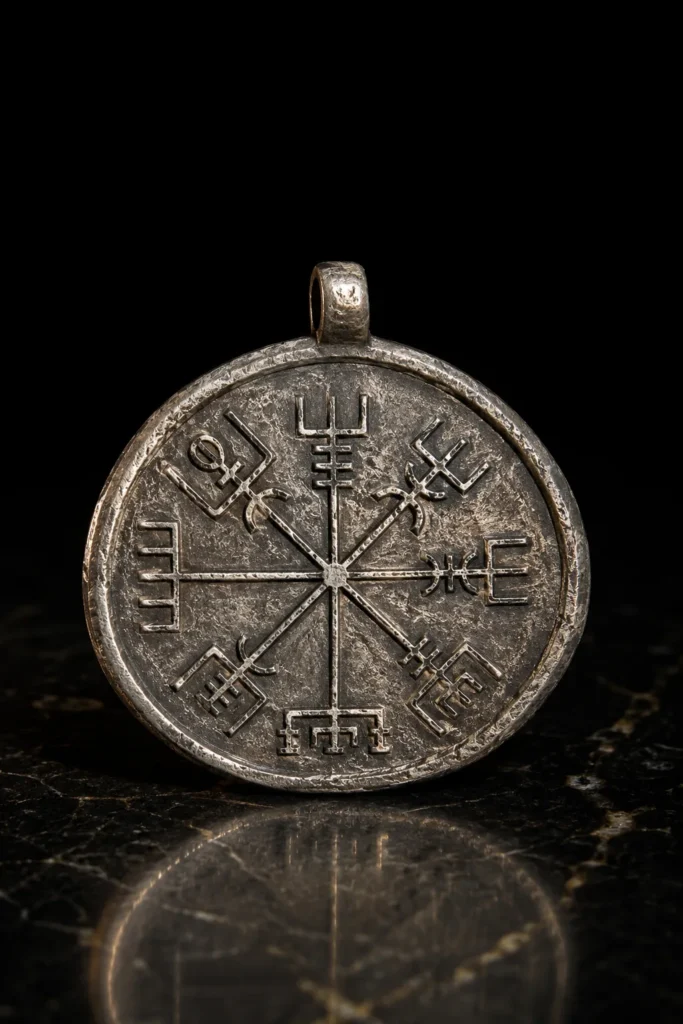
The Vegvísir is a sign from the Icelandic tradition of magical staves. It consists of eight stave-like arms radiating from a common centre.
Each of these arms is shaped differently and furnished with small branches or crossbars. This strict, star-shaped arrangement makes the Vegvísir unmistakable. It is one of the best-known signs associated with the Germanic and Nordic world.
Its task is clearly defined. The Vegvísir is meant to keep its bearer from losing their way. Whoever carries the sign is said to find the right path even in storm and bad weather, even when that path is unfamiliar to them.
This meaning is expressly recorded in an old source. The Vegvísir is thus a protective sign for a very concrete situation in life.
In religious studies and in the research on folk magic, the Vegvísir is classified with care. It does not belong to the Viking Age, even though it is often presented that way today. Its documented history begins only much later. This dating is decisive for a correct understanding of the sign.
The Vegvísir is thus an instructive case. It shows how a sign can derive from a particular, well-datable tradition and yet be assigned in the general consciousness to an entirely different era. A factual account separates documented knowledge from the popular notion. With the Vegvísir in particular, this distinction is especially worthwhile.
The name: that which points the way
The name Vegvísir comes from Icelandic and is readily understood. It is composed of the word for way and a word element denoting pointing or showing. Taken literally, the Vegvísir is therefore that which points the way. The name thus directly states the task of the sign.
This clarity of the name is remarkable. With many old protective signs the original designation is unknown or uncertain. With the Vegvísir, by contrast, the name is preserved in the source that describes the sign. Here name and meaning belong together from the very start.
In present-day usage the Vegvísir is often called the Viking compass. This designation, however, is misleading. It links the sign with the Viking Age and with the device of the compass. Neither applies, for the Vegvísir is neither of the Viking Age nor a compass in the technical sense.
More apt is the literal translation of the name. The Vegvísir points the way not by means of a needle and a cardinal direction, but as a magical sign that preserves its bearer.
Whoever takes the name seriously understands the sign correctly. The Vegvísir is a sign of not losing one’s way, not a measuring instrument.
The Icelandic magical staves
The Vegvísir belongs to a distinct group of signs, the Icelandic magical staves. In the Icelandic language they are called galdrastafir. They are geometric signs built up from staves, lines and small branches. A particular effect is attributed to each of these signs.
These magical staves belong to the Icelandic folk magic of the post-medieval period. They are preserved in handwritten collections that recorded magical knowledge. In these collections the signs stand alongside incantations, recipes and instructions. They form a coherent field of practical magic.
The Icelandic magical staves are not a pure continuation of the Old Norse religion. Various influences flowed into them, including Christian conceptions and learned magical traditions from continental Europe. The galdrastafir are thus an independent, later phenomenon. They combine several traditions into something new.
Within this group the Vegvísir is a single sign with a particular task. Other magical staves were meant to help against theft, to win love or to give aid in a quarrel. The Vegvísir was responsible for protection on the way. It thus had its fixed place within an entire system of signs.
The manuscripts
Knowledge of the Vegvísir rests on a small number of Icelandic manuscripts. The most important among them is a collection of magical signs compiled in the 19th century. This manuscript contains the sign together with a brief explanation. It is the central source for the Vegvísir.
The explanation in this manuscript is concise but clear. It states in essence that whoever carries the sign will not lose their way, neither in storm nor in bad weather, not even when the path is unfamiliar to them. These few sentences determine the meaning of the Vegvísir.
The manuscript itself dates from the 19th century. It was created by an Icelandic collector who gathered older magical knowledge. How far back the individual signs reach before this collection cannot always be said in detail. For the Vegvísir, at any rate, the collection is the oldest secure attestation.
From this follows an important observation. The Vegvísir as a sign with this meaning can be securely traced only from the 19th century onward. Earlier attestations are lacking. This source situation must be taken into account by any account of the sign, for it determines what can be said about the age of the Vegvísir.
Form: eight staves around a centre
The form of the Vegvísir is strictly constructed. From a central point eight arms radiate, pointing evenly in all directions. This division into eight recalls the division of the horizon into eight directions. It gives the sign its star-shaped, balanced appearance.
Unlike a regular star, however, the eight arms are not identically shaped. Each arm bears its own tip, its own crossbars or small branches. No arm fully resembles another. This variation among the arms is a characteristic feature of the Vegvísir.
The construction from stave-like lines links the Vegvísir with the other galdrastafir. They too consist of such staves with branches. The word stave in the term magical stave refers precisely to this construction. The Vegvísir is, as it were, composed of eight individual magical staves around a common centre.
The geometric clarity of the form has contributed to the great popularity of the sign. The Vegvísir lends itself well to drawing, engraving and tattooing. Its balanced star shape appears orderly and appealing. This formal strength is one of the reasons for its wide modern dissemination.
The protective function: protection against losing one's way
The protective function of the Vegvísir is narrowly and precisely defined. It is meant to guard against losing one’s way. The sign thus addresses a very concrete danger, namely that of losing the path and wandering astray.
For the lived world of Iceland this danger was by no means slight. The land is shaped by mountains, lava fields and wide, trackless stretches. Sudden changes of weather, fog and snowstorms could quickly cost a traveller their bearings. To lose one’s way under such conditions meant a serious danger to life.
Against this background the meaning of the Vegvísir becomes understandable. It was a sign for people who set out on a journey and hoped for a safe arrival. The protection it promised was thus directly related to everyday life. It answered to a real concern.
The Vegvísir thus belongs to a large group of protective signs related to travel. Other cultures too know signs and objects meant to preserve travellers. The Vegvísir is the Icelandic form of this widespread concern. It secures neither the house nor the child, but the person on the way.
The question of age
With the Vegvísir the question of age is of particular significance. In the present-day image the sign is widely held to be of the Viking Age. It is associated with the seafarers of the north, with dragon ships and with the world of the Old Norse gods. This attribution, however, is not documented.
The documented history of the Vegvísir begins only in the 19th century. From the Viking Age, that is, from the centuries around the year 1000, there is no find and no source that would show the sign. Between the Viking Age and the first attested depiction lie many centuries without attestation.
The Vegvísir belongs rather to the post-medieval Icelandic folk magic. This tradition is itself old and venerable, yet it is not to be equated with the religion of the Viking Age. The galdrastafir arose in a Christian period and processed various influences. The Vegvísir is a child of this later era.
This clarification takes nothing away from the appeal of the sign. The Vegvísir remains an impressive protective sign with a clear, beautiful form and a moving meaning. It is simply not a sign of the Viking Age. An honest account names this difference rather than perpetuating a widespread but mistaken attribution.
Vegvísir and related magical signs
Within the galdrastafir the Vegvísir does not stand alone. Closely related to it is the Ægishjálmur, often called the helm of awe. It too is a star-shaped sign of stave-like arms radiating from a centre. Vegvísir and Ægishjálmur are today often named together.
Despite their outward similarity, the two signs differ in their task. The Ægishjálmur was meant to confer protection and superiority upon its bearer, especially in distress and confrontation. The Vegvísir, by contrast, is directed toward protection against losing one’s way. Each sign has its own purpose.
Both belong to the same world of the Icelandic magical staves and share their peculiarities. They are built up from staves, they are preserved in manuscripts, and they derive from post-medieval folk magic. Whoever wishes to understand the Vegvísir should therefore see it within the context of this whole group.
The galdrastafir comprise many further signs for various concerns. The Vegvísir and the Ægishjálmur are only the two best known among them. This classification shows that the Vegvísir is not a single, isolated sign. It is part of a rich Icelandic tradition of practical protective magic.
Present-day reception
The Vegvísir is exceptionally widespread today. It is among the most popular motifs when it comes to signs of the Nordic world. As a tattoo in particular it is in wide demand, and beyond that it appears on jewellery, clothing and in design.
The Vegvísir owes this popularity to its clear, appealing form and its moving meaning. The thought of carrying a sign that guards against losing one’s way appeals to many people. It can also be understood in a figurative sense, as a sign of finding one’s way in life.
With its dissemination, however, comes the mistaken attribution already mentioned. Very often the Vegvísir is presented as an old Viking sign. This presentation is understandable, because it links the sign with a fascinating era, yet it cannot be sustained on factual grounds. A precise account should gently set this right here.
The Vegvísir thus remains a doubly interesting sign. It is a genuine protective sign from Icelandic folk magic with a well-attested meaning. And it is an example of how, in the modern image of history, signs are easily placed in the wrong eras. Both sides belong to a complete account of the Vegvísir.
Literature (selection)
Related key terms: Vegvísir Galdrastafir magical stave Iceland signpost Ægishjálmur folk magic Huld protective sign.
iWell Guard and protective traditions
iWell Guard stands in the cultural-historical line of wearable protective objects to which the Vegvísir also belongs. A modern companion for people who live with protective symbols: made in Germany, 41 layers of solid gold, platinum and silver, with a 30-day right of return.
Personal experiences may vary. Not a medical device. No healing promise.