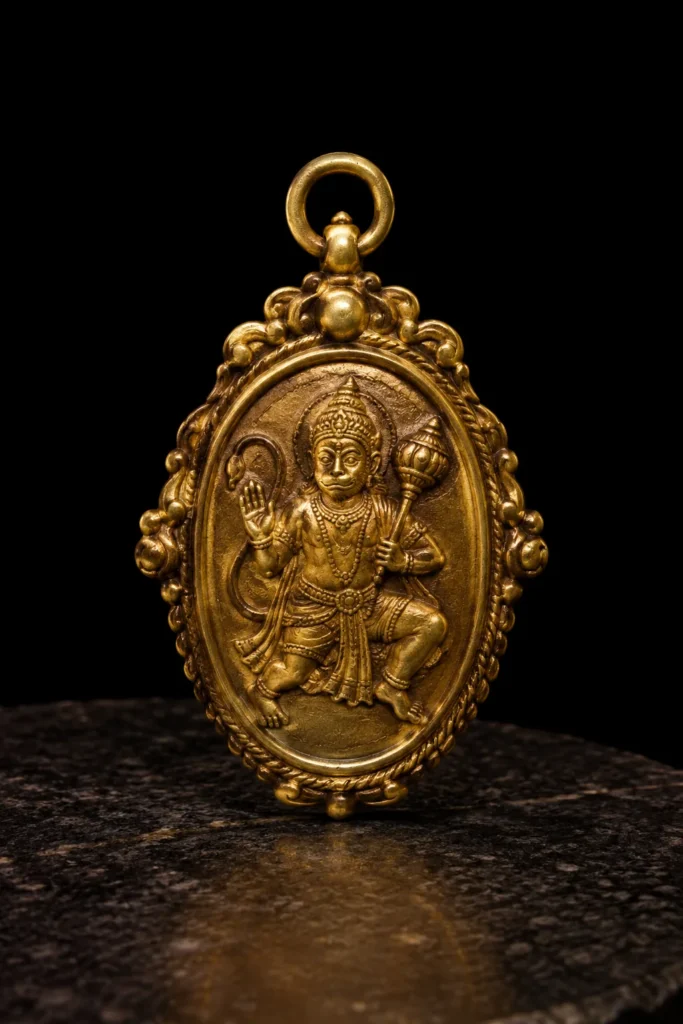
The Hanuman-Kavach is the protection of the monkey god Hanuman. The word kavach means armor or protection. In Hinduism it denotes both a protective hymn and a protective pendant that place the wearer under the assistance of Hanuman.
The Hanuman-Kavach belongs to the tradition of Hinduism. It is connected with Hanuman, one of the most popular gods of Hinduism, who is venerated in the form of a monkey.
The word kavach comes from Sanskrit and means armor, suit of armor or protection. A kavach is thus literally a protective armor, a means that surrounds the wearer much like a suit of armor.
In Hinduism the term kavach denotes two things. On the one hand it is a category of protective hymns, that is, certain spoken or recited texts. On the other hand it denotes the worn protective pendant.
The Hanuman-Kavach is the kavach that relates to Hanuman. As a hymn it calls upon Hanuman for protection. As a pendant it holds a written protective text and places the wearer under the assistance of Hanuman.
The protective significance of the Hanuman-Kavach rests on the figure of Hanuman himself. Hanuman is regarded as extraordinarily strong, faithful and brave, and as a god who effectively protects his worshippers.
In religious studies the Hanuman-Kavach is a good example of how a protective hymn and a protective pendant work together. The spoken and the worn protection follow the same basic idea, the turning toward a protecting god.

To understand the Hanuman-Kavach, a look at Hanuman himself is necessary. Hanuman is one of the most popular and most widely venerated gods of Hinduism.
Hanuman is depicted in the form of a monkey. He belongs to the principal figures of the great narrative of the king’s son Rama, in which he appears as a faithful companion and helper.
In this narrative Hanuman is distinguished by extraordinary strength, by courage and by unwavering loyalty. He accomplishes mighty deeds in the service of Rama and at the same time displays humility and devotion.
Hanuman is therefore regarded as the model of the faithful servant and the devoted worshipper. His strength is not selfish but is always placed in the service of the good.
From these qualities arises Hanuman’s role as a protective god. Because he is strong, brave and faithful, he is regarded as a god who effectively protects his worshippers from danger and from harmful powers.
Hanuman is venerated in numerous temples, and his images accompany many people in daily life. The Hanuman-Kavach belongs within the context of this broad and living veneration.
The word kavach carries a vivid imagery within it. It means armor or suit of armor and transfers this image to spiritual protection.
A suit of armor surrounds the body and protects it from blows and from missiles. It is precisely this image that underlies the kavach. Spiritual protection is meant to surround a person as a suit of armor surrounds the body.
A kavach as a hymn is therefore a text that raises up such a protective armor. Whoever speaks the hymn surrounds themselves, as it were, with a spiritual armor that wards off harmful influences.
The kavach hymns are often constructed so that they relate the protection to individual parts of the body. The hymn names in turn the head, the eyes, the hands and further limbs, and asks for the protection of the deity for each of them.
This structure reinforces the image of the suit of armor. Just as armor covers the body piece by piece, the kavach hymn covers the person limb by limb with divine protection.
The word kavach thereby shows how the Hindu idea of protection is conceived. Protection is not a vague wish but is imagined as a comprehensive armor surrounding the whole person.
In its original form the Hanuman-Kavach is a hymn, that is, a spoken or recited protective text. This hymn calls upon Hanuman for protection.
The hymn is composed in Sanskrit and arranged in verses. It praises Hanuman, his strength and his deeds, and asks him for assistance for the one who speaks the hymn.
Following the structure of the kavach hymns, the Hanuman-Kavach often relates the protection to individual parts of the body and to individual areas of life. In this way the whole person is included in the protection that is requested.
The hymn is spoken at particular times, for instance in the morning, before a journey or before a difficult undertaking. Whoever speaks it places the coming day or the coming undertaking under the protection of Hanuman.
The Hanuman-Kavach is connected with further texts in honor of Hanuman. Especially well known is a widespread hymn of praise that is regularly spoken in many families. The kavach stands close to these texts of veneration.
As a hymn the Hanuman-Kavach is thus a spoken means of protection. Its protection unfolds in the recitation, in the turning toward Hanuman through the spoken word.
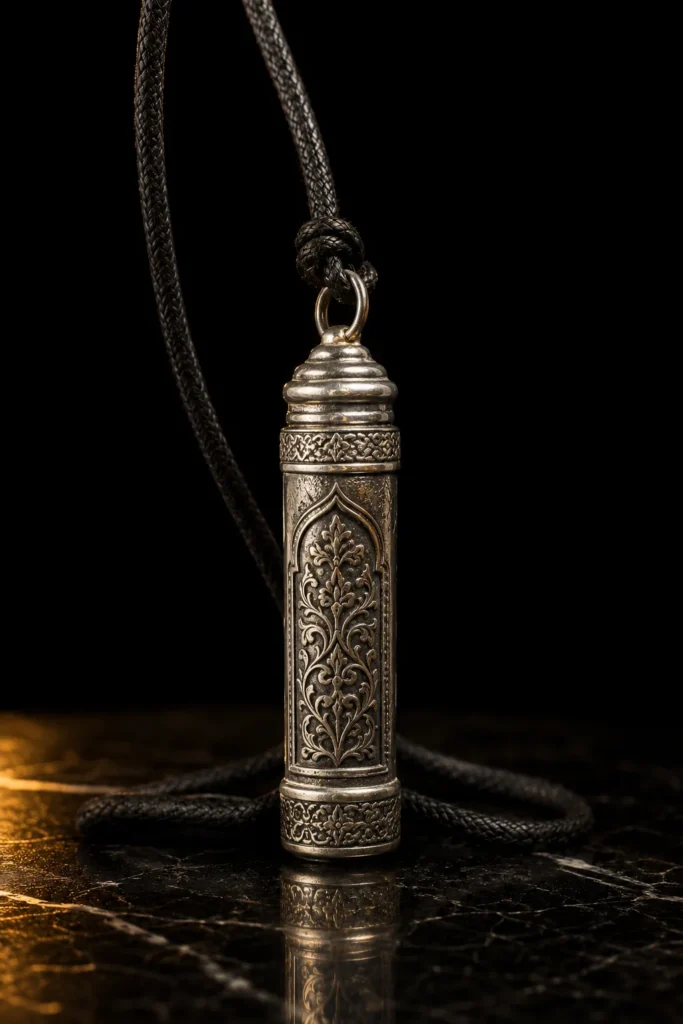
Beyond the spoken hymn, the term kavach also denotes the worn protective pendant. In this form the Hanuman-Kavach becomes a tangible protective sign.
The pendant is usually a small case made of metal, often of copper, silver or another metal. Within this case a written protective text is held.
The written text is often the Hanuman-Kavach hymn itself or another protective text relating to Hanuman. The spoken word thus becomes the written word and is enclosed in the pendant.
The pendant is worn on the body, usually on a cord around the neck or on the upper arm. It accompanies the wearer through the day and places them continually under the protection of Hanuman.
In this the Hanuman-Kavach resembles the script talismans of other religions, in which a written sacred text is held in a case and worn. The text provides the protecting content, the case the portable form.
As a pendant the Hanuman-Kavach thus combines the spoken and the worn means of protection. The hymn provides the core, the pendant gives it a lasting form worn on the body.
The protective effect of the Hanuman-Kavach rests on a clear basic idea, the turning toward a protecting god. The protection lies not in the object itself but in this turning.
Hanuman is regarded as strong, faithful and powerful in warding off danger. Whoever speaks or wears the kavach calls upon this god and places themselves under his assistance.
According to Hindu understanding, it is therefore not the pendant that protects by its own power. It protects because it points to Hanuman and binds the wearer to the turning toward this god.
This distinction is important. The kavach is a means and a sign. The actual protection proceeds from Hanuman, toward whom the worshipper turns through the hymn or through the pendant.
The Hanuman-Kavach is often attributed in particular with protection against fear, against harmful spiritual powers and against obstacles. Hanuman is regarded as a god who especially drives away fear and grants courage.
The Hanuman-Kavach is thus a means of protection whose effect remains bound to veneration. It preserves by reminding the person of the strength and the assistance of Hanuman and placing them under his protection.
The Hanuman-Kavach does not stand alone. Hinduism knows a whole series of kavach hymns and of protective pendants that are assigned to various gods.
There are kavach hymns for numerous deities. Each of these hymns calls upon the respective deity for protection and follows the common structure that spreads the protection over the whole person.
Which kavach is spoken or worn often depends on which deity a family or a person particularly venerates. The Hanuman-Kavach is among the most widespread of them, because Hanuman is so widely venerated.
Besides the kavach hymns, Hinduism knows further means of protection. These include blessed threads, worn yantras and pendants with sacred syllables. Related too is the chain made of sacred berries, presented on the page on the Rudraksha.
All these means follow a common idea. They bind the wearer to a protecting sacred reality, whether to a god, to a sacred syllable or to a sacred text.
The Hanuman-Kavach belongs within this rich family of Hindu means of protection. Its distinctive feature lies in the connection with Hanuman, the god of strength, of loyalty and of fearlessness.
The Hanuman-Kavach rests, like many means of protection in Hinduism, on the idea of the effective sacred word. This thought deserves its own consideration.
In Hinduism the spoken sacred word is regarded as powerful. Sacred verses and formulas are not mere sentences but carriers of a spiritual reality. In their being spoken, this reality becomes present.
A kavach hymn is therefore more than a request. In the speaking of the hymn the protection it speaks of is, as it were, called forth and laid around the speaker.
When the text is written and enclosed in a pendant, the person carries the effective word continually with them. The written text preserves the power of the spoken word in lasting form.
This idea of the effective sacred word connects the Hanuman-Kavach with protective texts of other religions. There too sacred verses are spoken and worn in written form in order to preserve the wearer.
The Hanuman-Kavach is the Hindu expression of this widespread idea. Its distinctive feature lies in the image of the suit of armor and in the connection with Hanuman, the strong and faithful protective god.
The Hanuman-Kavach is still living in Hinduism today. As a hymn it is spoken by many worshippers of Hanuman, often in the morning or before an important undertaking.
As a pendant the Hanuman-Kavach is likewise widespread. Many people wear it on the neck or on the arm, and in the temples of Hanuman such pendants are offered.
Hanuman is venerated in the present by countless people, and with this broad veneration the Hanuman-Kavach has also remained present. It belongs among the living, everyday means of protection of Hinduism.
In the Indian communities outside India too, the Hanuman-Kavach is carried on. The veneration of Hanuman and the means of protection connected with it travel with the families across national borders.
A factual account names the Hanuman-Kavach as what it is in its tradition, a protective hymn and a protective pendant that place the wearer under the assistance of Hanuman.
The Hanuman-Kavach is thus a striking example of a means of protection that lies in the word and in veneration. In it are combined the image of the protecting suit of armor, the spoken and written hymn, and the turning toward Hanuman, the god of strength and of loyalty.
Related key terms: Hanuman-Kavach Hanuman monkey god kavach protective hymn protective pendant armor Sanskrit Hinduism.
iWell Guard stands within the cultural-historical lineage of portable protective objects, to which the Hanuman-Kavach also belongs. A modern companion for people who live with protective symbols: made in Germany, 41 layers of solid gold, platinum and silver, with a 30-day right of return.
Personal experiences may vary. Not a medical device. No healing promise.