Fu Talisman: the Daoist paper talisman written in red brush script
By Ralf Ittermann · last reviewed on
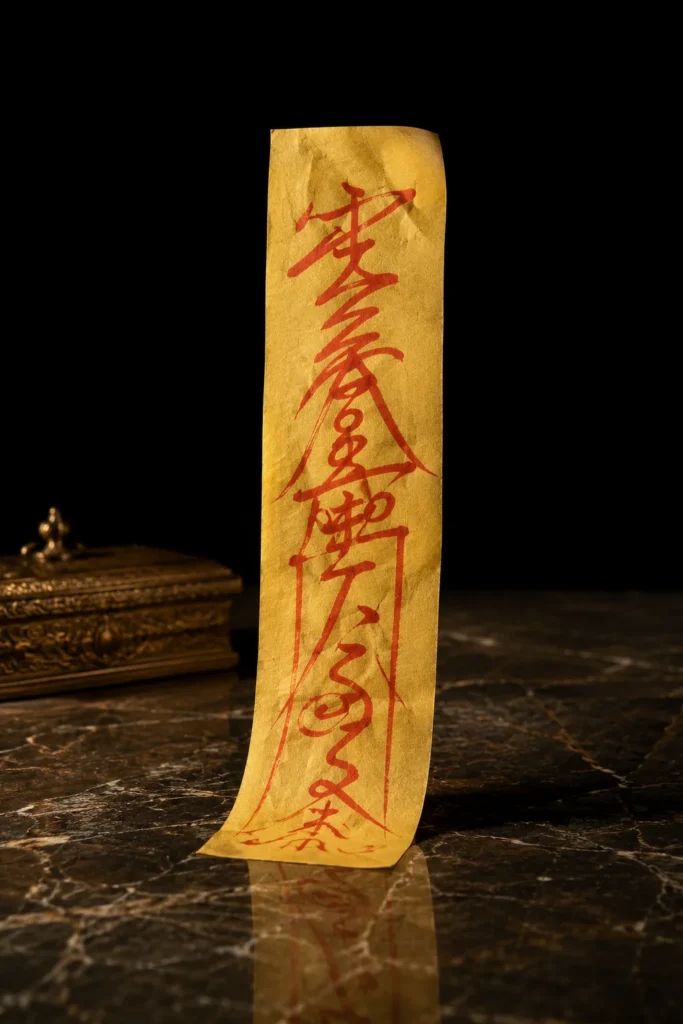
The Fu Talisman is a paper talisman from the tradition of Daoism. On yellow or red paper, characters are applied in brush script that are regarded as an instruction to higher powers. As a means of protection, the talisman is hung up, carried or burned.
Classification
The Fu Talisman is a paper talisman from the religious tradition of Daoism. It consists of an inscribed sheet of paper that is used as an effective means of protection.
The Chinese word underlying this talisman originally denotes an authentication or a token of recognition. In the Daoist religion it denotes the written talisman that mediates between people and the higher powers.
The Fu Talisman is usually written on yellow or red paper. The characters are applied with a brush, frequently in red, a color that in Chinese understanding is regarded as powerful and warding off.
The talisman is used in many ways. It is hung on doors and walls, carried on the body, dissolved in water or burned, depending on which purpose is pursued.
In religious studies, the Fu Talisman is a good example of a means of protection that rests on the power of written signs. Here it is not an image but a special script that carries the effect.
This page presents the Fu Talisman as a means of protection. It describes its origin, its form and its use, and places it within the Daoist protective tradition.
Origin in Daoism
The Fu Talisman is closely connected with the history of religious Daoism. Religious Daoism took shape in the first centuries of our era as an ordered religious movement with priests, scriptures and rites.
Already in the early Daoist movements, written talismans played an important role. They were regarded as a means by which the priest could come into contact with the higher powers.
The Daoist tradition attributes a heavenly origin to many of these talismans. According to this notion, the characters were not invented by humans but go back to heavenly models.
This gave the Fu Talisman a high rank. It was regarded not as a mere invention but as an image of heavenly writing that possessed a special effectiveness.
The making and the use of the talismans were the task of the Daoist priests. They commanded the knowledge of the correct characters and of the rites that first made the talisman effective.
The Fu Talisman is thus an inheritance of the long history of Daoism. It belongs to the oldest and at the same time still living elements of Daoist religious practice.
The red brush script
The most striking feature of the Fu Talisman is its script. It differs clearly from the ordinary Chinese writing of everyday life.
The characters of the talisman are intricate and hard to read. They appear like a script of their own, mysterious and familiar only to the learned priest.
Often the talisman characters are composed of components of known characters that are joined into new, dense forms. The result is a script that is related to ordinary writing but not the same as it.
The color of the script is mostly red, sometimes also black. In the Chinese tradition red is regarded as a powerful color that brings luck and wards off harm. The yellow paper combines with this red script into a characteristic image.
The characters are applied with a brush. The writing of the talisman is itself a deliberate process that is carried out with the necessary care and frequently accompanied by spoken words.
The intricate red brush script is therefore not merely the outer form of the Fu Talisman. It is an expression of its special character as heavenly, powerful writing that sets it apart from everyday script.
The talisman as an instruction to higher powers
In the Daoist tradition the Fu Talisman is understood in a particular way. It is regarded as a kind of document addressed to the higher powers.
Behind this stands the notion of an ordered heavenly world. In Daoist thought this world is conceived after the image of earthly administration, with offices, ranks and areas of responsibility.
Against this background the talisman acts like an official document. It is an authenticated instruction with which the priest calls upon a higher power to act in a particular way.
For such a document to be valid, it must be authenticated. This authentication is provided by the priest through his office, through the correct script and through the accompanying rites.
The Fu Talisman thus does not protect by a power of its own that is bound to the object. It protects by calling higher powers to aid and directing their protective force toward the person or the place.
In this notion lies the actual nature of the Fu Talisman. It is less an effective object than a mediating document that connects people with the protecting order of heaven.
Hanging up, carrying and burning
The Fu Talisman is used in various ways. The manner of use depends on the purpose the talisman is meant to serve.
Frequently the talisman is hung up. Placed at the front door, inside the house or above the bed, it is meant to preserve the place and its inhabitants from harmful influences.
The talisman can also be carried on the body. Folded small and kept in a case or sewn into the clothing, it accompanies the person and protects them on their way.
A distinct use is burning. The talisman is burned, and the ashes are added to water. This water is then drunk or used for washing, so that the power of the characters reaches the person or the place.
These various uses show that the Fu Talisman is a versatile means of protection. It can protect a place, accompany a person, or act directly through the water.
In all forms the basic principle remains the same. The written characters carry the protective instruction, and depending on the purpose this instruction is made effective in one way or another.
Protection against illness and harmful influences
The Fu Talisman serves a range of purposes. Everywhere the foremost concern is protection against harmful influences.
The talisman is frequently used against illness. In the Daoist conception, illness was often associated with the working of harmful powers, and the talisman was meant to ward off these powers.
The talisman is also used to protect the house. Placed at the door, it is meant to prevent harmful spirits or misfortune from entering the house.
A further use concerns the protection of individual people, especially children and pregnant women, who were regarded as vulnerable. The carried talisman was meant to preserve them.
Besides warding off misfortune, the talisman also serves to ask for good things. It can ask for blessing, health and good fortune, and thus take up the favorable side of the idea of protection.
The Fu Talisman is thus a comprehensive means of protection. It wards off illness and harmful influences, protects house and people, and at the same time asks for blessing and well-being.
The talisman in the protective tradition of China
The Fu Talisman does not stand on its own. It belongs to a rich protective tradition that has grown over a long time in Chinese culture.
This tradition includes further Daoist protective objects. The coin sword, the Bagua mirror and other objects serve the same aim of warding off misfortune.
Within this tradition the Fu Talisman occupies a place of its own. While other protective objects are objects made of metal, wood or glass, the Fu Talisman is a document made of paper.
The Fu Talisman thus belongs to the group of written characters and written means of protection. Its effect lies in the script, not in an image or in a shaped object.
Such written means of protection are also known from other cultures. The Islamic script talisman and the Jewish protective document rest on a related idea, the power of sacred or special writing.
The Fu Talisman is the Daoist form of this idea. Its distinctive feature lies in the heavenly talisman script and in the notion of the talisman as an authenticated instruction to the higher powers.
The priest and effectiveness
According to Daoist understanding, the Fu Talisman is not effective by itself. Its effectiveness depends on the priest who makes it.
The Daoist priest commands the knowledge of the correct characters. He knows the talisman script and knows which talisman must be written for which purpose.
Beyond that, the priest holds an office. Like an official who authenticates a document, the priest lends the talisman his standing before the higher powers.
The making of the talisman is therefore a ritual process. The writing is accompanied by words, by the right disposition and at times by further acts that first make the talisman valid.
A merely imitated sheet with similar characters is therefore not regarded as an effective talisman. It lacks the authentication by the priest and by the accompanying rite.
The Fu Talisman thus shows an important characteristic. The written sign and the ritual process belong together. Only the two together turn an inscribed sheet into an effective talisman.
Reception today
The Fu Talisman remains to this day a living element of Chinese religious practice. In temples of Daoism and of popular religion, talismans are made and handed out to the faithful.
Talismans can be seen especially on the doors of many houses and shops. They are frequently renewed at the turn of the year, so that the new year may begin under their protection.
The Fu Talisman is not confined to the Chinese mainland. In the Chinese communities all over the world it continues to belong to the familiar repertoire of protective practice.
For religious studies, the Fu Talisman is an instructive object. It shows how closely script, office and rite are connected in the Daoist conception of effectiveness.
A factual account names the Fu Talisman as what it is, a means of protection of the Daoist tradition to which, within its religious context, the power of mediating with higher powers is attributed.
The Fu Talisman is thus a striking example of a paper talisman. In it the heavenly talisman script, the notion of the authenticated instruction and the wish to place house and people under the protection of the higher powers all come together.
Literature (selection)
Related key terms: Fu Talisman paper talisman Daoism talisman script red brush script Daoist priest means of protection China heavenly script.
iWell Guard and protective traditions
iWell Guard stands in the cultural-historical line of wearable protective objects to which the Fu Talisman also belongs. A modern companion for people who live with protective symbols: made in Germany, 41 layers of solid gold, platinum and silver, with a 30-day right of return.
Personal experiences may vary. Not a medical device. No healing promise.