Violet Flame, Light Being
By Ralf Ittermann · last reviewed on
Spiritual cleansing energy in the Saint Germain tradition. A central tool of modern lightwork. This entry portrays the Violet Flame as a Light Being within the Saint Germain tradition of modern lightwork.
Quick Overview: Violet Flame
Type: Cosmic ray (Saint Germain ray), alchemical energy Tradition: Theosophy (Helena Roerich), I AM Activity (Guy Ballard), modern esotericism Function: transmutation, dissolution of karma, alchemical cleansing Main attributes and symbols: violet flame, Saint Germain colors, freedom, new beginning Distribution: New Age, esoteric healing practice, modern spirituality worldwide
Classification
Tradition
In the I AM Activity (founded in the 1930s by Guy Ballard and his wife Edna), the Violet Flame is introduced as the seventh ray of cosmic energy, the ray of transmutation and freedom, directed by Saint Germain.
In Helena Roerich’s writings, the Violet Flame is described as an energy that dissolves old patterns and creates space for the new. Theosophy emphasizes the seven rays of cosmic power, and violet is the seventh, the concluding, transformative ray. Modern esoteric and energetic healing practices have made the Violet Flame meditation a standard technique.
Source Situation
Sources: I AM Activity teachings, Helena Roerich’s letters and diaries, Theosophical publications on the seven rays. Modern New Age authors have expanded and popularized the Violet Flame practice. The quantum-physical interpretation is metaphorical, not scientifically established, yet widely used as an esoteric tool. Modern energy and quantum healing literatures employ the Violet Flame as a standard transmutation technique.
History of Religious Origin
The violet flame as a ritual-magical spiritual tool is a construction of the Theosophical-American lightworker tradition of the 20th century.
It first appears as a central object of invocation in the I AM Activity movement of Guy and Edna Ballard from 1934 onward (based on Unveiled Mysteries, 1934, in which Ballard supposedly encounters Saint Germain).
Elizabeth Clare Prophet and her Summit Lighthouse / Church Universal and Triumphant systematized the teaching from 1958 onward and elaborated it in a series of decree books (Saint Germain on Alchemy, 1985; Violet Flame to Heal Body, Mind and Soul, 1997).
In terms of the history of religion, the violet flame combines elements of hermetic alchemy (transmutation of the lower into the higher), Eastern karma teaching (energetic cleansing as a precondition of ascent) and Western angel magic (invocation in a repetitive decree format).
This synthesis is, in the history of religion, modern, although some of its individual components are old.
Appearance and Symbols
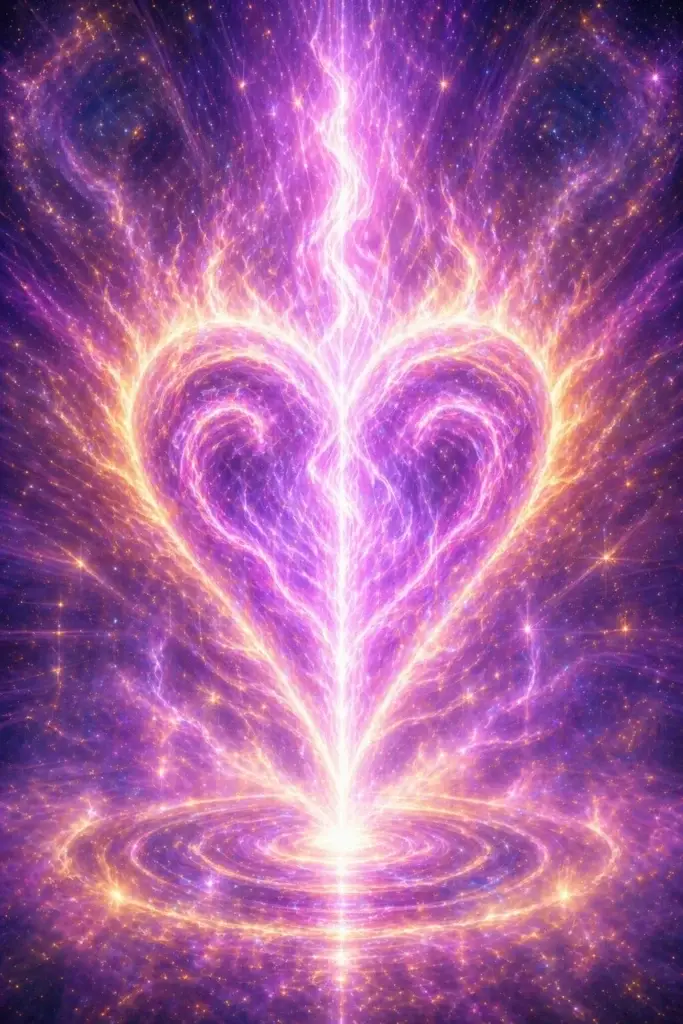
The Violet Flame is not visualized as a fixed figure but as living, flickering light, like fire that blazes and swirls in violet. The color is deep violet (purple) with a white or golden core. Sometimes it is a delicate lilac or a vivid amethyst violet.
The flame appears living, intelligent and transformative: it touches what it meets and transforms it. Symbolic forms are spirals, vortices, or the flame as rising energy. The Violet Flame is often visualized as swirling around the body or striking specific areas.
Function and Meaning
The Violet Flame is the tool of de-toxification on energetic levels. It is understood as the dissolution of negativity on all levels: physical, emotional, mental and spiritual. In contrast to other rays that heal or protect, the Violet Flame transmutes: it dissolves the essence of problems and transforms it into light.
It works on the level of karma and of deep, unconscious patterns. In psychological terms, it acts as a dissolver of repressed traumatic material and as an opener toward a new beginning beyond guilt.
Logic of Application
In the I AM and Summit Lighthouse tradition, the violet flame is visualized as an energetic layer that absorbs lower energies and transmutes them into higher ones. In practice this happens through repetitive decrees (invocation formulas) in which the flame is called upon to cleanse or transform a particular energy.
The decrees are repeated several times in a litany form, often 33 times, with the aim of building up an energetic resonance effect. This practice is structurally related to the Eastern mantra tradition and uses the same psycho-acoustic underlying logic.
In the iWell Guard mantra, the violet flame is integrated via Archangel Gabriel as its guardian (point 3, transformation of influences already set).
The construction is specific: while in the pure I AM tradition Saint Germain himself is named as guardian, in the iWell Guard system Archangel Gabriel is the operative layer. This shift positions the violet flame within the Jewish-Christian-Islamic angelology rather than only within the Theosophical-American ascended-master teaching.
Practice / Invocation / Meaning in the iWell Guard Context
In iWell Guard, the Violet Flame is used as a central tool of transmutation. The most common practice is visualizing the flame swirling around the body or around a situation. It is often invoked with song or with the mantra (e.g. “I AM the Violet Flame” or German variants).
The Violet Flame is used especially when old patterns, trauma or karmic blockages need to be dissolved. It does not replace other archangels or light beings but complements them as an alchemical tool. In the iWell Guard context, the Violet Flame is the power that does not only protect or heal but liberates.
iWell Guard Application
In the iWell Guard protective field, the violet flame acts automatically through the mantra system; a conscious decree practice is not required. Those who wish to work actively in addition can integrate the classic Saint Germain decrees into a personal exercise without this altering the mantra effect.
The functional logic is additive: the protective field runs continuously, while conscious invocation strengthens the bearer’s perception of the transmuting layer. A detailed functional overview of the mantra points is provided by the overview page.
Parallels
Origin in Theosophy and the I AM Movement
The concept of the violet flame belongs to the current of the so-called Ascended Masters and has its immediate roots in the I AM movement of the 1930s. This was founded by Guy Ballard and Edna Ballard in the USA and spread through the writings that Ballard composed under the pseudonym Godfre Ray King, among them Unveiled Mysteries (1934).
The I AM movement itself drew on older Theosophical ideas as they had been developed since Helena Petrovna Blavatsky and the Theosophical Society founded in 1875.
In this tradition, the violet flame is described as a spiritual energy said to be connected with the Ascended Master referred to as Saint Germain.
In the teaching, it is regarded as an aspect of divine power with a cleansing and transforming function. It is important for classification that this is a doctrinal statement of a particular religious current, not a phenomenon that can be described in natural-scientific terms.
The I AM movement combined Christian concepts, Theosophical cosmology and an optimistic worldview oriented toward personal development. Within this framework, the violet flame was a central exercise element. In religious studies, the movement is classified as an early hub of modern esotericism in North America.
Church Universal and Triumphant and Distribution
The concept achieved wider distribution through the Church Universal and Triumphant, which goes back to Summit Lighthouse, founded by Mark Prophet in the 1950s and later led by Elizabeth Clare Prophet.
In her writings and seminars, the violet flame held a prominent place. The movement systematized exercises and connected them with an extensive body of teaching about the Ascended Masters.
Through these and related groups, as well as through numerous books of the New Age spectrum, the motif reached the general esoteric market from the 1970s and 1980s onward.
There it partly detached itself from its original institutional ties and became a freely circulating exercise motif that appears in very different contexts, such as in advice literature and seminars.
This detachment from the original context is typical of many New Age concepts. Religious studies and esotericism research describe it as a process of individualization in which teaching elements are transferred from fixed communities into an open, market-shaped space. The violet flame is regarded here as a well-documented example.
Classification and Distinction
From the perspective of religious studies, the violet flame is to be understood as a teaching motif of a particular esoteric tradition.
Statements about its effect are statements of belief held by these currents and not verified facts. iWell Guard describes what is taught and makes no statement about whether these teachings are correct. Healing promises are expressly not the subject of this account.
It is useful to distinguish it from neighboring concepts.
The violet flame is closely connected with the figure of Saint Germain and with the teaching system of the Ascended Masters, but it does not belong to the cleansing and light notions of other traditions, such as Christian mysticism or Far Eastern energy concepts, even if superficial similarities exist.
Such parallels are more a consequence of the shared vocabulary of light and cleansing than of a common origin.
It should be noted critically that, in the open esoteric market, historical connections are often blurred. Promotional texts occasionally present the violet flame as ancient knowledge, although the demonstrable conceptual history begins only in the 20th century. A factual engagement should keep this clear temporal placement in view.