Salt and Iron: Apotropaic Substances in Protective Magic
By Ralf Ittermann · last reviewed on
Salt and iron are among the substances to which an unusually large number of cultures have attributed a warding significance. Unlike an amulet bearing a pictorial motif, they act as matter itself, whether as scattered grains or as attached metal.
This article places both substances within the study of religion and traces them from antiquity to their reception today. In doing so, it distinguishes historically documented custom from modern interpretation.
Salt and iron are classic protective substances of European folk magic.
Classification: Salt and Iron as Apotropaic Substances
Apotropaic means warding. An apotropaic substance is a material credited with the property of keeping harmful influences away. Salt and iron are the two best-known examples of this group.
What is distinctive about these substances is that the effect is not bound to an image or a sign. It is the substance itself to which the warding significance applies. A grain of salt or a piece of iron suffices, without needing to be shaped.
Salt was used above all by scattering, for example on thresholds, in the corners of rooms, or around people. In this use it often connects with the idea of a boundary and thus with the protective circle.
Iron was mostly used as an object. Nails, knives, scissors, horseshoes, and other iron objects were attached to doors, placed under beds, or carried on the body.
Within the protective symbols, salt and iron form the group of material means of protection. They thus stand alongside pictorial amulets and geometric protective forms.
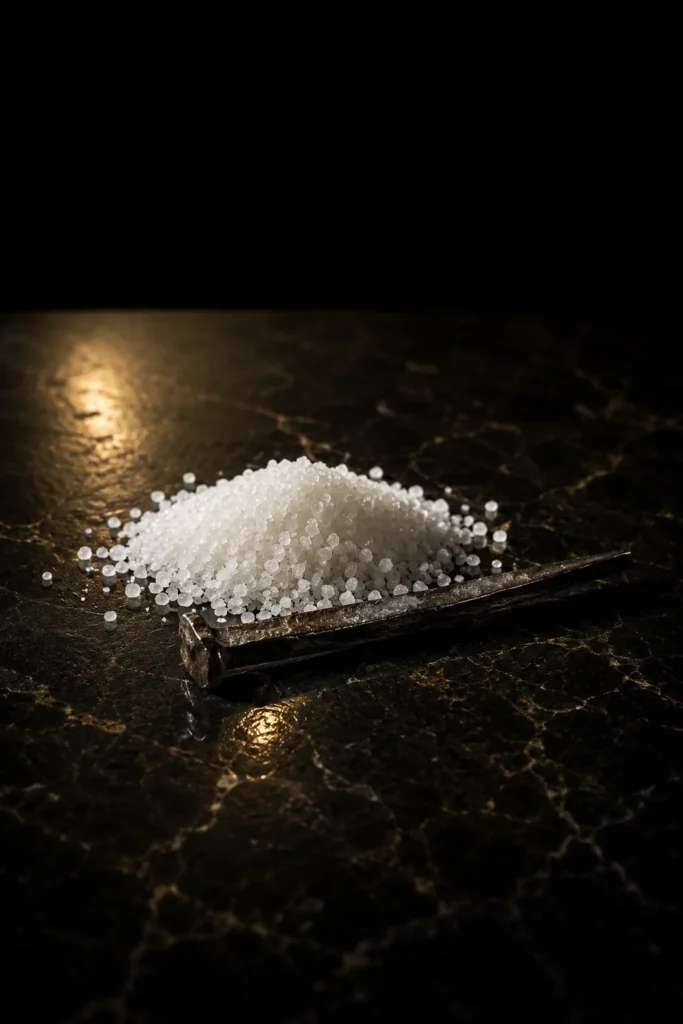
Both substances could be used individually or together. In some customs salt and an iron object were combined, for example salt with a knife, in order to join the effects of both substances.
Salt and iron differ markedly in their use, even though a similar significance is ascribed to them. Salt is a granular substance that can be scattered and dissolved; iron is a solid material that is shaped and attached. These differing properties shaped the respective customs.
In the protective magic of European folk culture, salt and iron form the classic pair of apotropaic substances: salt protecting through its cleansing dryness, iron through its sound and the hardness of its forged work.
Origins and Historical Depth of Substance Magic
For a long time salt was a valuable and vital substance. It served for seasoning and above all for preserving food. This practical importance forms the background of its special esteem.
From the ancient Near East and from antiquity, customs are known in which salt plays a cultic role. It appears in connection with sacrifice, purification, and covenant, and is charged with meaning in several religions.
Iron is younger than other metals. With the beginning of the Iron Age its working spread. Iron displaced older materials and was at the same time regarded in many places as a metal with special significance.
The production of iron was bound to the smith’s craft. In many cultures the smith was regarded as the bearer of special knowledge, and the iron he worked received a part of this special standing.
In the European Middle Ages and the early modern period, salt and iron are firmly anchored in household custom. Folklore sources of the modern era have documented the use of both substances in detail.
Overall it is evident that the warding interpretation of salt and iron extends across long periods and many cultures. It is closely bound to the practical and economic importance of both substances.
The production of salt also shaped its special standing. Salt was mined in pits or obtained from seawater and brine springs, which in many places established a trade of its own. The labor of this production contributed to salt being regarded as a valuable and significant substance.
The Underlying Idea of Warding Matter
With salt, an important notion is durability. Salt preserves food from spoiling. This observable property was transferred to the idea that salt could also preserve against other forms of corruption.
A second notion with salt is purity. Salt was regarded as pure and uncorrupted. A substance that is itself considered pure was understood as suited to setting an area apart from influences thought of as impure.
In addition there is the form of the single grain with salt. A scattered heap of salt consists of countless grains. Some traditions connected with this the idea that a harmful being would have to count each grain and would thereby be held up.
With iron, hardness is a central notion. Iron is firm and resistant. This firmness was transferred to the idea of a substance that withstands harmful influences.
With iron, working by fire also plays a role. Iron arises in the fire of the forge. This connection with fire and with the smith’s special knowledge reinforced the warding interpretation.
The ideas described here are cultural-historical explanations. They describe why people gave salt and iron a warding significance, and they document a belief. They are not proof of an effect. Scholarship describes the idea without confirming it.
Examples from Antiquity and the Near East
In the ancient world salt was a fixed component of sacrificial acts. It was added to offerings and was regarded as indispensable for the proper performance of certain cultic acts.
In several religions of the Near East salt is connected with the idea of covenant and constancy. It appears in religious texts as a sign of a lasting and firm bond.
Iron appears in ancient sources with a twofold meaning. On the one hand it was regarded as valuable and useful; on the other it was kept away from certain cultic areas, which points to its special standing.
From the Greek and Roman tradition, accounts are known in which iron objects are named in connection with warding. Nails and knives appear here as objects with a significance going beyond their everyday function.
In the Near East iron nails are attested that were driven into the ground or into walls and to which a securing significance was ascribed. They connect the substance iron with the idea of fastening.
These examples show that salt and iron in the ancient Mediterranean and the Near East were not merely materials. Both stood within a web of religious and magical ideas.
In pharaonic Egypt, too, salt had a cultic role. It served for purification and was used in embalming, where its preserving property was directly observable. This connection of salt and preservation forms a background of its later warding interpretation.
Examples from European Folk Magic
In European folk magic salt and iron are especially richly attested. Folklore collections report numerous customs that used both substances to protect house, farm, livestock, and person.
Salt was scattered on thresholds, placed in the corners of rooms, and given to newborns as well as to bridal couples. In some regions salt was placed in the cradle or mixed into the livestock’s feed.
Iron appears above all as a horseshoe over the door, as a knife or scissors under the bed, and as a nail at places regarded as endangered. The carrying of an iron object when leaving the house is also attested.
Both substances were frequently used at particular times. Before sensitive nights, at birth, wedding, and death, and at festivals, salt and iron were deliberately employed.
Accounts of these customs document the expectations of the users and not a proven effect. They show that salt and iron were understood as substances with a special, security-giving significance.
With the decline of magical household custom, many of these customs lost their everyday role. Individual remnants, such as the horseshoe over the door, persisted longer as a custom.
Folklore sources further note that salt and iron were frequently combined. A knife stuck into salt or an iron nail strewn with salt was meant to unite the significance of both substances. The Handwörterbuch des deutschen Aberglaubens records such combined customs from numerous regions.
Examples from Asia and Other Cultures
In Japan the scattering of salt is a well-known custom. Salt is heaped up in front of shops and at entrances and is scattered into the ring in sumo wrestling. Both customs rest on the idea of purification.
In parts of Asia salt is also used after funerals. Those returning home scatter salt over their shoulder or over their body in order to understand themselves as purified after contact with death.
Iron plays a role in South Asia in the protection of newborns and women in childbed. An iron object, such as a knife, is placed near them and is meant to make a securing contribution.
In various African cultures the smith holds a special standing, and the iron he works is charged with meaning. Iron objects appear there in the ritual sphere and in protective custom.
Across these regions it becomes apparent that salt and iron were connected with purity, constancy, and warding in many cultures. Both substances are not motifs of a single tradition.
The variety of examples makes clear that substance magic is to be understood as a principle. It arises wherever a material is given a special significance on account of its properties.
In parts of the Pacific region and in Siberia, too, a prominent standing has been ascribed to the smith. The iron he worked was regarded as connected with special knowledge and appears in protective and healing customs. This wide distribution shows that the interpretation of iron was not bound to a single cultural region.
Application in Ritual and Everyday Life
In its application salt was mostly scattered. It was distributed on thresholds, in corners, and around people. Often a particular order or direction was prescribed, such as scattering in all four directions.
Iron was mostly placed as an object. A knife under the bed, a nail in the wall, or a horseshoe over the door remained permanently in its place and did not have to be renewed.
Both substances were frequently bound into rites of passage. At birth, wedding, and burial, salt and iron were used because these life events were regarded as especially significant and sensitive.
Salt and iron also accompanied journeys and the leaving of the house. Carrying a grain of salt or a small iron object was meant to accompany the traveler at changing places.
Often the use was connected with spoken words. When scattering salt or attaching an iron object, a blessing could be said that accompanied the act.
There is no uniform ritual order for salt and iron. The precise form depended on region, occasion, and tradition, which folklore research has noted repeatedly.
The giving and receiving of salt was also regulated. In some traditions it was considered to bring misfortune to pass salt across the table or to spill it. Such rules of conduct belong to the wider circle of substance magic and show the special standing of salt in everyday life.
Related Protective Forms and Distinctions
Salt and iron stand in close kinship with the protective circle. Scattered salt often itself forms a line and thus a boundary. It joins the idea of the apotropaic substance with the idea of demarcation.
Both substances are also closely linked with threshold protection. Salt on the threshold and the horseshoe over the door are among the most frequent means by which the entrance was secured.
Salt and iron differ markedly from the pictorial amulet. An amulet or talisman frequently bears a motif or a sign. With salt and iron, by contrast, the significance applies to the pure substance.
Within the material means of protection, salt and iron stand alongside other materials. Certain stones, metals, woods, and plants were also given a warding significance. Salt and iron are the best-known but not the only examples.
A boundary exists toward practical use. Salt as a seasoning and iron as a material carry no protective meaning in themselves. Decisive is whether a warding function is ascribed to the substance.
Placing them in this neighborhood helps to define salt and iron precisely. They are material means of protection whose significance applies to the material itself, and they differ from pictorial amulets and from mere utilitarian function.
A boundary further exists toward the purely medicinal use of salt and iron. In older healing practice both substances were applied internally and externally. This use follows an idea of its own and is to be distinguished from the warding interpretation in protective custom.
The Reception of Salt and Iron Today
Some customs involving salt are still alive today. The scattering of salt in Japan and the heaping of salt at entrances remain widespread. The horseshoe over the door, too, is still attached in many places.
In modern esotericism, salt and iron are frequently taken up. There are instructions for cleansing a room with salt or establishing protection with iron. Such practices are credited with effects that are not proven.
These present-day offerings should be viewed critically. Salt and iron are to be understood as cultural symbols and as substances with a long history of meaning, not as verifiable means of protection.
In popular culture salt and iron frequently appear as means against eerie beings. Films, novels, and games take up the old ideas and exaggerate them into established narrative motifs.
For the study of religion, salt and iron are instructive examples. They show how observable properties of a substance, such as durability and hardness, could become the basis of a warding interpretation.
Anyone engaging with salt and iron today finds in them above all a topic of cultural history. A factual approach separates the documented history of the customs from modern promises of effect that do not withstand examination.
In material-culture research, iron objects from thresholds, walls, and graves are a recognized object of study. Driven nails and deposited knives are recorded, dated, and interpreted as testimonies of protective custom. In this way substance magic remains tangible even where the associated belief is no longer alive.
Literature (Selection)
Related key terms: salt and iron apotropaic substance substance magic horseshoe salt-scattering smith iron nail purity protective substance folk magic.
iWell Guard and Protective Traditions
iWell Guard stands in the cultural-historical line of portable protective objects, to which salt and iron also belong. A modern companion for people who live with protective symbols: made in Germany, 41 layers of solid gold, platinum, and silver, with a 30-day right of return.
Personal experiences may vary. Not a medical device. No promise of healing.