iWell Guard

Thai Spirit World, Phi Belief and the Spirit Houses San Phra Phum

In Thailand, belief in Phi, spirits of the most varied kinds, is closely interwoven with Theravada Buddhism rather than forming a competing religion. In front of almost every house, shop or hotel stands a small spirit house, San Phra Phum, in which the local spirit of the plot is provided with daily offerings. Tree spirits, Naga serpent beings and well-known ghost stories such as that of Mae Nak complete this web of beliefs.

Phi spirit belief and the Buddhist-framed veneration of the Naga shape the Thai spirit world to this day.

Beaivi: gods from the Sami tradition, historically illustrative
Thai Phi belief, together with Buddhist cosmology and older Brahmanical elements, forms a closely interlinked religious system.

Phi spirit belief and the spirit houses San Phra Phum are not seen as contradicting Buddhism; rather, many Thais understand them as complementary layers of the same religious practice.

Phi as the Basic Category of the Thai Spirit World

In Thai, Phi is the basic term for spirits of every kind, from ancestral spirits and nature spirits to the souls of the dead. The ethnologist Stanley J. Tambiah showed in his study Buddhism and the Spirit Cults in North-East Thailand (1970) that Phi belief and Buddhism, in lived practice, do not form an opposing pair but rather a shared cosmological system in which monks and spirit mediums take on distinct, complementary roles.

The Thai folklorist Phya Anuman Rajadhon documented numerous Phi beliefs first-hand as early as the first half of the twentieth century, laying the groundwork for later religious-studies research.

This close interweaving of Phi spirit belief and Buddhism is especially evident in the ubiquitous spirit houses San Phra Phum.

Spirit Houses: San Phra Phum in Front of Homes and Shops

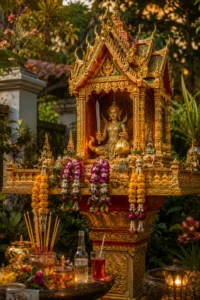
The San Phra Phum is a small, often elaborately decorated spirit house intended to shelter the local spirit of a plot of land. Before a building is erected, Thais traditionally negotiate with this spirit over a suitable place for its house, usually outside the shadow of the main building. Daily offerings, flowers, drinks and incense sticks, are meant to keep the local spirit well disposed.

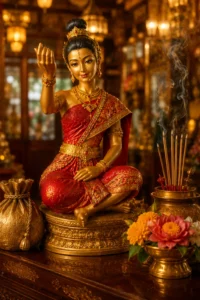
In addition to the local spirit, many Thai shops feature the figure of Nang Kwak, a waving figure of prosperity believed to attract customers and good fortune.

Tree Spirits: Nang Tani, Nang Ta-khian, Nang Mai

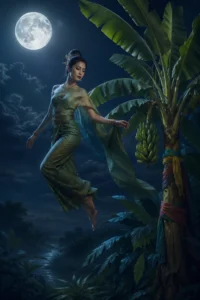
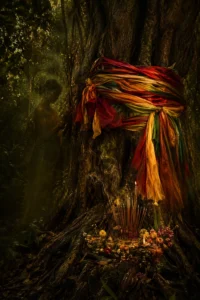
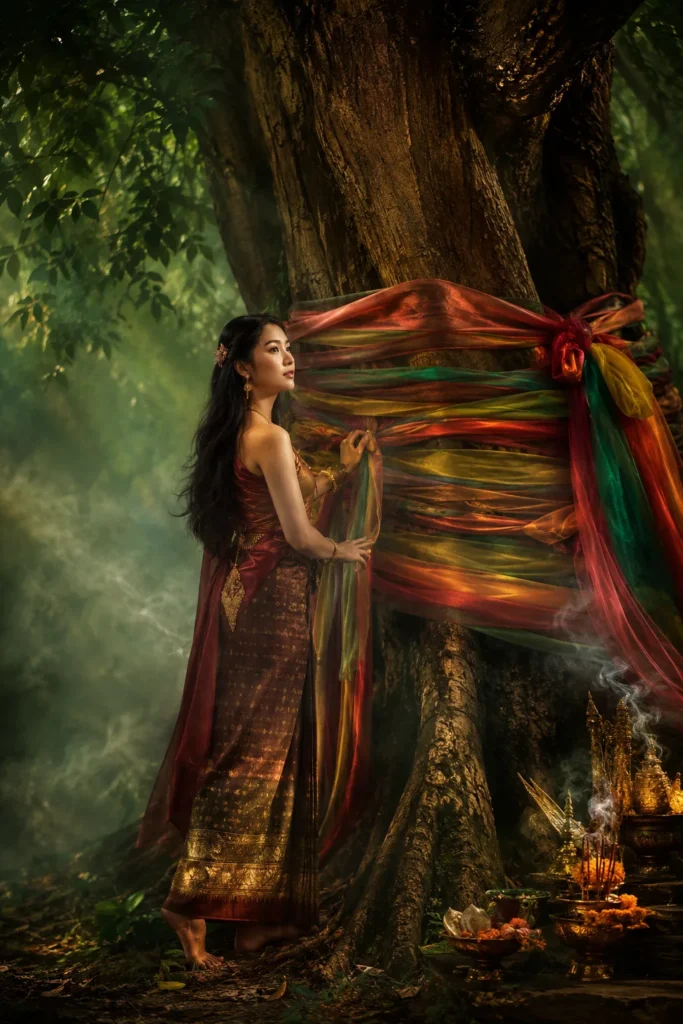
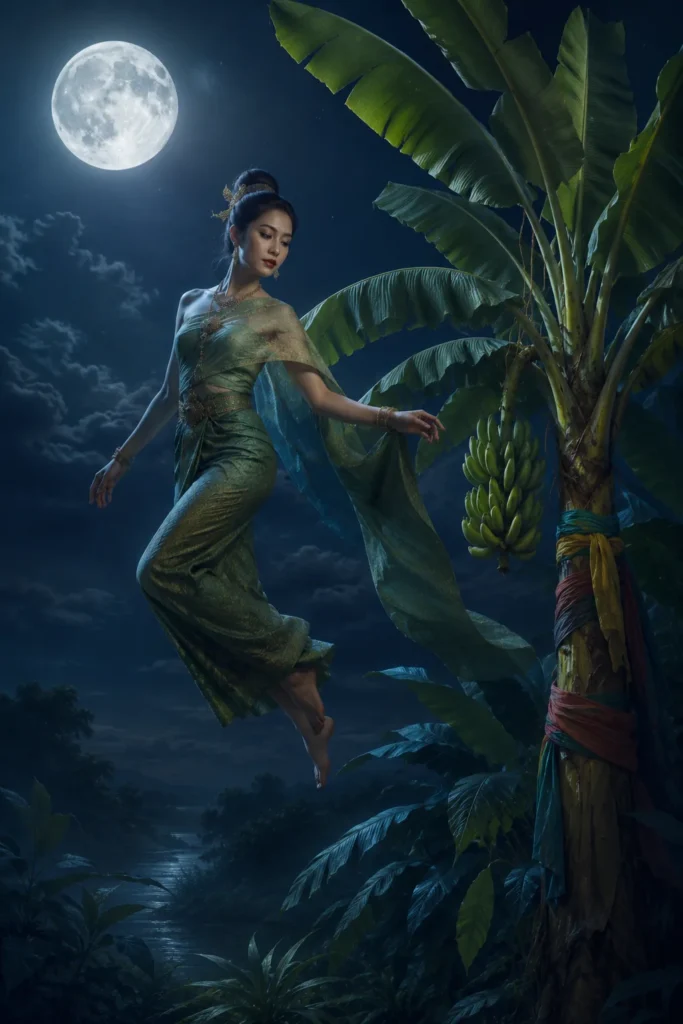
Under the collective term Nang Mai, literally ‘tree lady’, Thai tradition groups together several female tree spirits. According to legend, Nang Tani inhabits wild banana plants and appears at dusk as a young woman. Nang Ta-khian is regarded as a powerful spirit of the Takhian tree, which is why woodcutters traditionally only used its timber after performing the appropriate rituals.

Buddhist Framing: Merit, Monks and Ritual Protection

The Theravada Buddhism that predominates in Thailand frames Phi belief without replacing it. Buddhist monks are regularly asked to bless new houses, shops or even spirit houses with holy water and the so-called Sai Sin, a consecrated cotton thread, in order to ward off misfortune and secure the goodwill of the resident spirits.

The Buddhist concept of merit-making, Tambun, also plays a role in dealing with restless Phi: relatives transfer merit to the deceased to ease their passage and prevent their reappearance as a dangerous spirit such as a Phi Tai Hong. Alongside the clergy, independent spirit mediums exist whose practice differs from monastic religious observance, as the anthropologist Stanley J. Tambiah has described.

Frequently Asked Questions about the Thai Spirit World

What is a Phi?


Phi is the basic Thai term for spirits of every kind, from ancestral spirits and nature spirits to the souls of the deceased. Phi belief is closely interwoven with Theravada Buddhism and together with it forms a shared religious system.

What is a San Phra Phum?


San Phra Phum is a small spirit house placed in front of Thai homes and shops to shelter the local spirit of the plot and provide it with daily offerings.

What is the story of Mae Nak?


Mae Nak is a well-known Thai ghost story from the Phra Khanong district of Bangkok, in which a woman who dies in childbirth continues to appear to her husband as if still alive. A shrine at Wat Mahabut is dedicated to her to this day.

How do Phi belief and Buddhism relate to each other?


Scholars of religion such as Stanley J. Tambiah describe Phi belief and Buddhism in Thailand not as competing religions but as an interwoven system in which Buddhist monks and spirit mediums take on distinct, complementary roles.

Naga Veneration and the Mekong River

The Phaya Naga, a royal serpent being, is regarded in both Thai and wider Southeast Asian Buddhist tradition as a protector of the Buddha and lord of the waters, especially the Mekong. At the end of the Buddhist Lent, believers along the river report the so-called Naga fireballs, a phenomenon still debated today and given a religious interpretation in the Nong Khai region.

Feared Phi: Krasue, Phi Pop, Phi Krahang, Phi Am

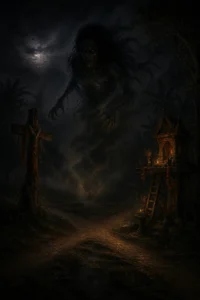
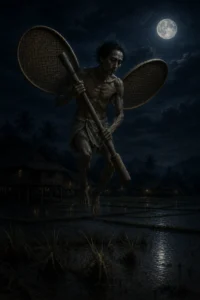
Among the most feared figures is the Krasue, a head that flies at night with its entrails hanging beneath it, said by day to be concealed within an ordinary woman, a motif also known in related form in neighbouring countries of the region. The Phi Pop, feared particularly in north-eastern Thailand and Laos, is said to possess a human host and devour raw entrails, which is why affected individuals were once shunned in some villages.

The Phi Krahang is regarded as its male counterpart, a practitioner of black magic who flies at night. The Phi Am is associated with the experience of sleep paralysis, a feeling of pressure on the chest during sleep.

Restless Dead: Phi Tai Hong and the Legend of Mae Nak

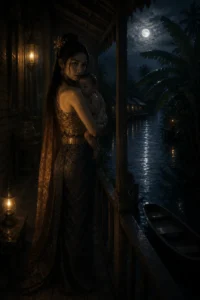
According to tradition, anyone who dies a sudden, violent or unnatural death becomes a Phi Tai Hong, a spirit regarded as especially restless and dangerous, one for whom the proper death rituals to bring peace were lacking. The best-known story of this kind is that of Mae Nak from the Phra Khanong district of Bangkok, who is said to have continued appearing to her husband as if still alive after dying in childbirth; her shrine at Wat Mahabut is still visited today by believers seeking good fortune or the fulfilment of wishes.

Phi as a Collective Term for a Multifaceted Spirit World

Thailand has no closed spirit mythology with a fixed hierarchy, but rather a broad, regionally varied world of belief brought together under the collective term Phi. The term covers a wide spectrum: ancestral spirits, local spirits, nature spirits in trees and waters, as well as the spirits of those who died particularly unfortunate deaths.

This diversity varies markedly from one part of the country to another. In the north-east, Isan, belief in the possession-causing Phi Pop is particularly widespread and closely related to neighbouring traditions in Laos, while stories such as that of Mae Nak are closely tied to the capital, Bangkok.

Most Phi beliefs share a close interweaving with the Theravada Buddhism that predominates in the country: spirits are not understood as opponents of Buddhist teaching but as further, lesser beings within the same cosmological system of karma and rebirth.

In religious studies, Thailand is therefore a frequently cited example of how a world religion and older animistic beliefs can coexist, not in competition, but in mutual complementarity.

San Phra Phum: The Spirit House as Daily Practice

The most conspicuous everyday testimony to Thai Phi belief is the San Phra Phum, a small house, often designed like a shrine or temple, placed in front of private homes, shops and hotels. It is meant to serve as a dwelling for the Phra Phum, the spirit of the respective plot of land.

Before a building is erected, a favourable location and time for the spirit house is traditionally determined, often with the involvement of a Brahmin priest or a Buddhist monk. It is important that the shadow of the main building does not fall on the spirit house, which is considered disrespectful towards the local spirit.

In daily practice, the local spirit receives offerings, fresh water, flowers, incense sticks and occasionally food, accompanied by requests for goodwill and protection for the property and its residents. According to popular belief, if the San Phra Phum is neglected, the spirit can bring misfortune to the house and business.

This daily practice illustrates how closely animistic local-spirit belief and the Buddhist practice that dominates the country are interwoven, without the two being experienced as separate religions.

The Sources: Ethnography, Phya Anuman Rajadhon and Tambiah's Field Studies

The scholarly tradition concerning the Thai spirit world relies largely on ethnographic fieldwork from the twentieth century. The Thai scholar Phya Anuman Rajadhon documented numerous customs and Phi beliefs first-hand in the first half of the century and is regarded as the founder of modern Thai folklore studies.

One of the most influential studies in religious studies comes from the anthropologist Stanley J. Tambiah, whose Buddhism and the Spirit Cults in North-East Thailand of 1970 is based on fieldwork in a village in north-eastern Thailand. Tambiah showed that the Phi cult and Buddhist practice cannot be separated in lived religion but form a shared system.

Later researchers such as Pattana Kitiarsa examined, in works on spirit mediums and amulets, how Phi belief is changing in modern, urbanised Thailand, while Justin McDaniel focused among other things on popular ghost stories such as that of Mae Nak.

This body of sources shows that the Thai spirit world does not derive from a single canonical text but is reconstructed from a combination of lived everyday practice, oral narrative tradition and repeated ethnographic documentation.

Buddhist Framing, Modernisation and Present-Day Practice

Theravada Buddhism reached the territory of present-day Thailand from the first millennium onwards, mediated via Sri Lanka, and became the dominant state religion at the latest with the Kingdom of Sukhothai. Unlike in some other regions, this spread did not lead to the complete displacement of older spirit beliefs but rather to their incorporation into a shared cosmological system of karma, merit and rebirth.

Buddhist monks continue to this day to take on tasks closely linked to Phi belief, such as blessing new spirit houses or performing rituals to calm restless Phi Tai Hong. At the same time, independent spirit mediums and ritual specialists exist whose practice differs from monastic religious observance, as Stanley J. Tambiah and later Pattana Kitiarsa have described.

With the urbanisation and modernisation of Thailand since the second half of the twentieth century, practice has changed but not disappeared: spirit houses still stand in front of office buildings and shopping centres, and ghost stories such as that of Mae Nak have been adapted into films several times and remain part of popular culture.

In religious studies, Thailand is therefore regarded as an example of a living coexistence of a world religion and older spirit belief, which permeate one another rather than excluding one another.

Thai Phi spirit belief combines ancestor veneration, tree spirits and the Naga cult into a distinctive protective practice, most visibly in the spirit houses San Phra Phum that are provided with daily offerings to keep properties and shops safe from the displeasure of the respective local spirit.

Related key terms: Phi San Phra Phum Naga Mae Nak Krasue Phi Pop Isan Mekong Theravada Buddhism.

Protective Objects in This Cultural Tradition

Thai tradition includes the San Phra Phum spirit house as a stationary protective object for properties, monk-consecrated amulets, called Phra Kreuang, worn on the body, as well as incense sticks and flower offerings for the daily appeasement of local and nature spirits. Such objects are to be understood, in cultural-historical terms, as an expression of everyday religious practice, not as a proven protective effect. An overview of protective traditions from various cultures is offered by the Protection Compass.

iWell Guard fits into this cultural-historical line of portable protective objects, in contemporary material architecture, crafted in Germany. 41 layers, genuine gold, platinum, silver. 30-day right of return.

Personal experiences may vary. Not a medical device. No promise of healing.