The Eye of Horus – the Wedjat as an Egyptian protective sign
By Ralf Ittermann · last reviewed on
The Wedjat is regarded as an Egyptian protective sign that guarantees healing, wholeness and the restoration of what is complete. The Eye of Horus, called Wedjat in the Egyptian language, is one of the best-known protective signs of the ancient world.
It stands for healing and wholeness and was, for more than two thousand years, one of Egypt’s most common amulets, worn by the living and by the dead alike.
Classification
The Eye of Horus, called Wedjat in the Egyptian language, is one of the best-known protective signs of the ancient world.
It shows a stylised human eye, supplemented by the markings of a falcon’s eye, and was in use in Egypt for more than two thousand years. As an amulet it appears from the Old Kingdom well into the Roman period.
The name Wedjat means something like the intact or the whole. The basic idea of the sign is already contained in the word itself. It stands for wholeness, for restoration and for protection against harm.
According to Egyptian belief the eye was not merely an image but an effective power that could ward off misfortune and make what was damaged complete again.
In religious studies the Wedjat is counted among the apotropaia, the objects of misfortune-aversion. It is one of the most frequently preserved amulets of ancient Egypt overall.
This large number of finds makes the Eye of Horus an important source for understanding everyday Egyptian piety, because it was worn by people of all classes and not only by an elite.
Beyond the amulet, the Wedjat pervaded the entire Egyptian world of images. It appears on coffins and tomb walls, on jewellery and vessels, on stelae and in architecture. This omnipresence shows that the Eye of Horus was far more than a single protective object; it was a fundamental sign of Egyptian culture.
Anyone walking through the Nile valley encountered the Wedjat in many settings of daily life, and it was precisely this constant visibility that reinforced its role as a reliable sign of preservation.
The myth of the Eye of Horus
Behind the sign lies one of the central narratives of Egyptian mythology: the dispute between Horus and his adversary Seth over the succession to Osiris.
In the course of this conflict Horus loses his eye. Seth tears it out and destroys or divides it, and with this a body part is damaged and, beyond that, order itself is disturbed.
The eye is, however, restored. In most accounts it is the god Thoth who heals it and makes it whole again. The healed eye thus returns from injury to wholeness. In a famous gesture Horus presents it to his father Osiris, to whom it gives back life and strength.
This narrative explains why the Wedjat was considered so potent as a protective sign. It is the emblem of a harm that was overcome. Whoever wore the Eye of Horus placed themselves under the model of this healing. The amulet brought to mind the moment in which destruction had once again become completeness.
The tradition knows several versions of this narrative. In some texts it is the goddess Hathor who heals the injured eye with gazelle’s milk. In others the eye is linked with the moon, whose waxing and waning was interpreted as injury and healing.
The filling up of the eye, described by the Egyptians as becoming full, thus mirrored the course of the moon. This diversity of interpretations does not weaken the sign but shows how deeply the idea of restoration was anchored in the Egyptian world of ideas.
Wedjat: healing and wholeness
The meaning of the Wedjat can be summed up in a single term: restoration. The eye was destroyed and has become whole again, and it was precisely this movement from the injured to the intact that made it a sign of health, protection and the wholeness of the body.
This idea reached deep into the Egyptian language and into ritual. Offerings could be designated as the Eye of Horus, for the gift too restored a lack and made the recipient complete. The Wedjat was thus a protective image and, beyond that, a term for the healing and completing in general.
For the wearer of a Wedjat amulet this meant a comprehensive protection. It was not directed against a single named threat but stood for the preservation of bodily integrity as a whole. In this the Eye of Horus differs from amulets that, like the Pazuzu amulet, were aimed at a particular opponent.
This idea also shaped the offering cult. When a gift was presented to the god or to the deceased, it could be addressed as the Eye of Horus. Incense, food and anointing oil were regarded as that which made up for a lack and made the recipient whole and complete.
The term thereby connected the sphere of ritual with the basic meaning of the sign. Whoever wore a Wedjat stood within the same logic as the one making the offering, for both invoked the power of restoration.
Form and iconography
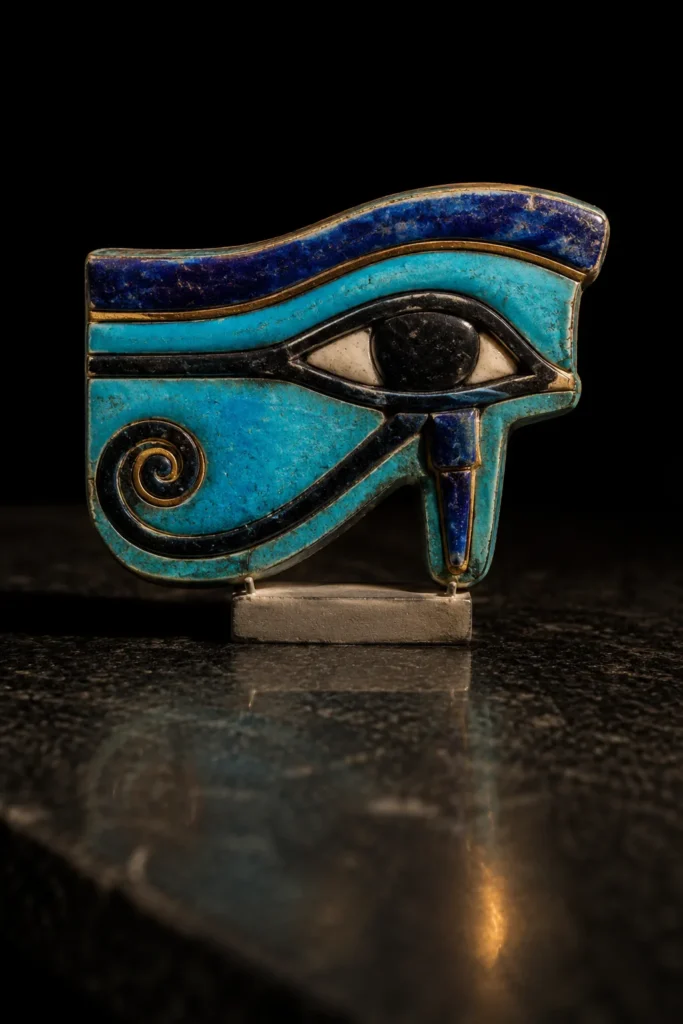
The Wedjat follows a fixed compositional pattern. At its core is a human eye with eyeball and pupil, above which lies a curved eyebrow. Two elements adjoin the eyeball that derive from the markings of the falcon’s face. Below the eye runs a straight, slightly tapering line, and beside it curls a spiral-shaped lock.
These falcon features point to Horus himself, who appears as a sky god in falcon form. The combination of human eye and falcon markings makes the Wedjat unmistakable. The sign exists as a left and as a right eye, with the left eye traditionally assigned to the moon and to Horus.
The clear, easily recognisable form was important for the protective effect. The eye was meant to be recognisable at a glance as the Egyptian sign of well-being. Over the centuries the image type remained remarkably stable, even though the execution ranged from coarse mass-produced ware to the finest goldsmith’s work.
The eye was frequently depicted in pairs, as a left and right Wedjat side by side. On coffins the two eyes often looked outward, so that the deceased could, as it were, see out through them.
The sign could moreover be integrated into writing, for the Egyptian writing system knew pictorial signs that carried both sound and meaning. The Wedjat was thus amulet and jewellery, and it was also a readable word, which further consolidated its standing in the culture.
Material and manufacture
The most common material for Wedjat amulets was faience, a glazed quartz ceramic in a luminous turquoise or blue-green. These colours were considered life-promoting and protective, so that the material and the meaning of the amulet worked together. Gold, carnelian, lapis lazuli and coloured glass are also attested.
Faience amulets were produced in moulds in large numbers. This made the Eye of Horus an affordable protection that broad sections of the population could afford. More valuable pieces of gold and precious stones were made for wealthy wearers and for the furnishing of royal tombs.
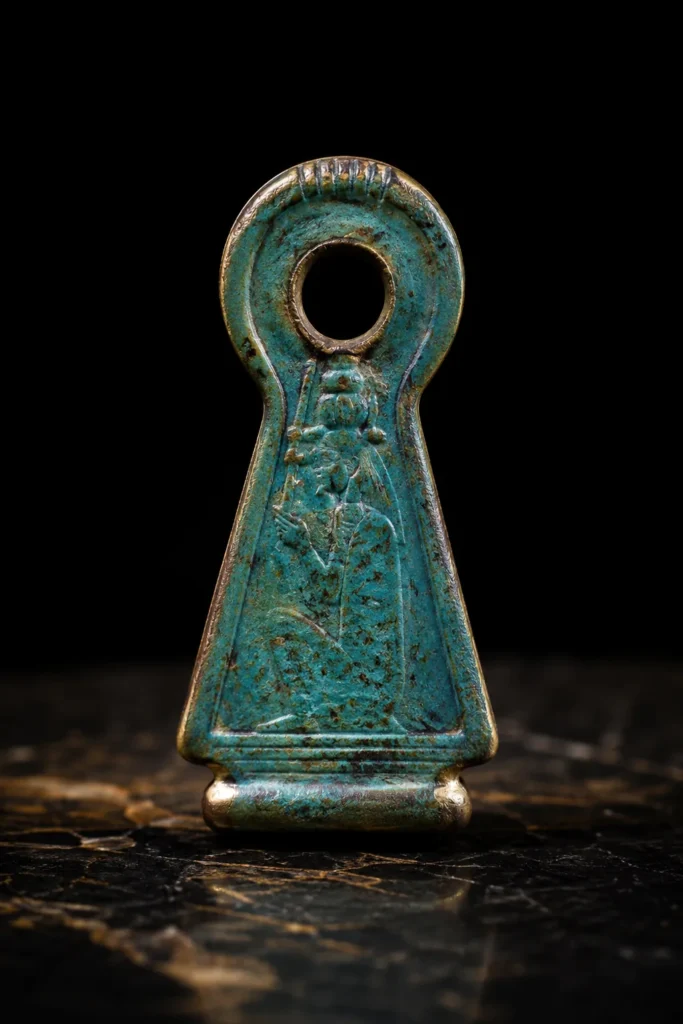
The Wedjat appears in many forms. There are independent pendants with a suspension loop, it adorns the plates of finger rings, and it is worked into broad collars and bangles. It was also frequently joined into rows or combined with other protective signs, so that several amulets were worn together.
The choice of colour followed a symbolism of its own. Turquoise and blue-green were considered colours of life and renewal, while red could mean strength but also danger. A Wedjat of carnelian thus carried a different tone than one of light faience.
The eye was also frequently combined with other signs, for instance with the scarab, so that a single piece brought together several protective ideas. The workshops of the Nile valley produced such combinations in large numbers.
Protection for the living and for the dead
The Eye of Horus accompanied people in life as in death. The living wore it as a pendant or ring to preserve health and to ward off misfortune. Precisely because it stood for the restoration of bodily wholeness, it was an obvious protection in everyday life.
Its role in burial was especially significant. Wedjat amulets were laid into the bandages of mummies, distributed in the coffins and depicted in the books of the dead.
A particular place was given to the incision through which the internal organs were removed during embalming. Over this opening a Wedjat was often placed, so that the injured body might symbolically become whole again.
The Eye of Horus thereby combined the two great concerns of Egyptian protective practice. It secured the well-being of the living and it prepared the deceased for the transition into an unharmed continued existence. Hardly any other amulet covered both areas so naturally.
The funerary literature assigns the Wedjat fixed places. Spells of the Book of the Dead name the Eye of Horus and connect it with the protection of individual body parts.
In the royal tombs, for example in the furnishings of Tutankhamun, the Wedjat appears on pectorals and pieces of jewellery in precious execution. From the simple faience amulet to the king’s golden pectoral, the same idea thus extended, namely the preservation of the body beyond the threshold of death.
Eye of Horus and Eye of Ra
The Eye of Horus is often confused with the Eye of Ra, although the Egyptian tradition knows two different conceptions. The Wedjat of Horus is the healed, moon-like eye that stands for restoration and wholeness. It is a sign of reconciliation after a harm.
The Eye of Ra, by contrast, is a sun-like, active eye. It is thought of as an independent goddess whom the sun god sends out and who proceeds as a wrathful, dangerous power against his enemies.
Goddesses such as Sachmet or Hathor appear in this role. The Eye of Ra protects through attack, the Eye of Horus through healing.
This distinction is important for understanding the protective amulet. The widespread Wedjat amulet refers to the Horus myth and thus to the idea of restoration. Whoever wore an Eye of Horus did not seek the wrathful solar power but the protection of regained wholeness.
The two eyes are not entirely clear-cut in the sources, however. In some texts the conceptions blend into one another, and the same eye can appear, depending on the context, as healing or as wrathful.
Well known is the myth of the distant goddess, in which the sent-out eye must be appeased and brought back. For the use of the amulet the assignment nonetheless remained clear. The widespread Wedjat was the healing Eye of Horus, and it was precisely this meaning that whoever wore it sought.
The Horus eye fractions
A much-cited peculiarity of the Wedjat concerns mathematics. The individual pictorial parts of the eye, the eyebrow, the pupil, the two white fields, the lock and the straight stroke, can be associated with the unit fractions one half, one quarter, one eighth, one sixteenth, one thirty-second and one sixty-fourth.
This system was brought into connection with the measuring of grain in the Egyptian administration. The fractions served to note down portions of a measure of volume.
That precisely the parts of the Horus eye took on this function linked the protective sign with the idea of completeness, for the fractions taken together amount to nearly a whole.
More recent scholarship views this interpretation more cautiously, however. Whether the Egyptian scribes actually understood the fraction signs consciously as parts of the Wedjat, or whether the resemblance was only established later, is not conclusively settled. The close linking of eye, wholeness and number nonetheless remains a striking example of the reach of the symbol.
A well-known tradition relates that the individual fractions taken together do not quite amount to the whole and that Thoth supplied the missing remainder. This anecdote is a late, interpretive image and not an ancient Egyptian rule of calculation, yet it captures the basic idea aptly.
The eye strives toward wholeness, and what is lacking is completed through divine intervention. Whether historically attested or not, this narrative shows how closely later interpreters linked number, image and the idea of well-being.
Spread and modern reception
The Eye of Horus was known beyond the Nile valley. Through trade, Wedjat amulets reached the entire Mediterranean region, and the motif of the protective eye on the bow of boats can be traced down to the present day.
On many coasts the painted eye on the ship is still alive today, even though the direct connection to Horus has long faded there.
Today the Wedjat is among the most easily recognisable signs of Egyptian culture. It appears on jewellery, in design and in popular imagery. In this it is occasionally confused with the eye in a triangle, the so-called Eye of Providence, which has a quite different, modern origin and does not belong to the Egyptian tradition.
Original Wedjat amulets can be seen in almost every larger Egyptian collection, for example in the Egyptian Museum in Cairo, in the British Museum and in the Louvre.
They bear witness to a protective sign that for thousands of years was one of the central answers of Egyptian culture to the desire for healing and preservation.
One line reaches into the present. The painted eye on the bow of boats, which can still be found in the Mediterranean region today, stands within the long tradition of the protective eye, even if it does not descend directly from the Wedjat.
The modern use of the Horus eye as jewellery and sign ties in with its meaning many thousands of years old. It should only not be confused with the eye in the triangle, which derives from a quite different, modern-European pictorial tradition.
Literature (selection)
Related key terms: Wedjat Udjat Horus eye apotropaion faience amulet Thoth healing mummy ancient Egypt.
iWell Guard and protective traditions
iWell Guard stands within the cultural-historical line of wearable protective objects to which the Eye of Horus also belongs. A modern companion for people who live with protective symbols: made in Germany, 41 layers of solid gold, platinum and silver, with a 30-day right of return.
Personal experiences may vary. Not a medical device. No promise of healing.