iWell Guard

The Hei-tiki: the Ancestral Pendant of the Maori from Pounamu

The hei-tiki is an ancestral pendant of the Maori and is passed down as a precious Maori pendant across generations to keep the connection to the ancestors visible.

The hei-tiki is the best-known neck pendant of the Maori. Carved from the green stone pounamu and passed down through generations, it connects its wearer to the ancestors and is regarded as a cherished treasure.

Protective SymbolPolynesiaAncestral Pendant
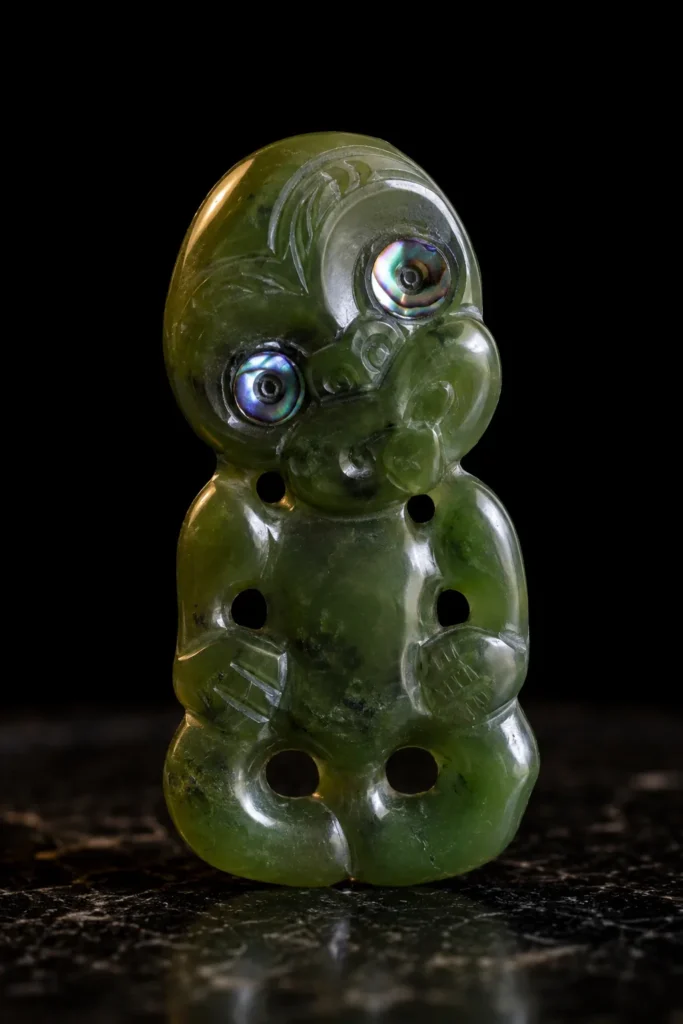
Hei Tiki - protective symbol, museum illustration

Classification

The hei-tiki is a neck pendant of the Maori, the indigenous people of New Zealand. It shows a stylized human figure and is carved from a green stone. The hei-tiki is the best-known ornament of the Maori and a sign of their culture.

The hei-tiki is more than an ornament. It is regarded as a precious treasure that is passed down through generations within a family. With each generation that wears it, it gains in significance and spiritual weight.

At the center of its meaning lies the connection to the ancestors. The hei-tiki connects its wearer to the forebears who wore it before them. It is a bond between the living and the deceased of a family.

In religious studies and in ethnology, the hei-tiki is a good example of an object whose protective meaning lies in the connection to the ancestors.

It does not protect through warding off or through a sacred sign, but through the presence of the forebears. Polynesia and the world of the Maori have produced in it a remarkable treasure.

The hei-tiki belongs to those objects that cannot be separated from their culture without losing their meaning. It is not mere ornamentation and not an arbitrary collector’s piece, but part of a living web of kinship, memory, and obligation.

Anyone who wishes to understand the hei-tiki must think alongside the world of the Maori. In that world, objects, people, and ancestors are closely intertwined. The hei-tiki is a node in this web.

Name and Meaning

The name hei-tiki is composed of two parts, both drawn from the language of the Maori. The first part, hei, denotes something worn around the neck. It identifies the object as a neck pendant.

The second part, tiki, denotes a human figure. In the tradition of the Maori, Tiki is connected with the first human being. A tiki figure is therefore an image of the human and at the same time a reference to the origin of humanity.

Taken together, hei-tiki means something like the human figure worn at the neck. The name describes the object precisely. It names its form, the human shape, and its manner of wearing, the pendant at the neck.

This human form is essential to its meaning. The hei-tiki is not an abstract sign but the image of a person. It is from the outset oriented toward the world of persons, ancestors, and kinship.

The language of the Maori, Te Reo Maori, preserves much meaning in its words. The name hei-tiki is a good example of this, for it describes the object precisely and at the same time points to the origin of humanity.

In the tradition, Tiki is a figure connected with the first human being. To wear a human figure at the neck means to carry an image of humanness itself. The name connects the individual piece to a larger narrative.

Pounamu, the Green Stone

The hei-tiki is carved from pounamu, a green, very hard stone. In Western usage, pounamu is often called nephrite or greenstone. It is found in New Zealand at specific locations, primarily on the South Island.

Pounamu holds an extraordinarily high standing among the Maori. It is itself regarded as a treasure, a precious material whose extraction and working are bound to knowledge and particular care. Pounamu is not an arbitrary material.

Working the hard stone without metal tools was a laborious undertaking. Carving and grinding a hei-tiki could take a very long time. This effort contributed to every hei-tiki being considered of great value.

The green color and the luster of polished pounamu give the hei-tiki its distinctive appearance. Material and meaning work together. A treasure that connects the wearer to the ancestors is made from a stone that is itself regarded as a treasure.

Obtaining pounamu involved long journeys and precise knowledge, since the stone occurs only in certain places. The Maori knew the deposits and the routes to reach them. The stone was a sought-after good traded over great distances.

Its hardness made it durable, so that a hei-tiki could survive many generations. Material and meaning thus correspond, for a treasure intended for the ancestors is fashioned from a lasting, prized stone.

Form of the Figure

The hei-tiki shows a human figure in a distinctive, stylized posture. The head is large and usually tilted to one side. The body is compact, the legs are bent, and the hands often rest on the body or on the thighs.

The sideways tilt of the head is a striking feature. Various interpretations of its precise meaning exist. What is certain is that this posture belongs to the fixed image type of the hei-tiki and makes it unmistakable.

The eyes of the hei-tiki are often depicted as large and round. They are frequently emphasized with inlaid material, such as the iridescent shell of the paua. These inlays give the figure a vivid, arresting gaze.

The form of the hei-tiki has remained remarkably consistent over time. Within the fixed image type there are variations, but the basic form with the tilted head and compact figure recurs consistently. The hei-tiki is immediately recognizable by it.

Working pounamu without metal tools required great patience. The stone was ground and perforated with sand, water, and harder stones. A single hei-tiki could be the work of many weeks or months.

This invested effort became part of the value of the piece. An object into which so much labor has gone is not treated carelessly but is regarded as precious and preserved with care.

The Hei-tiki as Taonga

In the world of the Maori, the hei-tiki belongs to the taonga. This word denotes the precious, cherished goods of a family and a community. A taonga is not merely a valuable object but a treasure with spiritual significance.

As a taonga, the hei-tiki is passed down across generations. It moves from the ancestors to the descendants and remains within the family or the community. This passing on is an essential part of its meaning.

With each transfer, the hei-tiki accumulates history. It carries the memory of all who possessed it before the current wearer. An old hei-tiki that has been passed down many times is therefore especially significant, for it is connected to many ancestors.

This means the hei-tiki is not an object one buys and sells at will. It is embedded in a web of kinship, memory, and obligation. Whoever wears a hei-tiki carries a piece of their family’s history.

As a taonga, the hei-tiki is bound into the history of a family. It may be presented at ceremonial occasions, it may affirm a connection between groups, and it returns to the community in times of mourning.

Each of these moments adds history to the piece. A hei-tiki is therefore never only an object of the present. It carries the names and the stories of those who possessed it before the current wearer and passes them on.

Mana and the Connection to the Ancestors

A central concept for understanding the hei-tiki is mana. In the world of the Maori, mana denotes a spiritual force, a standing, and a dignity that can belong to persons, places, and objects.

A hei-tiki worn by many ancestors carries their mana within it. It is charged with the dignity and the force of the forebears. The longer a hei-tiki has been passed down, the more mana it has accumulated.

Whoever wears such a hei-tiki stands in connection with the ancestors and their mana. The pendant is, as it were, a bond that links the generations. The ancestors are present in the wearer’s life through the hei-tiki.

In this connection lies the protective significance of the hei-tiki. It protects by binding its wearer to the ancestors. The forebears watch, as it were, over the one who wears their hei-tiki. The protection comes not from a sign but from the persons who possessed the hei-tiki before the wearer.

The concept of mana cannot be captured in a single English word. It encompasses spiritual force, standing, dignity, and efficacy at once. Mana can grow and can be diminished, and it passes from persons to objects.

A hei-tiki worn by significant ancestors is filled with their mana. Whoever wears it stands in this stream of mana and is connected to the dignity and force of their own origins.

Protection through the Ancestors

The protective idea of the hei-tiki differs from that of many other protective objects. It does not ward off through an intimidating image, and it bears no sacred scripture. Its protection rests on the connection to the ancestors.

In many cultures, the ancestors are regarded as powers that watch over their descendants. The deceased are not simply gone but remain connected to the living and take part in their fate. The hei-tiki makes this connection tangible.

By linking its wearer to the ancestors, the hei-tiki places them under their assistance. The ancestors who wore the piece remain present in it and accompany the wearer of today. The protection is the accompaniment by one’s own origins.

This form of protection is widespread among the world’s protective traditions. Very many cultures know objects that connect the living with the ancestors and secure their assistance. The hei-tiki is the Maori expression of this widespread idea of protection through the ancestors.

Protection through the ancestors is a foundational idea in many cultures. The forebears are not regarded as definitively gone but as still present and involved in the fate of the living. They can assist, warn, and preserve.

The hei-tiki makes this presence tangible, for in it the ancestors who wore it are present. The protection it offers is the accompaniment by one’s own origins, and that is one of the oldest forms of protection of all.

Interpretations and Their Limits

Various views exist on the precise meaning of the hei-tiki. A complete and certain interpretation cannot be given in every respect. An honest account therefore also names the limits of knowledge.

A widespread interpretation connects the hei-tiki with fertility and with the desire for offspring. In this view, the figure is associated with a figure from Maori tradition connected with birth. This interpretation is widespread but not undisputed.

Another line of interpretation places the connection to the ancestors at the center and sees in the hei-tiki primarily an ancestral treasure. The two interpretations need not exclude each other, since the ancestors and the continuation of the family are closely related.

Important is the insight that the meaning of the hei-tiki is not fixed rigidly. It is an object of a living culture, and its meaning has been and continues to be carried and interpreted by the Maori themselves. A hasty, one-sided definition would not do justice to this living tradition.

Humility is appropriate when interpreting the hei-tiki. Much of what appears in older, externally produced accounts as established meaning is in fact conjecture. The Maori themselves are the bearers and the interpreters of their culture.

An honest account therefore draws on what has been transmitted from Maori tradition itself and openly acknowledges where knowledge remains uncertain. The hei-tiki is part of a living culture, not a closed puzzle from the past.

Contemporary Reception

The hei-tiki is today widely known and belongs to the most recognizable signs associated with the Maori and with New Zealand. It is worn as jewelry and appears as a motif in many contexts.

Within Maori culture itself, the hei-tiki has preserved its significance as a taonga. It continues to be carved, passed down, and treated with respect. For the Maori, it is a living piece of their culture and their family history.

With its wide distribution comes the question of appropriate handling. The hei-tiki is not an arbitrary souvenir but a meaningful object with a spiritual dimension. Mindful engagement knows its significance and respects the culture from which it comes.

The hei-tiki thus remains a striking example of a protective object of its own kind. It does not protect through warding off, but through the connection to the ancestors and through the mana it has accumulated across generations. It makes visible that protection can also reside in the connectedness to one’s own origins.

The wide distribution of the hei-tiki as souvenir and fashion jewelry has prompted critical discussion. Machine-made replicas from foreign materials detach the sign from its meaning.

Set against this is the hei-tiki carved by Maori craftspeople from genuine pounamu, which remains rooted in the tradition. Anyone who acquires a hei-tiki should be aware of this distinction. Knowledge of origin and meaning is part of mindful engagement with the piece.

Literature (Selection)

  • Roger Neich, Mick Pendergrast: Pacific Jewelry and Adornment (2004)
  • Hirini Moko Mead: Te Maori. Maori Art from New Zealand Collections (1984)
  • Dougal Austin: Te Hei Tiki. A Cultural Continuum (2019)
  • Anne Salmond: Hui. A Study of Maori Ceremonial Gatherings (1975)
  • Russell Bishop: Studies on Maori Culture

Related key terms: hei-tiki Maori pounamu greenstone taonga mana ancestors New Zealand pendant.

iWell Guard and Protective Traditions

iWell Guard stands in the cultural-historical line of wearable protective objects, to which the hei-tiki also belongs. A modern companion for people who live with protective symbols: made in Germany, 41 layers of solid gold, platinum, and silver, with a 30-day right of return.

Individual experiences may vary. Not a medical device. No claims of healing.