Tilaka: the forehead mark as blessing, protection and belonging
By Ralf Ittermann · last reviewed on
The Tilaka is the forehead mark of Hinduism, applied to the forehead. Designed differently depending on the tradition, it stands for blessing, for protection and for belonging to a particular religious direction.
Classification
The Tilaka is a mark applied to the forehead in Hinduism. It is a marking between the eyebrows or on the forehead, made with coloured pastes or with ash.
The word Tilaka comes from Sanskrit. It denotes the forehead mark that is applied. In everyday usage and depending on the region, other names for this mark are also encountered.
The Tilaka is not a uniform mark. It is designed differently depending on the tradition, depending on the venerated deity and depending on the occasion. Form, colour and material are not the same everywhere.
In its meaning, the Tilaka combines several aspects. It is a sign of blessing, a sign of protection and a sign of belonging to a particular religious direction.
The forehead, more precisely the area between the eyebrows, is regarded in Hinduism as a significant place. It is associated with spiritual perception and with concentration. Applying the Tilaka precisely at this spot is therefore not accidental.
In religious studies, the Tilaka is a good example of a body marking that unites several meanings within itself. It is a sign of blessing, a sign of protection and a sign of recognition all at once.
The forehead as the place of the mark
The Tilaka is applied to the forehead, above all to the area between the eyebrows. This place of the mark carries a meaning of its own.
In Hinduism, the area between the eyebrows is regarded as a significant place of the body. It is associated with inner concentration, with spiritual perception and with focus.
In the notion of the subtle centres of the body, which is widespread in Hinduism and in yoga, an important centre lies at this spot. It is associated with insight and with spiritual clarity.
Applying the Tilaka precisely at this spot thus sets a mark at a significant place. The mark marks and honours the place of spiritual concentration.
Some interpretations therefore understand the Tilaka as a reference to the turning towards the spiritual. The mark reminds the wearer and the observer that a human being is not only a bodily but also a spiritual being.
The forehead is also the most visible place of the face. A mark at this spot can be recognised from afar. The Tilaka is therefore by its nature a visible, public sign.
Forms and materials of the Tilaka
The Tilaka is encountered in numerous forms. This diversity is one of its most important characteristics and is closely connected with its meaning as a sign of belonging.
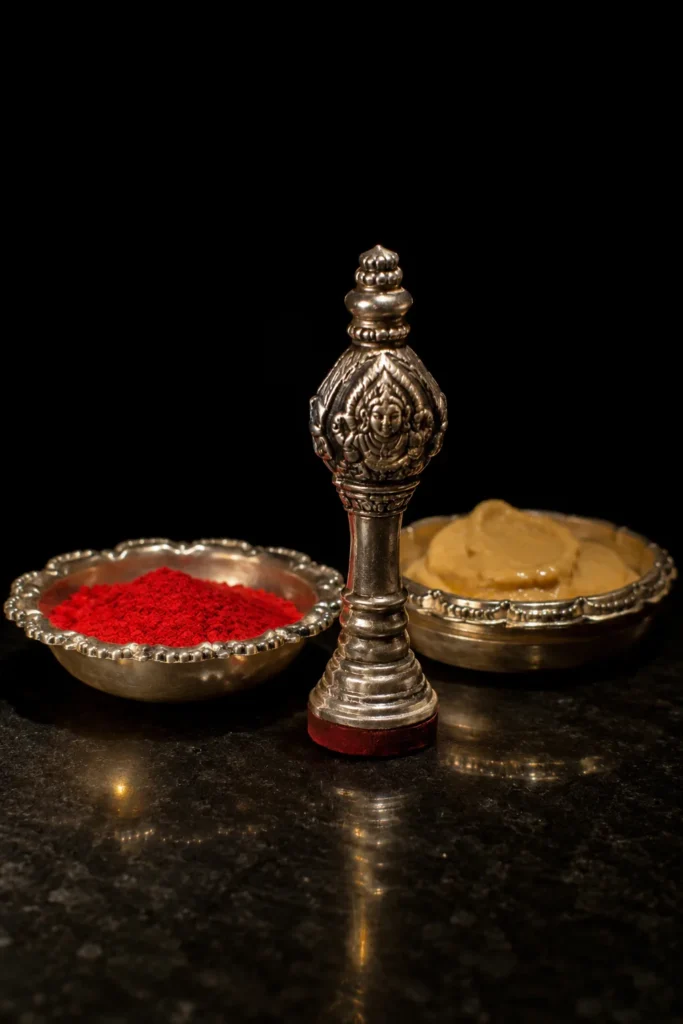
The materials of the Tilaka vary. Coloured pastes are common, for example from sandalwood, from saffron or from other substances. Equally common is the use of sacred ash, above all among the worshippers of certain deities.
The colours also differ. There are red, yellow, white and, with ash, grey forehead marks. The colour is frequently connected with a particular tradition or with a particular deity.
Above all, however, the form differs. The worshippers of one great divine direction frequently wear horizontal lines of ash. The worshippers of another direction frequently wear vertical lines, often in the shape of a narrow sign open at the top.
These different forms are not arbitrary. They follow the handed-down rules of the respective tradition and are passed on from one generation to the next.
The diversity of forms makes the Tilaka an expressive sign. Anyone who knows the forms can read from the Tilaka which religious direction the wearer belongs to.
The Tilaka as a sign of belonging
One important meaning of the Tilaka is belonging. The form of the forehead mark indicates which religious direction of Hinduism a person belongs to.
Hinduism is not a uniform religion with only one teaching. It encompasses several great directions, each of which places a particular deity at the centre, as well as numerous further currents and schools.
Each of these directions has its own shape of the Tilaka. The horizontal ash lines belong above all to one divine direction, the vertical signs above all to another.
The Tilaka thus makes a religious belonging visible. Anyone who wears a particular forehead mark identifies themselves as a worshipper of a particular deity and as a member of a particular tradition.
In this the Tilaka resembles other markers of identity in religions. Like the cross in Christianity or the Star of David in Judaism, the Tilaka makes a belonging visible to the outside.
The Tilaka is thus not only a pious sign but also a social sign. It locates the wearer within the diversity of Hinduism and visibly connects them with their community.
The Tilaka as a sign of blessing
Beyond belonging, the Tilaka is a sign of blessing. In this meaning it belongs to worship and to the transitions of life.
In Hindu worship, the Tilaka frequently becomes a sign of the blessing received. After worship in the temple, a forehead mark is applied to the believer that makes the blessing received visible.
A Tilaka is also applied at the greeting of guests, at festivals and at the start of undertakings. It is then a sign of honour and of good wishes for the one who receives it.
At the transitions of life, for example at weddings and at other ceremonies, the Tilaka has a firm place. It accompanies the important moments and places them under the blessing.
The blessing that the Tilaka expresses is connected with the venerated deity. The mark reminds one that a human being stands under the blessing of the divine.
In this meaning the Tilaka is a friendly, well-disposed sign. It expresses good wishes and makes the blessing received visible for the wearer and for others.
The Tilaka as a sign of protection
The Tilaka also carries a protective meaning. This meaning is closely connected with the place of the mark and with its connection to the divine.
The spot between the eyebrows, where the Tilaka is applied, is regarded as significant and at the same time as something to be protected. The mark marks and secures this spot.
By connecting the wearer with a venerated deity, the Tilaka places them under its protection. Anyone who wears the sign of a deity is regarded as placed under the support of that deity.
The idea that the Tilaka wards off the evil eye is also widespread. Small children in particular are therefore sometimes given a dark dot meant to deflect the harmful gaze.
Here, however, a careful distinction must be made. The dark dot warding off the evil eye on children is not in every respect the same as the religious Tilaka of the worshippers. The two customs are close to one another but are not identical.
The protective meaning of the Tilaka is thus part of its comprehensive sense. As a sign that connects the wearer with the divine, it is also understood as a sign that preserves from misfortune.
Tilaka and Bindi
In connection with the Tilaka, the Bindi is also frequently mentioned. Both are forehead marks, yet they are not the same, and a distinction is useful.
The Bindi is a mostly round dot applied to the forehead, above all by women. Today it is widespread in India and, for many women, belongs to their daily appearance.
The Bindi has a religious origin and still carries a symbolic meaning that is connected with the significant spot on the forehead. For married women it is at the same time a sign of marital status.
In the present, however, the Bindi has for many wearers also become a sign of adornment. It is worn in numerous colours and forms, sometimes without close religious meaning.
The Tilaka in the narrower sense, by contrast, is more strongly bound to worship and to religious belonging. It is applied according to handed-down rules and follows the form of the respective tradition.
Tilaka and Bindi thus belong to the shared world of Hindu forehead marks but each have their own emphasis. The Tilaka is more strongly a religious sign, the Bindi today is also a widespread sign of adornment.
Body markings in the religions
The Tilaka can be considered in the larger context of religious body markings. Placing a mark on the body is known in many religions.
In numerous traditions, a mark is applied to the body in order to make visible a belonging, a blessing received or a special devotion.
Some of these marks are permanent, others are applied anew again and again. The Tilaka belongs to the marks that are renewed daily or on particular occasions. It is not a permanent mark.
This renewal has a sense of its own. Anyone who applies the Tilaka anew each morning thereby carries out again and again the turning towards the divine and the remembrance of their own belonging.
The religious body marking connects the inner with the outer. An inner attitude, the worship and the belonging, is made visible through the mark on the body.
The Tilaka is the Hindu expression of this widespread idea. Its distinctiveness lies in the diversity of forms, which at the same time express belonging, blessing and protection.
Reception today
The Tilaka is to this day extraordinarily present in Hinduism. In the temples, at festivals and in the everyday life of many people, the forehead mark is a familiar sight.
For many Hindus, applying the Tilaka belongs to the daily worship in the morning. Others wear it above all at festivals, at ceremonies and during temple visits.
The Tilaka is also carried on in the Hindu emigration. It belongs to the visible signs by which religious belonging remains recognisable across national borders.
In the present, the Tilaka is understood partly as a conscious religious practice, partly, above all in the shape of the Bindi, also as a sign of adornment. Both understandings exist side by side.
A factual account names the Tilaka as what it is in its tradition: a Hindu forehead mark that is designed differently depending on the tradition and that expresses blessing, protection and belonging all at once.
The Tilaka is thus a striking example of a religious body marking. In it, the significant spot on the forehead, the diversity of the handed-down forms and the wish to carry the turning towards the divine visibly come together.
Literature (selection)
Related key terms: Tilaka forehead mark Bindi blessing belonging ash stroke sandalwood paste worship Hinduism.
iWell Guard and protective traditions
iWell Guard stands in the cultural-historical line of wearable protective objects, to which the Tilaka also belongs. A modern companion for people who live with protective symbols: made in Germany, 41 layers of solid gold, platinum and silver, with a 30-day right of return.
Personal experiences may vary. Not a medical device. No healing promise.