Haetae: the lion-like stone being as guardian of Korea
By Ralf Ittermann · last reviewed on
Haetae, also called Haechi, is a lion-like hybrid being from Korean tradition. Set up as a stone figure at gates and buildings, it is regarded as a guardian that wards off fire and calamity and watches over justice.
The Haetae is a Korean guardian being whose stone figures are meant to ward off fire and injustice.
Classification
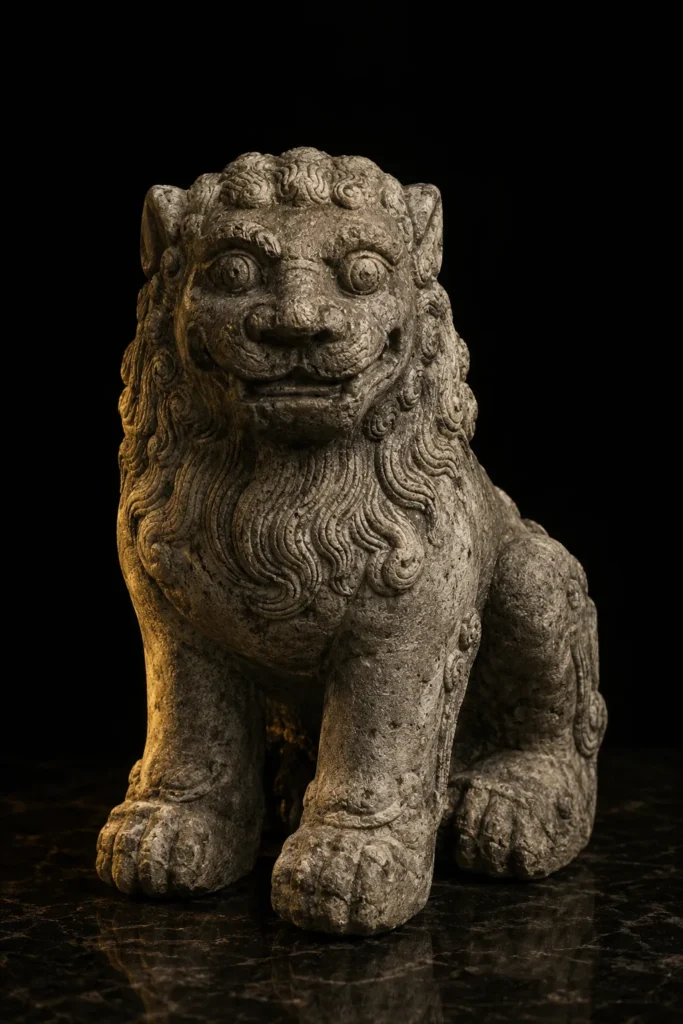
Haetae is a guardian being from the tradition of Korea. It has the form of a lion-like hybrid being and appears above all as a stone guardian figure.
The being is known by two names. Alongside the older form Haetae, the form Haechi is widespread and is used especially often today. Both names refer to the same being.
The Haetae is not an ordinary animal but a hybrid being of tradition. It unites traits of the lion with further features and thus belongs to the mythical creatures of East Asia.
Two tasks are ascribed to the Haetae. It wards off fire and calamity, and it watches over justice. Both tasks make it a being of protection and order.
In religious studies, the Haetae is a good example of a guardian being that joins protection and justice together. It not only guards against calamity but also embodies a moral order.
This page treats the Haetae as a guardian being. It belongs to a large family of lion-like guardian figures of East Asia, among which the Japanese Shisa are also to be counted.
Form of the hybrid being
The Haetae has the form of a lion-like hybrid being. It resembles a lion but carries additional features that distinguish it from an ordinary animal.
Characteristic are a powerful, stocky body, an abundant mane and a broad, expressive maw. The body is often covered with scales, which sets the Haetae apart from a plain lion.
One feature that tradition ascribes to the Haetae is a single horn on the head. Not every depiction shows this horn clearly, yet it belongs to the traditional form of the being.
The Haetae is often depicted with a small bell at the neck or with further adornments. Its expression is mostly massive and watchful, sometimes also marked by a certain cheerfulness.
As a stone guardian figure, the Haetae is often shown in a sitting or crouching posture. In this posture it appears at rest and yet ready at any moment, an image of watchful composure.
The form of the Haetae is thus that of a mythical creature. It is not an image of nature but a being composed of several traits, whose appearance expresses its task as a guardian.
The being against fire
An important task of the Haetae is the warding off of fire. It is regarded as a being that protects against blazes.
The tradition connects the Haetae with water and with the ability to tame fire. In some accounts it is described as a being that stands in connection with water and is therefore set against fire.
This connection with fire protection is the reason why the Haetae was often set up at buildings that were threatened by fire. In cities with dense wooden construction, fire was a constant danger.
Well known is the placing of Haetae figures at significant structures that were endangered by fire or had already suffered damage from fire. The Haetae was meant to preserve the structure from future blazes.
The protection against fire makes the Haetae a being with a very tangible task. It is not directed against an indefinite calamity but against a particular, everyday threat.
The Haetae thus belongs to the guardian beings whose task is precisely defined. Its most important concern is the warding off of fire, a danger that in old Korea threatened houses, palaces and entire cities.
The guardian of justice
Beyond protection against fire, the Haetae has a second meaning closely bound up with it. It is regarded as a being that watches over justice.
The tradition ascribes to the Haetae the ability to distinguish right from wrong. It is said to recognize who is in the right and who is in the wrong, and to set itself against the wrong.
From this conception arose the use of the Haetae as a sign of jurisdiction and of just order. It was associated with the places where decisions about right and wrong were made.
The Haetae thus stands against fire and against injustice alike. Both tasks belong together, for both concern the preservation of an order, the natural and the moral.
This linking of protection and justice is instructive. It shows that a guardian being can be more than a warder-off of dangers. It can also embody a moral order.
The Haetae is thus a guardian in a twofold sense. It guards the house and the city against fire, and it guards at the same time the order of justice. In both tasks it sets itself against calamity and against injustice.
The Haetae as stone guardian
Most often the Haetae appears as a stone guardian figure. In this form it guards gates, buildings and special places.
Stone Haetae figures stand in many cases at the entrances of significant structures. They guard the threshold, the transition from the outside to the inside, and are meant to hinder calamity from entering.
The figures often appear in pairs. Two Haetae together guard a gate, one on each side of the passage. The pair guards the access from both sides.
The stone is significant as a material. A stone figure is durable and imperishable. A guardian of stone keeps watch, as it were, tirelessly and over a long time.
The size of the figures varies. There are mighty Haetae that guard entire structures, and smaller figures for narrower areas. Common to all is the watchful posture turned toward the entrance.
As a stone guardian, the Haetae thus fulfils its task in a durable form. It stands at the threshold, keeps watch and places the structure behind it under its protection against fire and against calamity.
The Haetae and the lion guardians of East Asia
The Haetae belongs to a large family. Throughout East Asia, lion-like guardian figures are widespread, and the Haetae is their Korean form.
In China, lion-like figures stand as a pair before temples and gates. There, too, there is a horned mythical creature that watches over justice, and the Haetae stands in connection with this conception.
In Japan, lion-like stone figures guard the shrines, and in Okinawa the Shisa stand on the roofs and at the gates. On the page about the Shisa, this related figure is presented in more detail.
The same basic idea underlies all these figures. The lion, the powerful, fearsome animal, becomes the guardian that deters calamity and guards the access.
The Haetae shares this basic idea but has its own form. It is more than a defensive guardian; it joins the warding off of fire with the watch over justice.
The Haetae thus shows how a wandering image, that of the lion guardian, takes on its own form in each culture. Its Korean form is the horned being set against fire and against injustice.
The hybrid being as a protective figure
The Haetae is a hybrid being, and precisely as a hybrid being it is suited as a protective figure. This characteristic deserves a separate consideration.
A hybrid being unites traits of several animals and features that do not occur together in nature. Thereby it is something extraordinary that points beyond the ordinary order.
This extraordinariness makes the hybrid being powerful. A being that crosses the bounds of the natural order is held to be suited also to confront the calamity that threatens this order.
The Haetae unites the strength of the lion, the connection to water and the horn as a sign of discernment. From these traits a being is composed that unites power, fire protection and justice within itself.
The Haetae thus belongs to the guardian beings that work through their extraordinary, composite form. It is not an animal of nature but a figure of tradition, created for the task of the guardian.
The hybrid being Haetae is thus a good example of how tradition forms its protective figures. From selected traits a being is shaped whose appearance expresses its protective task.
The Haetae as a symbol of Seoul
Beyond its task as a guardian, the Haetae has in more recent times become a symbol of the Korean capital.
The capital of Korea has chosen the Haetae, in the form Haechi, as its emblem. The old guardian being thereby became an emblematic figure of the city.
This choice is grounded in the history of the Haetae. Already in ancient times, stone Haetae were associated with significant structures of the city, where they were meant to protect against fire and against calamity.
The use as an emblem ties in with this old connection. The Haetae stands for the history of the city, for its protection and for the values of justice that are bound up with the being.
In this new role, the Haetae appears in a friendly, often cheerful form. The stern stone guardian has become an approachable, inviting figure, without the old meaning having been lost.
The Haetae thus shows how an old guardian being can gain a new meaning. From the guardian against fire and injustice it has at the same time become a unifying sign of a city and its history.
Reception today
The Haetae is a present-day sign in today’s Korea. The old stone figures still stand at the significant structures they have long guarded.
As the emblem of the capital, the Haetae, in the form Haechi, is familiar to many people. It appears in the design of the city, as a friendly figure and as an emblematic figure of Seoul.
For many people today, the Haetae is associated less with a strictly worked-out belief than with a sense of attachment to Korean tradition and to the history of its cities.
The Haetae also appears in art and in design. As a figure, as ornament and as a keepsake, the lion-like being is a popular and easily recognizable motif.
A factual account names the Haetae as what it is, a guardian being of Korean tradition, directed against fire and calamity and watching over justice. An effect going beyond this cannot be demonstrated.
The Haetae thus remains a living sign of Korean culture. In it are joined the wandering image of the lion guardian, the tangible protection against fire and the idea of a watch over just order.
Literature (selection)
Related key terms: Haetae Haechi guardian being fire Korea lion guardian justice stone figure hybrid being Seoul.
iWell Guard and protective traditions
iWell Guard stands in the cultural-historical line of portable protective objects, to which the Haetae also belongs. A modern companion for people who live with protective symbols: made in Germany, 41 layers of solid gold, platinum and silver, with a 30-day right of return.
Personal experiences may vary. Not a medical device. No healing promise.