iWell Guard

Nachtkrapp, the black bird of dusk

The Nachtkrapp is a spirit of the alpine tradition.

The black bird that takes naughty children into the night.

Table of Contents

Nachtkrapp - spirits from the Alpine tradition, historical-illustrative
Nachtkrapp

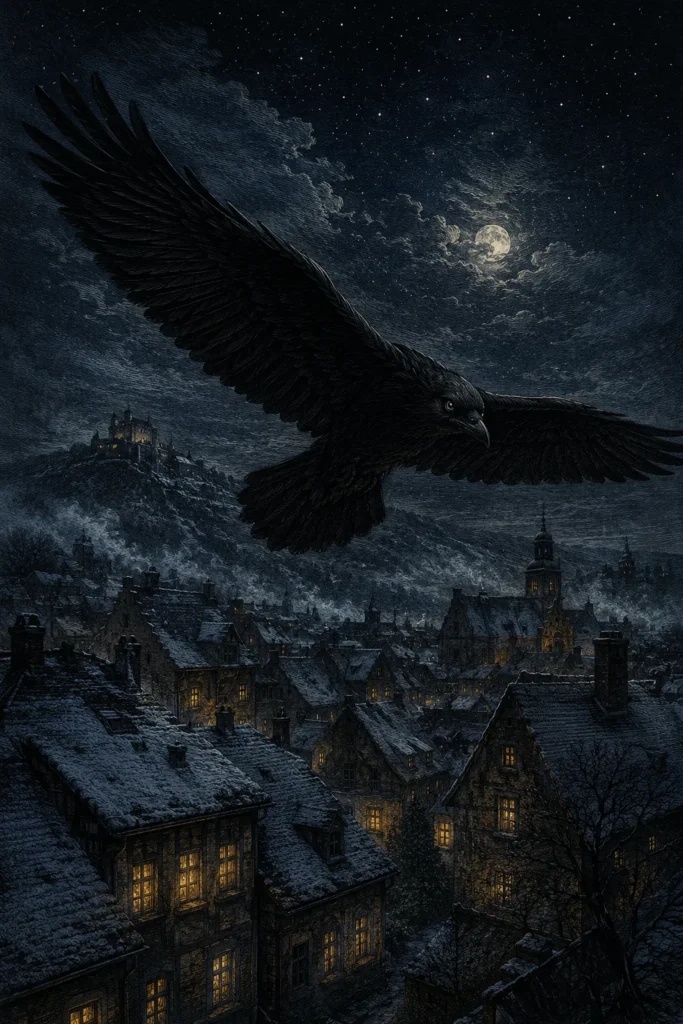
The Nachtkrapp is a bogeyman figure of the South German-Austrian alpine foreland: a huge, raven-black bird that flies through the darkness at night and takes children who are still outside after nightfall. Behind the frightening figure lies less an independent being with intentions than a simple rule of behaviour for children.

Depending on the region, the depiction ranges from a bloodthirsty bird to a gentler figure that merely lulls naughty children to sleep. The figure is widespread in Bavaria, Swabia, Franconia and Austria, and has been documented in writing mainly since the 19th century in dictionaries and folklore collections.

At a glance: Nachtkrapp

Type: bogeyman figure, gigantic raven-black bird
Origin: South German-Austrian alpine foreland, with offshoots into central Thuringia and Burgenland
Texts: Grimm’s German Dictionary, Handwörterbuch des deutschen Aberglaubens
Period: presumably older orally, documented in writing mainly since the 19th century
Appearance: gigantic, deep black bird, less often thought of merely as a shadow

Region of origin and sources

Period of the Texts

Presumably older orally, documented in writing mainly since the 19th century in dictionaries and folklore collections.

Area of Diffusion

Bavaria, Swabia, Franconia and Austria, with offshoots into central Thuringia and Burgenland.

Sources

Mainly documented lexicographically, for instance in Grimm’s dictionary and in the Handwörterbuch des deutschen Aberglaubens, along with regional customs; a coherent early collection of legends is lacking.

Name and variants

Upper German: The determining word Krabb, also Krapp, Krabbe or Grabbe, derives from Old High German hraban and denotes the raven or related corvid birds in Upper German dialects. Research considers the actual origin of the legendary figure itself not yet conclusively resolved. In Franconia the variant form Nachtgiger is attested, while in Burgenland tradition knows the milder good Nachtkrapp.

Appearance

Appearance

The Nachtkrapp appears as a gigantic, deep black bird with wide wingbeats, sometimes only as a black shadow heard passing across the night sky without being clearly seen. In the South Swabian tradition it carries a sack in which it carries away the children it takes, while in Austrian versions it is openly said to devour children.

Effect

The Nachtkrapp becomes active as soon as dusk falls and children are not yet indoors. It swoops down low and seizes those left outside, in the harsher versions to eat them, in the milder ones to hold them until morning or simply to put them to sleep. In practice, the effect lay not in an alleged attack but in the preventive behaviour that the tale produced.

Profile: Nachtkrapp

The most important aspects of the terror bird at a glance.

Tradition

Bogeyman figure of the South German-Austrian alpine foreland, mainly documented lexicographically, without an independent early collection of legends.

Responsible for

Children still outdoors after nightfall: the call of the Nachtkrapp is said to drive them indoors in time.

Depiction

Gigantic, raven-black bird with wide wingbeats, less often thought of merely as a dark shadow in the night sky.

Sphere of Influence

From the harsh Austrian version, which devours children, to the mild Burgenland variant, which merely lulls them to sleep.

Conduct

Not a protective charm but the rule of behaviour itself: return to the parental home in time as soon as dusk sets in.

Related figures

The English Boggart as a comparable cautionary figure, the Scandinavian nattramn as an independent belief in a nocturnal corvid bird.

From raven word to frightening figure of dusk

The determining word Krabb, also Krapp, Krabbe or Grabbe, derives from Old High German hraban and denotes the raven or related corvid birds in Upper German dialects; the actual origin of the legendary figure is considered not conclusively established in research. The Nachtkrapp can be traced above all through linguistic documentation: the Grimm dictionary records the word, as does the Handwörterbuch des deutschen Aberglaubens, whereas an independent early collection of legends devoted specifically to the Nachtkrapp is lacking.

The figure is widespread in Bavaria, Swabia, Franconia and Austria; in Franconia the variant Nachtgiger is attested, while in central Thuringia Nachtraben appear in flocks. In Burgenland, tradition knows the good Nachtkrapp, who does not take naughty children away but merely rocks them gently to sleep, an indication of how strongly the figure varies regionally between threat and mere admonition. In Murrhardt the legendary figure merges with a real model: the Nachtkrabb shown there as a carnival figure takes on features of the Waldrapp, a dark-plumaged ibis with a bare red face whose colonies are historically documented in the region.

Legacy and classification

The Nachtkrapp lives on in regional customs, for instance in the Murrhardt carnival figure of the Nachtkrabb, which is documented in the local Carl-Schweizer-Museum. In contemporary literature, Heiderose Kesselring took up the figure for a children’s book of the same name, though its fame remains regionally limited and is fed mainly by oral transmission within families.

From the perspective of religious studies, the Nachtkrapp belongs to the widespread type of the child-frightening figure, which translates a rule of behaviour into a narratable form. Unlike beings with their own cult or fixed rituals, it has no veneration and no counter-magic, but works solely through the fear of darkness that it personifies. Its closeness to the older image of the raven as a bird of misfortune and death shows how real observation of nature and moral educational intent combine in a single figure.

Returning home before dusk as the only protection

Tradition knows no counter-charm against the Nachtkrapp, only the rule of behaviour that it itself is meant to enforce: children should be in the house at nightfall. In the tales, the parental home with a locked door is regarded as the only safe place; a burning light in the window marks this place and at the same time calls the children home. Where bells were used to ring in the evening, they also served as an audible signal to set out on the way home before dusk. No independent magical defence against the Nachtkrapp can be documented from the sources.

Frightening birds and night figures compared

As a pure child-frightening figure, the Nachtkrapp stands alongside the English Boggart, which was likewise used to admonish and frighten in house and yard, albeit with a broader range of effect. A looser parallel is offered by the English Black Shuck, a nocturnal, ill-omened phantom animal that likewise fills the darkness itself with a menacing shape. In the Scandinavian-speaking world, the nattramn or nattravn represents an independent belief in a nocturnal corvid, which shares the same core image but has been handed down separately from the southern German-Austrian tradition. Within the Alpine region, the wild procession of Krampus and the clattering Habergeiss stand close to the Nachtkrapp as further frightening and warning figures of the Rauhnächte period, although these are tied to fixed dates rather than to the daily onset of dusk.

Frequently asked questions about the Nachtkrapp

Does the Nachtkrapp really eat children?

In the stricter Austrian versions this is claimed of it, while in milder variants, for example in Burgenland, it merely rocks naughty children to sleep. This range shows that it is an educational warning figure whose severity varied according to the narrator and the region.

Where does the name Nachtkrapp come from?

The determining word Krabb derives from the Old High German word for raven and denotes corvid birds generally in southern German dialects. The origin of the legendary figure itself, however, has not been conclusively established.

Is there a real animal behind the legend?

For the Murrhardt carnival figure, the Waldrapp, a dark-plumaged ibis with a red face, is considered a possible model. For the legendary figure as a whole, this cannot be generalised, since it is fed above all by the nocturnal calling and flying of large birds.

Further links

Recommended internal links:

Literature (selection)

A selection of key sources and studies:
  • Grimm, Jacob und Wilhelm: Deutsches Wörterbuch. Leipzig 1854-1961 (Stichwort Nachtrabe).
  • Bächtold-Stäubli, Hanns (Hg.): Handwörterbuch des deutschen Aberglaubens. Berlin/Leipzig 1927-1942 (Art. Nachtrabe).
  • Vernaleken, Theodor: Alpensagen. Wien 1858.
  • Ejdestam, Julius: Svenskt folklivslexikon. Stockholm 1975.
  • Beitl, Richard und Beitl, Klaus: Wörterbuch der deutschen Volkskunde. 3. Auflage, Stuttgart 1974.

Further standard works in the bibliography.

Whether one speaks of the Nachtkrapp legend or simply the Nachtkrapp bogeyman, the same educational warning figure of southern German-Austrian children’s folklore is always meant, one that turned the call of a nocturnal bird into an effective rule for the way home before darkness fell.

Classification & Protection

ILEVEL
The Protection Compass assigns this being to influence level I, Minor influence.

Against its influence, cross-cultural tradition names these protective means:

Compare in the Protection Compass →

Recommended protective means

iWell Guard

The simplest protective means in this collection: 41 layers of fine gold 999, platinum, silver and silicon, manufactured in Ruhla, Thuringia. It requires no activation, is bound to no person, and is effective within a radius of around 50 meters, even without being worn.

All protective means at a glance →