


Gaia, earth mother and planetary being of light
Personification of the earth, primordial goddess of Greek mythology and earth mother, understood in the modern earth soul tradition as a planetary being of light.
On this page, Gaia is treated as a being of light concept.
Quick Overview: Gaia
Type: Primary planetary intelligence, conceived in both mythological and modern terms Tradition: Greek mythology (Hesiod, Theogony), James Lovelock (Gaia hypothesis), modern esotericism Function: earth consciousness, provider of telluric protective field energies, support and grounding of all life Main attributes/symbols: green and brown colors, soil, crystals, plant life, the earth itself Distribution: antiquity mythology, modern Gaia theology, environmental movement, esoteric and shamanic practices
Classification
Tradition
In Hesiod’s Theogony, Gaia (Gé) is the titanic goddess of the earth, who emerged from Chaos and gave birth to the universe. She is the primordial mother, from whose womb all earthly and heavenly beings arose.
In the twentieth century, the British chemist James Lovelock revived the Gaia hypothesis: that the earth itself is a self-regulating, living system.
Helena Petrovna Blavatsky and subsequent theosophists integrated Gaia ideas as an “earth principle” into Western esoteric philosophies. In modern usage, Gaia is often understood as “Mother Earth”: not merely material, but the conscious substrate of all organic life.
Source Situation
Mythological sources are Hesiod’s “Theogony” (eighth century BC) and Ovid’s “Metamorphoses”. Modern scientific evidence stems from Lovelock’s “Gaia: A New Look at Life on Earth” (1979). Theosophical texts such as Blavatsky’s “The Secret Doctrine” integrated the earth mother myth into cosmic hierarchies.
Modern ecological and new spirituality literature interweaves mythology with environmental awareness. The Gaia hypothesis remains scientifically contested, but as a metaphor and philosophical concept it is widely held.
Religious-Historical Layers of the Gaia Tradition
Hesiod’s Theogony (verses 116, 138) gives the oldest systematic account of the Greek conception of Gaia. From Chaos, Gaia arises as the second entity after the primordial abyss; from her come Uranus (sky), Pontos (sea) and the mountains, without her needing a sexual partner.
This parthenogenetic creation is decisive in religious-historical terms, because it grants Gaia an ontological primacy that is no longer attained in the later Olympian pantheons with their personal gods.
The Homeric hymn to Gaia (Hymn XXX) and the Orphic hymn 26 continue this tradition and emphasize the mother function of the earth for all living things.
A distinct layer is formed by the Delphic tradition: the Pytho oracle was originally a Gaia oracle before it was taken over by Apollo, as Aeschylus reports in the opening speech of the Eumenides (verses 1, 8) and Pausanias in his Description of Greece (X,5,5, 6).
The transition from Gaia via Themis and Phoibe to Apollo documents a shift from matriarchal earth-bound to patriarchal sky-bound religion, which has been discussed at length in religious-historical research since Johann Jakob Bachofen (Das Mutterrecht, 1861).
Appearance and Symbols
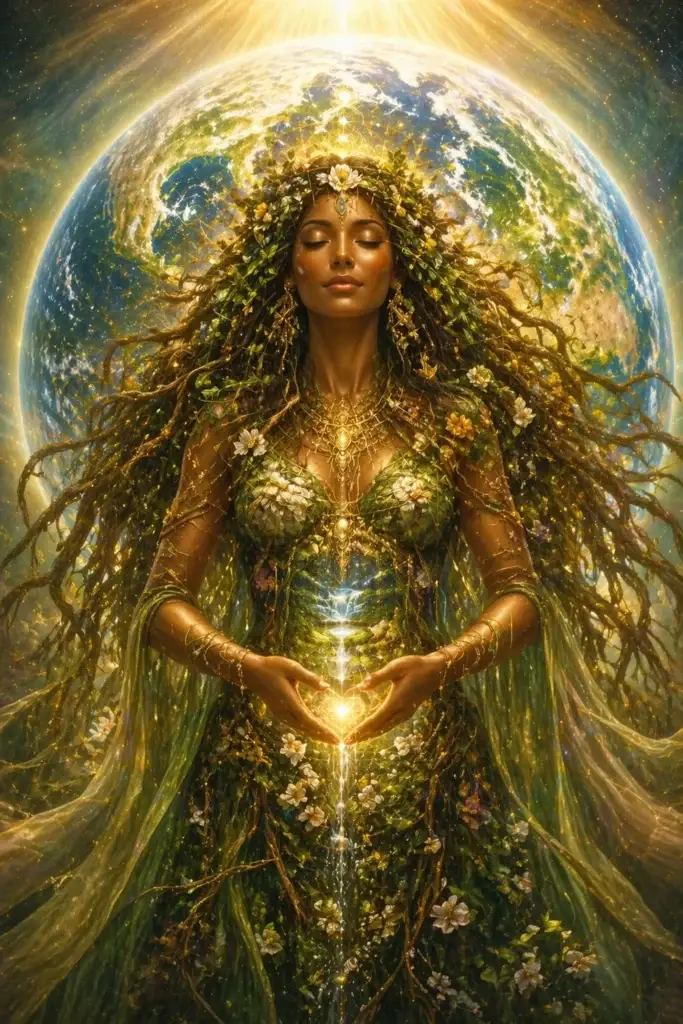
In Greek depictions, Gaia appears as a female figure, often half-mortal, merged with earth and plants or bearing them. She may rise half out of the soil. In modern esoteric contexts, Gaia is depicted less as a goddess figure than as a green and brown energy aura permeating the earth’s sphere.
Symbols are crystals, springs, ancient trees, mountains and the soil itself. Colors: green (life, growth), brown (earth, stability), deep red (magma, the life energy of the depths). The globe as a holistic mandala is the highest symbol of her presence.
Comparative Earth Mother Tradition
The earth mother figure is documented in religious history far beyond the Greek tradition. In Roman religion, she corresponds to Tellus or Terra Mater, invoked in Horace’s Carmen Saeculare and in the agrarian tradition of the Suovetaurilia sacrifice.
The Hindu tradition knows Bhumi or Bhudevi as an earth goddess, who appears in the Vedas as a companion of Vishnu.
In the Andes, Pachamama is the central reference figure of pre-Columbian and present-day indigenous religiosity, with her own rituals (challa, despacho) of honoring. The Aztec tradition knows Tonantzin as earth mother, who after the conquest was continued syncretistically in the Marian veneration of the Virgin of Guadalupe.
The African Akan tradition knows Asase Yaa as an earth goddess with her own day of rest (Thursday), and the Norse tradition names Jörd, the mother of Thor.
In The Goddesses and Gods of Old Europe (1974) and The Civilization of the Goddess (1991), Marija Gimbutas advanced the thesis that Paleolithic and Neolithic religion was consistently matriarchal and earth-mother-oriented, and was patriarchalized only with the Indo-European migration.
The thesis is contested in archaeology (Lynn Meskell, Cynthia Eller), but remains formative to this day for feminist-spiritual reception.
Function and Significance
Gaia is the energy source that carries all earthly manifestation. She is not blind matter, but a conscious substrate that organizes and regenerates itself. In esoteric thought she counts as one of the great cosmic intelligences, whose decisions guide geological, climatic and biological processes.
She acts as a buffer between cosmic energies and human existence. Gaia stands for wholeness, interdependence and the idea that human existence is embedded in a living, sensitive system.
Lovelock-Gaia and Ecological Reception
From 1972 onward, elaborated in 1979 in Gaia: A New Look at Life on Earth, James Lovelock formulated the Gaia hypothesis: the earth with its biosphere behaves like a self-regulating system that keeps temperature, atmospheric composition and the salinity of the oceans within a range favorable for life.
As co-author of the hypothesis, Lynn Margulis contributed the microbiological underpinning. The Daisyworld model (Lovelock and Andrew Watson, 1983) shows mathematically how a biosphere establishes a temperature equilibrium through albedo feedback, without any central control being necessary.
The Gaia hypothesis has been further developed in academic earth system research into the broader Earth System Science, without the teleological undertone of the original formulation.
In parallel, a spiritual-esoteric Gaia reception has become established, in which Lovelock’s model is brought together with the mythological Gaia tradition. The iWell Guard position refers to this spiritual-esoteric conception of Gaia as a planetary instance of consciousness, without conflating it with Lovelock’s natural-scientific model.
Practice / Invocation / Significance in the iWell Guard Context
In iWell Guard, Gaia is activated through grounding: walking barefoot, meditation with a focus on the earth beneath you, breathing into the depths. Her power is invoked to anchor the protective field in the telluric (earthly) planes.
She complements the high beings of light (archangels, Metatron) with the necessary grounding principle. An iWell Guard practice thus connects the source through the upper beings of light down to Gaia’s earth power. This balance between heaven and earth creates stability and protects against uprooting and dissociative-spiritual disturbances.
Function in the iWell Guard mantra System
In the protective mantra, Gaia is the carrier of energy transformation. The construction laid out in point 3 (see function overview) provides that black-magic influences which have reached the wearer are passed from the source to Gaia.
There they are converted in a transformation process that, in religious-historical terms, ties into the earth mother function of the ancient tradition. When Gaia cannot absorb the respective energy, Archangel Gabriel as guardian of the violet flame takes over the transfer into the light.
This dual line is not standard ritual-magical repertoire, but a specific construction of the iWell Guard tradition, which draws on the lightworker tradition (Saint-Germain school, theosophical and anthroposophical predecessors).
Structurally, the function corresponds to the shamanic embedding of the earth as carrier and transformer of illness energies (Felicitas Goodman, Michael Harner) and to the gnostic-hermetic tradition of the earth mother as an absorbing layer.
In practice, iWell Guard wearers work with the Gaia connection through grounding, that is, a conscious connection of the feet with the ground, ideally barefoot on natural surfaces. This practice is not a precondition of the mantra effect, but it strengthens it, because it opens the wearer’s layer of perception to Gaia’s transforming function.
Parallels
Connection within iWell Guard
In iWell Guard, Gaia is described as the grounding reference point of the protective field. Energies that are transformed in the protective field are returned to Gaia via the source. Function level 3 of the Seven Building Blocks.
Directions of effect are described in purely functional terms. Not a medical device. No promise of healing.
Hesiod's Theogony: Gaia at the Beginning of the Divine World
The most important source for the Greek Gaia is the Theogony of the poet Hesiod, probably composed around 700 BC. It describes the emergence of the world and of the gods.
According to Hesiod, at the beginning there is Chaos, the yawning void, and then Gaia, the earth, arises as the broad, secure seat of all things.
Gaia brings forth from herself, without a partner, the sky Uranus, the mountains and the sea Pontos. With Uranus she then begets a multitude of offspring: the twelve Titans, the one-eyed Cyclopes and the hundred-armed Hecatoncheires. Gaia thus stands at the very beginning of the genealogical chain leading to the Olympian gods.
In Hesiod, however, Gaia is not merely a passive ancestress. She intervenes decisively in the course of events.
When Uranus hates his children and holds them back inside the earth, Gaia devises a plan, fashions a sickle and incites her son Cronus to castrate his father. Later, when Cronus in turn becomes a tyrant, Gaia helps to overthrow him.
Hesiod’s Gaia is thus a figure of dual character: at once the stable foundation of the world and an active, scheming power who triggers and decides generational conflicts among the gods. This combination of permanence and cunning makes her one of the most peculiar figures of Greek mythology.
Oracle and Cult: Gaia in Delphi and Olympia
Unlike some purely literary deities, Gaia also possessed a cult, which was, however, less pronounced than that of the Olympian gods. Ancient sources report that the famous oracle of Delphi was originally consecrated to Gaia before Apollo took it over. The Greek travel writer Pausanias transmits this tradition in the second century AD.
Historical research is cautious here. Whether there actually was a pre-Apollonian Gaia cult in Delphi, or whether this account is a later construction meant to explain the transition from an older to a younger order, cannot be decided with certainty.
The myth of the dragon Python, whom Apollo slew at the oracle site, belongs to the same context.
Altars and sanctuaries of Gaia are attested in several places. In Olympia, according to Pausanias, there was an altar and a cult site of Gaia, and in Athens too a precinct was consecrated to her.
She was venerated under epithets such as Kourotrophos, „the nourisher of children“, which emphasizes her role as nurturer of all living things.
In oaths, Gaia played a special role: whoever swore a solemn oath frequently invoked earth and sky as witnesses. The earth, as that which carries everything and takes everything back in again, was suited to be the guarantor of inviolability.
The Gaia cult was thus diffuse and ancient rather than spectacular, a background cult that honored the earth as the omnipresent foundation of life.
From Earth Mother to Gaia Hypothesis: The Modern Reception
The name Gaia had an unusual second career in the twentieth century, far outside classical philology. In the 1970s, the British chemist James Lovelock, later together with the microbiologist Lynn Margulis, developed the so-called Gaia hypothesis. At the suggestion of the writer William Golding, Lovelock chose the name of the Greek earth goddess.
The Gaia hypothesis states, in simplified terms, that the totality of living beings and their environment forms a self-regulating system that keeps certain conditions, such as temperature and atmospheric composition, within a range favorable for life.
It is a natural-scientific, often controversially discussed thesis, not a religious statement. Critics charged that it improperly attributed a kind of intention to the earth.
Independently of the scientific debate, the name was taken up in the environmental movement and in spiritual currents. Here the ancient earth goddess merged with modern notions of a living earth worthy of protection. In parts of Neopaganism and ecospirituality, Gaia is venerated as a goddess.
From the standpoint of religious studies, it is important to distinguish this modern Gaia from the ancient one. Hesiod’s Gaia is the personified earth of an archaic didactic poem, embedded in a complex genealogy and in the generational conflicts of the gods.
The Gaia of the present is partly a scientific metaphor, partly a modern religious construction. The two are connected only by the name and by the shared basic image of the earth as the bearer of all living things.
Comparable Earth Deities in the Ancient Near East and Beyond
The notion of an earth deity is not Greek. In many cultures one finds a deity or a bundle of notions that conceives the earth as a nourishing and at the same time absorbing power. The comparison helps to recognize more precisely what is distinctive about the Greek Gaia.
In the Mesopotamian tradition there is, with Ki, an earth deity regarded as the partner of the sky god An, yet she is not a strong narrative agent like Gaia. In the Hittite and Hurrian region, earth deities are attested.
In Roman religion, Gaia corresponds to Tellus or Terra Mater, whose cult was connected with fertility and agriculture; the imperial age celebrated her, among other places, in the well-known relief on the Ara Pacis in Rome.
What is striking about the Greek Gaia is that she is not primarily a fertility deity of agriculture, but a cosmogonic figure who stands at the very beginning of the world’s emergence and intervenes actively in the power struggles of the divine generations.
Other earth deities are connected rather with the agricultural cycle of the year.
The older religious studies, for instance the school built around the concept of the „Great Goddess“, tended to draw all of these figures together into a single primeval mother goddess. This thesis is today regarded as overstated and poorly supported.
The sober view holds that various cultures personified the earth independently of one another, each with its own profile. Gaia is one of these figures, shaped by the particular form of the Greek theogony.
Frequently Asked Questions about Gaia
Who is the goddess Gaia?
In Greek mythology, Gaia is the personified earth and the primordial mother of all gods. Having emerged from Chaos, she gives birth from herself to Uranus (the sky), Pontos (the sea) and the Ourea (the mountains). With Uranus she begets the Titans, the Cyclopes and the Hecatoncheires. Gaia is regarded as the oldest layer of the Greek pantheon.
Which symbols belong to Gaia?
Classic Gaia symbols are fruits and grain (fertility), snakes (connection to the depths and the earth sphere), the reclining mother figure in the archaic iconographic tradition, and the globe in later depictions. In the modern ecology movement, Gaia became the personification of the living planet through James Lovelock’s Gaia hypothesis.