Protective Stones: Stones as Protective Means in Folk Belief
By Ralf Ittermann · last reviewed on
Stones have long been among the traditional protective objects: naturally formed hag stones, thunderbolts derived from lightning and the god Donar, fossilised amber resin, or set boundary stones intended to mark an area against unauthorised access and harmful influence.
This page presents the traditional forms and uses of protective stones, including modern-day practices such as carrying black tourmaline or obsidian. It describes tradition and custom without making any promise of effect.
Protective stones are used in folk belief as amulets and as protection on buildings.
Quick Overview
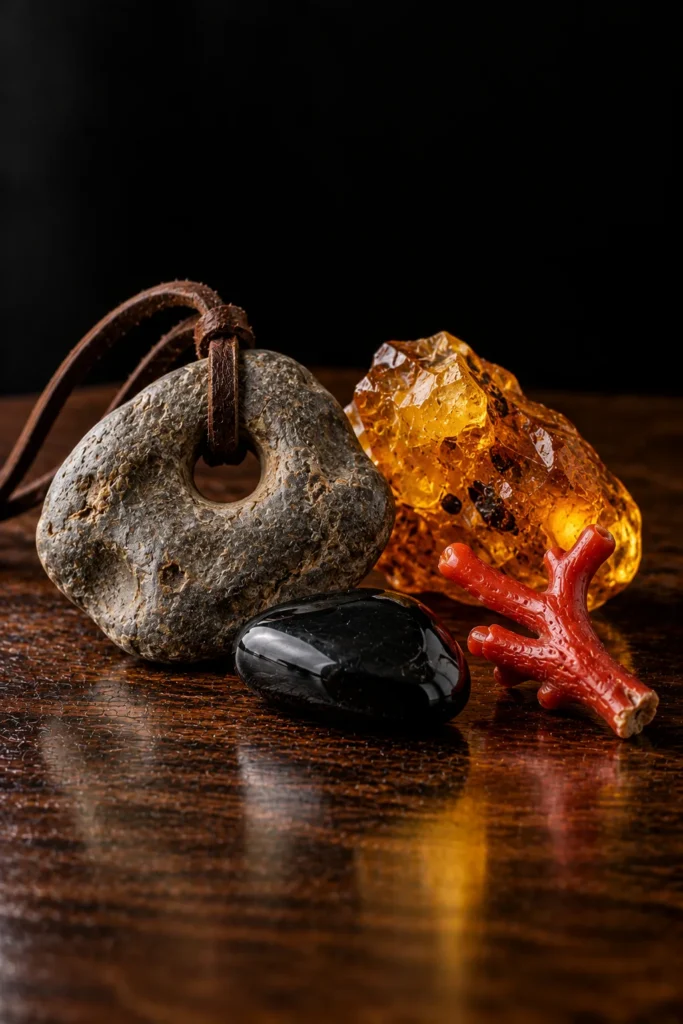
The traditional protective stones include above all hag stones, also called drudenstein or hen god stones, thunderbolts formed from fossilised belemnites, amber worn as an amulet, and set boundary and threshold stones. In modern esoteric practice, black tourmaline and obsidian are also used as protective stones.
Common to all these forms is the idea that a lasting, unchanging object such as a stone can develop an equally lasting protective effect.
Origin and Tradition
Hag stones are stones that have acquired a hole through the natural action of water, for example on Baltic Sea beaches or in riverbeds. In northern Germany and the Baltic region they are called hen gods, in Bavaria and Austria drudenstein. In this function they were meant to protect against the drude, a nocturnal, alp-like being that pressed down on people in their sleep, the so-called nightmare. For this purpose the drudenstein was hung above the bed, on the stable door, or on the halter of livestock. The drudenfoot sign, treated elsewhere, shares its name and defensive purpose with the drudenstein, but as a drawn symbol it is a separate topic.
Thunderbolts are fossilised rostra of belemnites, fossil cephalopods, whose elongated, pointed shape was popularly interpreted as having been hurled into the earth by lightning or by the god Donar. They were set beneath the roof ridge or embedded in the door threshold to protect house and farmstead from lightning strikes, and were also considered protection for livestock in the stable.
Amber, fossilised tree resin washed ashore on the coasts of the North and Baltic Seas, has served since antiquity as a worn amulet, often as a necklace for children, to whom general protection against illness and the evil eye was attributed. In the Baltic region, belief in the special power of amber is alive to this day.
Boundary and threshold stones not only marked the legal course of farm and field boundaries; moving them was also considered a grave offence that was believed to bring misfortune. Marked with a carved cross, they were additionally meant to protect the boundary itself from harmful influence.
Operating Principle According to Tradition
With the hag stone, the natural hole is regarded as the source of its power: in some regions, looking through the opening was itself described as protective or clairvoyant, in others as a symbol that harmful gazes and powers pass through the stone into emptiness. With the thunderbolt, the power lies in its supposed origin: an object that, according to tradition itself came from lightning was also meant to protect against lightning.
Amber, boundary stone and hag stone share the idea of permanence: a stone hardly weathers and does not change, and this durability was, in tradition, transferred to the duration of the protection the stone was meant to provide.
Cross-Cultural Distribution
Hag stones and amber are documented above all in the Baltic and North Sea region, where their natural origin on the beach favoured their spread. Thunderbolts appear as protective objects throughout Central Europe and Scandinavia, linked to the respective thunder god, Donar in the German-speaking area and Thor in the Nordic-speaking area.
Boundary stone cults with a magico-legal double meaning are documented across Europe, from the Roman Terminus stones to the cross-marked boundary stones of Central European farmland.
What It Is Used Against
Hag stones and drudensteine, according to tradition, protect against the nightmare and nocturnal alp-pressure. Thunderbolts protect against lightning strikes and, according to tradition in some regions, against illness in livestock. Amber is considered protection against illness and the evil eye, especially for children. Boundary stones protect the set boundary itself from unauthorised displacement and the misfortune associated with it.
The Protection Compass assigns these types of stones to the respective threat scenarios for which they are documented in the sources.
Application and Limits
Tradition records the hanging of a hag stone on a cord above the bed, on the stable door, or on the halter of livestock, the embedding of a thunderbolt beneath the roof ridge or in the door threshold, and the wearing of an amber necklace. In modern esoteric practice, which should be distinguished from historical folk tradition, black tourmaline and obsidian have additionally been used as worn protective stones since the 20th century.
This page describes tradition and practice without promising any effect: protective stones are classified here in cultural-historical terms, not promoted as healing stones with proven effects. In the past they were always combined with further means such as amulets or iron on door fittings.
Literature (selection)
Related key terms: protective stones, hag stone, drudenstein, thunderbolt, boundary stone.
iWell Guard and Protective Traditions
Belief in protective stones reveals a fundamental need: to possess a lasting, tangible object that makes visible one’s own boundary against a world perceived as threatening. This principle of permanence also underlies the iWell Guard, which is conceived as a durable object carried with the wearer.
Where the drudenstein once hung above the bed and the thunderbolt was set into the roof ridge, the pendant stands for a protection that does not remain in one place but accompanies the person themselves.
Personal experiences may vary. Not a medical device. No promise of healing.